This article synthesizes publicly available research from NIQ, Deloitte, UPS, Capital One Shopping, and other cited sources. Trusted Buyer Report has not independently tested the products or services mentioned. Sources are linked throughout. AI-assisted research, human-reviewed before publication. We may earn a commission if you click links on this page — our recommendations are finalized before any affiliate link is applied. Full disclosure →
TL;DR — Key Takeaways
- The average US household spends $4,222/year in-store vs. $1,737 online (NIQ 2026). Most money-saving guides focus on the smaller channel.
- Value-seeking is now structural, not a post-inflation phase — 4 in 10 Americans across all income brackets are actively trading down.
- Channel strategy by category matters more than generic "coupon tips" — Health & Beauty and Pet Care favor online subscriptions; Grocery and Household favor in-store and warehouse clubs.
- Gen Z shops social-first but verifies prices elsewhere before buying; Millennials drive BOPIS (buy online, pick up in-store); Boomers anchor in-store dominance.
- Your highest-ROI move: audit where you're actually spending (in-store vs. online) before applying any tactics.
The Number That Changes Everything
Most money-saving articles hand you a list of browser extensions and stop there. That's optimizing the wrong bucket.
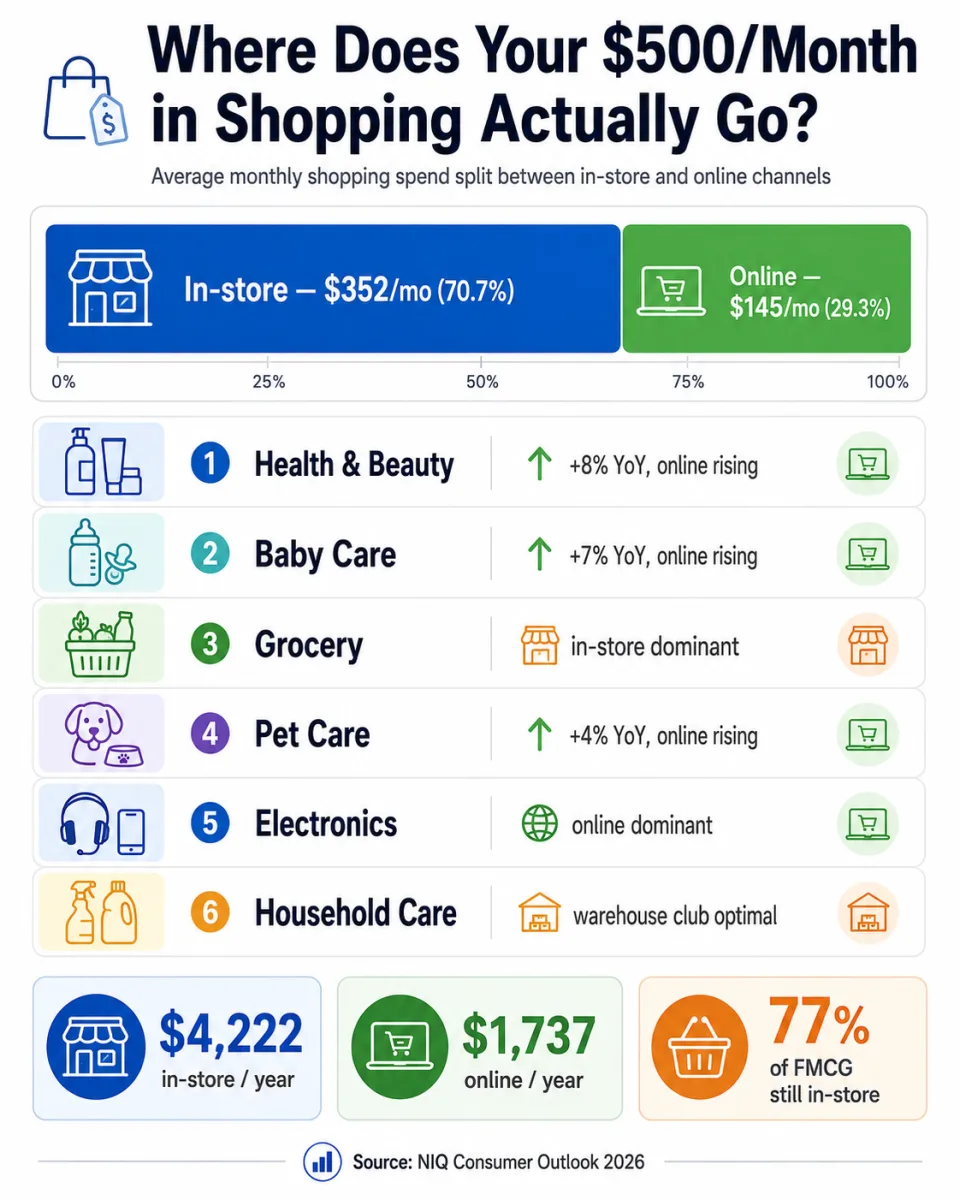
According to NIQ's Consumer Outlook: Guide to 2026, the average US household spends $4,222 per year in physical stores versus $1,737 online — a nearly 3-to-1 ratio. In-store still accounts for roughly 77% of fast-moving consumer goods (FMCG) sales, even after losing 3 share points to e-commerce year over year.
That ratio is the reason this guide is structured differently from most. If you spend 80% of your optimization energy on cart-abandonment tactics and cashback apps, you're managing a fraction of your actual household spend. A strategy that ignores in-store spending is a strategy that ignores the majority of your money.
Here's what that looks like at the monthly level:
| Channel | Annual Spend (NIQ avg.) | Monthly Equiv. |
|---|---|---|
| In-store | $4,222 | ~$352 |
| Online | $1,737 | ~$145 |
| Total | $5,959 | ~$497 |
So before any tactics: pull 60 days of transactions and split them by channel. If your in-store number is close to the NIQ average, your in-store habits are where the biggest savings live.
Why "Value-Seeking" Is No Longer Just a Budget Behavior
Here's something worth sitting with before we get into tactics: the mindset driving US consumer spending in 2026 has structurally changed. This isn't a post-pandemic hangover.
Deloitte's 2026 Retail Industry Global Outlook finds that four in ten Americans now demonstrate deal-driven or cost-conscious shopping habits — and critically, this includes higher-income households reassessing what "fair price" actually means. Nearly 70% of retail executives surveyed by Deloitte describe this behavior (trading down, shopping value channels, swapping convenience for savings) as a structural change, not a temporary response to inflation.
The financial backdrop explains why. According to Wedbush Securities, citing Federal Reserve SHED data, 73% of US adults say they're "doing okay financially" — yet 37% still cannot cover a $400 emergency expense without borrowing or selling something. That gap between perceived stability and actual financial fragility is one of the defining tensions of household finance right now. US credit card balances hit a record $1.23 trillion in late 2025 (New York Federal Reserve, via Wedbush), which means the cost of carrying debt is quietly eroding purchasing power for millions of households that otherwise feel fine.
Even in fashion — a category where aspiration traditionally overrides price logic — Strategy& (PwC) finds that 98% of consumers across all income levels shop for off-price fashion items to find quality products. The top three purchase triggers: frequent offers and discounts (51%), trend relevance (42%), and trusted quality (41%).
The practical implication: saving money in 2026 doesn't mean buying the cheapest option. It means understanding when a discount represents genuine value versus when it's an impulse trigger engineered by the retailer.
What the Spend Data Looks Like by Generation
Generational labels get overused, but the 2026 spending data shows behavioral differences that directly affect which savings strategies apply to you.
| Generation | Primary Channel | Top Priority | Key Discovery | Core Saving Behavior |
|---|---|---|---|---|
| Gen Z | Mixed (social + in-store) | Affordability & value | TikTok Shop, Instagram | Active budgeting, price comparison |
| Millennials | Hybrid (BOPIS preferred) | Convenience + value | Search, retailer apps | Loyalty programs, subscriptions |
| Gen X / Boomers | Primarily in-store | Quality & familiarity | In-store browsing, circulars | Bulk purchasing, loyalty cards |
Gen Z is the most financially self-aware cohort in the current market. The UPS 2026 Consumer Trends report finds that 48.8% of Gen Z respondents list affordability, value, and product availability as their top purchasing priorities. A striking 62% say they're actively trying to save more and budget more carefully.
But here's the catch: social commerce creates real impulse-buying pressure for this group. Escalent's 2026 consumer trends research projects that 17% of online sales will occur through social platforms by 2026, with livestream shopping approaching $45 billion in the US. Knowing the difference between a genuinely good deal surfaced on TikTok Shop and an algorithmically optimized impulse trigger is a real skill — and one worth developing.
Millennials drive hybrid behaviors like BOPIS (buy online, pick up in-store), which combines online price research with in-store convenience and eliminates shipping costs. For this group, loyalty app optimization and subscription stacking deliver the highest consistent returns.
Gen X and Boomers anchor the in-store dollar dominance in NIQ's data. Their highest-leverage strategies are in-store focused: unit price comparisons, warehouse club memberships, and knowing when markdowns cycle at their preferred retailers.
Where to Shop Online vs. In-Store, Category by Category
Channel strategy only works when you apply it to specific spend categories. Here's what 2026 data says about where each one performs best.
Health & Beauty
NIQ's 2026 data shows Health & Beauty is the fastest-growing CPG category by household spend, up 8% year over year, with online occasions rising significantly. This is one of the clearest wins for online subscription purchasing. Items like vitamins, shampoo, skincare, and personal care consumables have predictable usage rates — auto-ship programs (Amazon Subscribe & Save, Walmart+, Target Circle subscriptions) are genuinely cost-effective here.
The in-store risk in this category: impulse upgrading. A $8 shampoo becomes a $15 one because the packaging looks more premium on the shelf.
Verdict: Default online for consumables you buy regularly. Visit in-store for items where texture, scent, or shade matters and you need to test first.
Baby Care
Baby Care household spend is up 7% (NIQ), with online occasions rising. Parents research extensively before purchasing — this is a natural online category. Diapers and formula in particular benefit from subscription pricing: Amazon's Subscribe & Save on Pampers or Huggies consistently undercuts in-store shelf prices when you factor in the 5–15% subscription discount.
Verdict: Online for diapers, wipes, formula. In-store for items you want to inspect — clothing, gear, anything size-dependent.
Food & Grocery
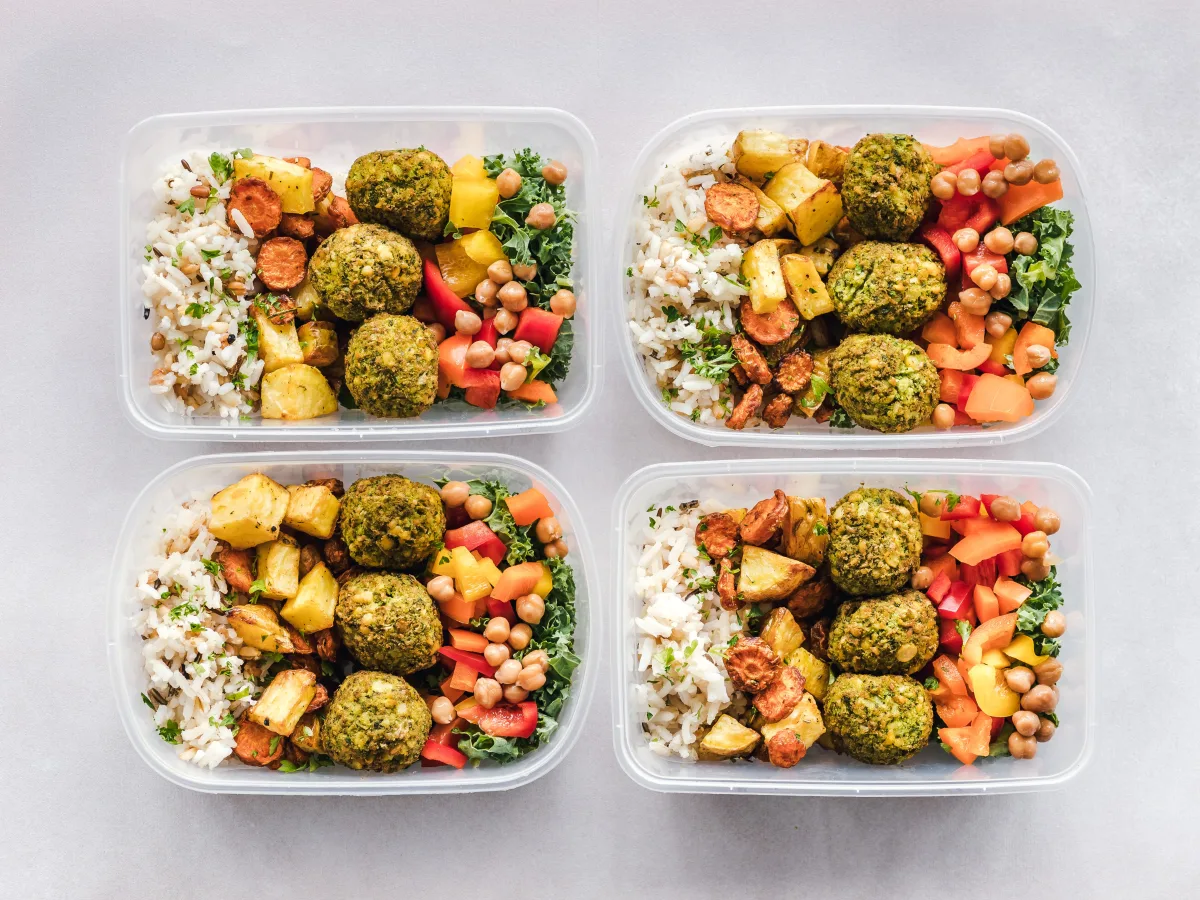
In-store dominates food spending by a wide margin. Online grocery works best for non-perishables, pantry staples, and bulk orders — not for fresh produce or items where you want to assess quality before buying.
Warehouse clubs (Costco, Sam's Club, BJ's) offer real per-unit savings on staples: olive oil, canned goods, cleaning supplies, paper products. The trade-off is volume commitment. A Costco vs. Sam's Club comparison can help you figure out which membership structure matches your household size.
The in-store advantage in grocery is also sensory: you can check sell-by dates, assess produce ripeness, and avoid the substitution problem that plagues grocery delivery services.
Verdict: In-store for fresh and produce. Online or warehouse club for dry goods and household staples.
Pet Care
Pet Care is up 4% (NIQ) and increasingly migrating online due to subscription convenience and easy price comparison. Chewy's Autoship program is the benchmark: it typically offers 5–10% off recurring orders on food and medication, with free shipping over $49. For large-breed dog food in 30–40 lb bags, the shipping economics favor online delivery over carrying heavy bags from a store.
Verdict: Strong case for online Autoship for food and recurring medications. In-store for unplanned items, toys, and accessories.
Electronics
Electronics are where online price comparison is most powerful. Capital One Shopping's eMarketer data confirms electronics as one of the top e-commerce categories by market share. For a TV or laptop, checking prices across Amazon, Best Buy's website, and Walmart.com simultaneously takes under five minutes and can surface $50–$200 differences on the same SKU.
Verdict: Research online thoroughly. Check in-store only for display models where you want a hands-on comparison before purchasing.
Household Care (Cleaning, Paper, Storage)
In-store bulk purchasing at warehouse retailers often beats online here, particularly for heavy or bulky items where shipping costs erode the price advantage. If you're not a warehouse club member, check whether a Costco or Sam's Club membership would pay for itself based on this category alone.
Verdict: Warehouse club first; online for items not worth a store trip on their own.
How to Build a Household Budget That Accounts for Both Channels
Most household budgets treat "shopping" as a single line item. That approach fails in 2026 because in-store and online channels have different spending dynamics, different impulse-buying risks, and different optimization levers.
Step 1: Run a channel audit. Pull 60 days of bank and credit card statements and categorize each transaction as in-store or online. Most people are surprised by what they find. The NIQ baseline works out to roughly $352 in-store and $145 online per month. If your numbers deviate significantly from that ratio, you've identified where your optimization energy should go.
Step 2: Build the emergency buffer before optimizing. Wedbush Securities cites Federal Reserve SHED data showing that 37% of US adults can't cover a $400 emergency without borrowing. A $1,000–$2,000 emergency fund in a separate high-yield savings account removes the scenario where an unexpected expense lands on a credit card at 20%+ APR — which immediately negates any shopping savings you've achieved.
Step 3: Set specific, not vague, savings goals. As Museo del Risparmio's 2026 savings research notes, generic goals ("I want to save more") fail. A specific target works: "I will reduce in-store grocery spending from $650 to $525 per month by moving two household care categories to warehouse club purchasing." Automate the savings transfer on payday — move the target amount before discretionary spending begins.
Step 4: Separate in-store and online budgets. Give each channel a monthly ceiling. In-store spending is harder to track and easier to overspend on; a hard weekly cash or debit cap for groceries and household shopping is one of the most effective behavior constraints available.
In-Store Money-Saving Strategies That Actually Work in 2026
Since in-store spending represents the majority of household dollars, these are the highest-leverage tactics — at the shelf, not the browser.
Use retailer apps in-store, not just at home. Walmart, Target, Kroger, and most major grocery chains now offer app-based digital coupons, price match tools, and in-store navigation. The apps are designed to be used while you shop, not just as a pre-trip planning tool. Walmart's app lets you scan shelf items to see if a lower online price is available through "endless aisle" ordering — a feature that emerged from NRF's reported retail integration trends for 2026.
Know when markdowns cycle. Most large retailers follow a predictable markdown schedule by department. Electronics tend to drop around Super Bowl (January/February), Black Friday, and back-to-school. Apparel marks down at end-of-season. Knowing these cycles removes the urgency pressure of "limited time" sale framing.
Compare unit prices, not shelf prices. Unit price labels (price per oz., per count, per lb.) are required by most state laws but printed in smaller text. On bulk packaging or multi-count items, the unit price is often the only number that matters. A 24-count pack at $8.99 beats a 12-count at $5.49 — but only if you'll actually use it before it expires.
Stack loyalty rewards with sale pricing. Major grocery chains (Kroger, Albertsons, Safeway) let you stack manufacturer coupons, store loyalty discounts, and digital app coupons simultaneously. Learning the stacking rules for your specific store is a one-time investment that pays out every shopping trip.
Evaluate warehouse club membership ROI annually. A Costco Gold Star membership costs $65/year. If you buy 3–4 categories regularly from warehouse clubs (paper products, cooking oil, frozen foods, vitamins), the membership typically pays for itself in one to two trips. But if you're buying the same items in smaller quantities online at similar unit prices, the math doesn't hold. Run the numbers every year rather than auto-renewing by habit.
Online Money-Saving Strategies That Hold Up in 2026
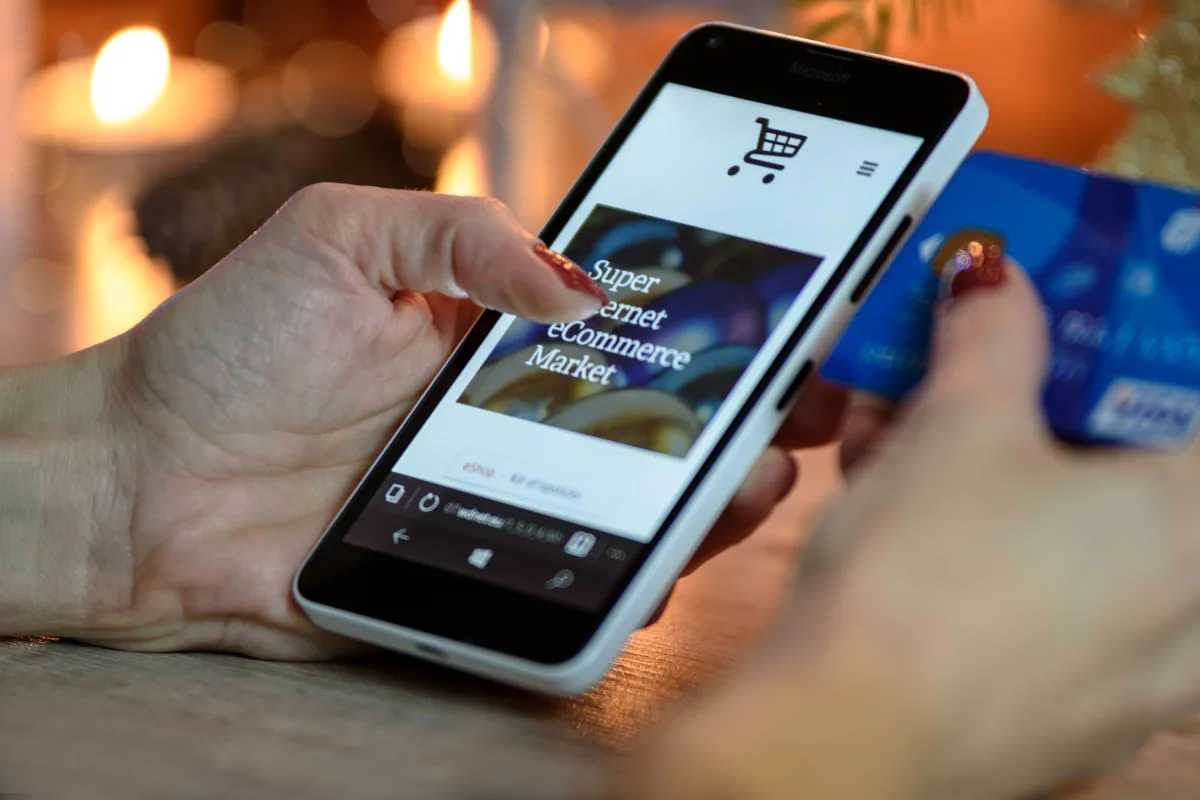
Browser extensions and cashback apps are useful — but only when layered on top of a channel decision that was already correct.
Price track before you buy. Tools like CamelCamelCamel (for Amazon), Google Shopping's price history view, and Honey's DropList let you set price alerts on specific items. For non-urgent purchases over $50, waiting for a drop is almost always worth it. Amazon's "Subscribe & Save" price can fluctuate significantly — checking the price track before subscribing takes 30 seconds and sometimes reveals that a one-time purchase is currently cheaper than the subscription rate.
Use our Price Trend Analyzer to identify the best time to buy for specific product categories before committing. It shows historical pricing patterns by category so you can buy at a trough instead of a peak.
Stack cashback portals with credit card rewards. Services like Rakuten, TopCashback, and Capital One Shopping offer cashback at major retailers. Stacking these with a credit card that earns 2–5% on purchases (and paying the balance in full each month) compounds the discount. The rule: never let the rewards justify a purchase you wouldn't otherwise make.
Understand social commerce impulse patterns. TikTok Shop, Instagram Shopping, and livestream events are engineered for fast conversion. The practical counter-strategy is a 24-hour rule on any social-commerce purchase over $30: add to cart or wishlist, wait a day, then decide. Most algorithmically triggered impulse purchases don't survive 24 hours of reflection.
Evaluate subscriptions annually. Subscription fatigue is real. The average US household now pays for 4–6 recurring subscriptions beyond streaming services (meal kits, beauty boxes, pet supply Autoship, clothing rental). At least once a year, cancel everything and re-subscribe only to what you actively used in the prior 90 days.
How Retail Technology Is Changing the Shopping Experience in 2026
Retailers have made structural changes that directly affect how you shop — if you know the tools are available.
Walmart's full-channel integration is the clearest example. According to NRF's 2026 retail trend report, Walmart has expanded same-day delivery and curbside pickup, integrated with TikTok Shop, and deployed "endless aisle" kiosks in physical stores — letting customers order online-only items at online prices without leaving the store. The practical implication: a Walmart shopper who can't find a specific SKU on the shelf can order it at the same online price from within the store, with no second trip required.
Mall foot traffic is recovering — but with a different purpose. NRF cites Capital One Shopping research showing indoor mall visits rose 1.8% in the first half of 2025 year over year, with visit durations up 3.3%. Malls are being repositioned as entertainment and social destinations, with retail as one component. Understanding this helps you separate genuine value from experiential marketing: a well-designed store environment is engineered to increase dwell time and impulse purchases. Going in with a list (and a hard time limit) is one of the most effective countermeasures.
AI shopping tools are emerging as legitimate research aids. Trusted Buyer Report's own Shopping Assistant and Product Comparator let you compare products, check price trends, and verify store reputation before committing. Using AI-assisted research before a significant purchase (any item over $100) typically surfaces price differences, return policy caveats, or quality signals that aren't visible in a standard product listing.
Seasonal Buying Calendar: When to Buy What in 2026
Timing matters. Here are the consistently reliable markdown windows for major categories, based on recurring retail patterns:
| Category | Best Time to Buy | Avoid |
|---|---|---|
| Electronics (TVs, laptops) | January (post-CES), Black Friday, back-to-school (Jul–Aug) | June–October full price |
| Winter apparel | January–February clearance, October pre-season | December peak |
| Summer apparel | August–September clearance | June–July |
| Appliances | Labor Day, Black Friday, holiday weekend sales | Spring/summer |
| Furniture | January, July, Labor Day | Spring (peak season) |
| Gym equipment | January (New Year demand spike clears by February) | October–November |
| Mattresses | Memorial Day, Labor Day, Presidents Day | Back-to-school season |
| Groceries/CPG | Weekly store cycles; stock up at sale price, not out of need | Impulse purchases at full price |
Capital One Shopping's 2026 research confirms that in-store preference increases during summer months — which means online deals on non-seasonal products often improve over the summer as retailers try to shift volume.
Which Shopping Strategy Is Right for Your Situation?
Not every tactic applies to everyone. Here's how to match strategy to your actual situation:
If your biggest spend is groceries and household staples: The highest-ROI move is a warehouse club membership — evaluate Costco vs. Sam's Club vs. BJ's based on your location and household size. Layer in retailer app coupons for the items you can't buy in bulk.
If you're a Gen Z or Millennial primarily shopping online: Build the 24-hour rule into your social commerce browsing habit. Set up price alerts on CamelCamelCamel or Google Shopping for any non-urgent purchase over $50. Stack cashback portals with your existing credit card rewards.
If you're carrying credit card debt: Stop optimizing shopping tactics until you've addressed the debt. At 20%+ APR, a $500 credit card balance costs $100/year in interest — which is more than most people save through coupon stacking. The emergency fund principle from Federal Reserve SHED data applies directly here.
If you primarily shop for family/household: The in-store bulk + loyalty stacking combination is your core strategy. Know your store's markdown cycle. Use the unit price label, not the shelf price.
Frequently Asked Questions
Is it cheaper to buy groceries online or in-store in 2026? For most categories, in-store remains cheaper when you factor in delivery fees and the substitution problem (grocery delivery services frequently substitute out-of-stock items with more expensive alternatives). The exception is dry goods and non-perishables from warehouse clubs, where online ordering can match or beat in-store pricing when you factor in the time and fuel cost of a trip.
What's the best cashback app for US shoppers in 2026? Rakuten and TopCashback consistently offer the broadest retailer coverage. Capital One Shopping is useful if you already use a Capital One card. The most important rule for cashback apps: always start your shopping session from the cashback portal (not a saved direct link) so the tracking cookie fires correctly.
How much can the average household save by switching to warehouse club purchasing? The answer depends on which categories you consolidate. For a household regularly buying paper products, cleaning supplies, dry goods, and vitamins, a single $65 Costco membership typically saves $200–$400/year versus grocery store pricing — but only if you buy in quantities you actually use before expiration.
Does social commerce (TikTok Shop, Instagram) offer real deals or mostly impulse traps? Both. Social platforms surface genuinely good deals from brands trying to acquire customers — the deals are real. The problem is the environment: livestream shopping and shoppable videos are engineered for fast conversion, not deliberate decision-making. Using a 24-hour waiting rule neutralizes the urgency engineering while still letting you capture the deals that hold up on reflection.
When is the best time to buy electronics in 2026? January (post-CES, when new models release and prior-year models discount), Black Friday/Cyber Monday, and back-to-school season (July–August for laptops and tablets). Avoid buying electronics in spring and early summer — there's no structural driver of discounting during those months.
We may earn a commission when you use our links to make a purchase. Our editorial recommendations are finalized before any affiliate link is applied. Read our full disclosure → | How we use AI →