Disclosure: Trusted Buyer Report may earn a commission from purchases made through links on this page, at no extra cost to you. This article was researched and drafted with AI assistance, then reviewed and fact-checked by our editorial team before publishing. Our ratings are finalized before any affiliate link is placed. Read our full methodology →
Quick Verdict
Wayfair is worth it — under the right conditions. Mid-range items ($300–$900) from CastleGate-fulfilled listings consistently deliver strong value. Budget pieces work for low-traffic setups. Premium buys require careful vetting. Delivery is reliable when expectations are set correctly; it breaks down when buyers expect Amazon-level speed without doing pre-purchase research.
Bottom line: If you're willing to spend 20–30 minutes checking materials and reading reviews before you buy, Wayfair delivers real value that most local retailers can't match on selection or price. If you need guaranteed next-day delivery or you're buying blind, consider alternatives.
| Rating | |
|---|---|
| Product Selection | ⭐⭐⭐⭐⭐ 5/5 |
| Mid-Range Value | ⭐⭐⭐⭐½ 4.5/5 |
| Delivery Reliability | ⭐⭐⭐½ 3.5/5 |
| Customer Service | ⭐⭐⭐ 3/5 |
| Return Experience | ⭐⭐⭐ 3/5 |
| Overall | ⭐⭐⭐⭐ 4/5 |
How This Review Was Researched
This guide synthesizes manufacturer specifications, customer satisfaction data from CheckThat.ai's analysis of 16,000+ verified customer experiences, structured sofa testing data from Dweva's 2026 review, Wayfair's official Q1 2026 investor release, and outdoor furniture testing data from KINGMAKE's 2026 analysis. We did not conduct hands-on product testing. Where we cite third-party test data, we link directly to the source.
What Most Wayfair Reviews Get Wrong
Here's the problem with most Wayfair coverage: it either raves about low prices or rails about a single damaged shipment. Neither tells you what you actually need to know.
Wayfair delivered 9.4 million orders to 21.4 million active customers in Q1 2026 alone. At that scale, sweeping verdicts are useless. A $79 side table and a $1,400 sectional sofa are both "Wayfair orders" — but they carry completely different quality expectations and risk profiles.
The useful question isn't "Is Wayfair good or bad?" It's: under what specific conditions does Wayfair work — and when does it fail? That's exactly what this review answers.
What Wayfair Actually Is (and Why It Matters for Your Purchase)
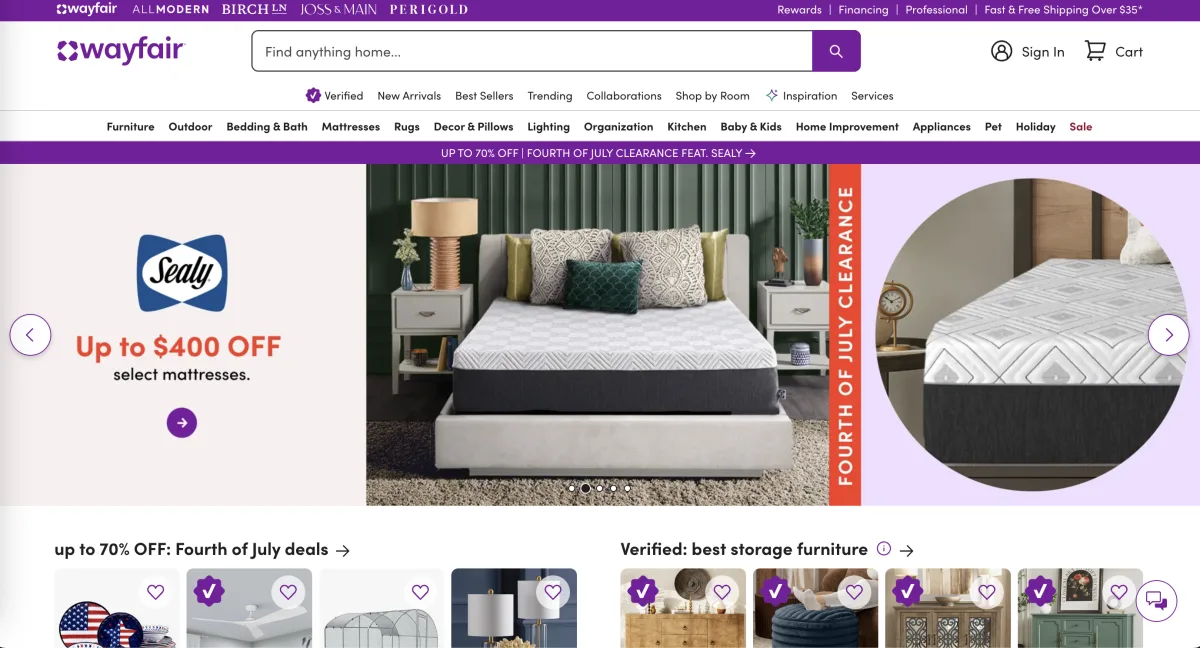
Most shoppers don't realize this: Wayfair is not a furniture brand. It's a marketplace.
When you buy from Wayfair, you're not buying from one manufacturer with consistent quality control. You're buying from one of 20,000+ supplier partners whose products are listed under Wayfair's umbrella. Quality happens at the catalog and review level — not on a factory floor that Wayfair owns.
This single fact explains everything about why Wayfair reviews are so polarized.
Wayfair's Four Brand Storefronts
Wayfair operates four distinct storefronts, each targeting a different buyer:
| Brand | Style | Price Point |
|---|---|---|
| Wayfair.com | Broad selection | Budget to mid-range |
| AllModern | Contemporary / minimalist | Mid-range |
| Birch Lane | Traditional / cottage | Mid to premium |
| Joss & Main | Transitional / eclectic | Mid-range |
| Perigold | Luxury / designer | Premium to luxury |
Despite the distinct branding, all five run on the same supplier network and fulfillment infrastructure. A sofa on AllModern and a similar one on Joss & Main may come from the same factory — just styled and priced differently. Per Matrix BCG's competitive analysis, Wayfair's catalog exceeds 30 million SKUs across its supplier network.
CastleGate: The Fulfillment Difference That Actually Matters
The most important operational detail most Wayfair shoppers overlook is CastleGate — Wayfair's proprietary fulfillment network.
Items stored in CastleGate warehouses ship faster, arrive with lower damage rates, and create fewer delivery headaches than items shipped directly from supplier warehouses. By 2025, Wayfair had expanded CastleGate to enable two-day delivery on bulky items — rare in e-commerce furniture.
Practical tip: When browsing, look for indicators that an item ships from a Wayfair fulfillment center rather than directly from the supplier. That distinction often predicts a smoother experience more reliably than star ratings alone.
Wayfair Furniture Quality: A Realistic Three-Tier Breakdown
The single most actionable framework for shopping Wayfair is understanding its three price tiers — and what each one realistically delivers.
Entry-Level (Under ~$200–$300 for most categories)

Entry-level Wayfair furniture uses basic frames, thinner materials, and lighter hardware. These pieces work well for:
- Apartments and temporary setups
- Guest bedrooms and low-traffic spaces
- Accent pieces that won't take daily wear
Used heavily in a high-traffic context — a primary sofa in a household with kids and pets — wear can appear within one to two years. The value is real for the right use case. Buyers who expect entry-level durability to match mid-range furniture are setting themselves up for disappointment.
Mid-Range ($300–$900 for most furniture): The Sweet Spot

This is where Wayfair delivers its best, most consistent value — and where the platform genuinely earns its reputation.
Materials are meaningfully better: frames are more likely to use solid wood or metal rather than MDF or particleboard, and cushion fill density is higher. Structured sofa testing by Dweva in 2026 found that mid-range Wayfair sofas scored 4.2 to 4.3 overall, with value scores of 4.3 to 4.4 — strong results for the price points. If you're furnishing a living room, dining room, or bedroom on a real-world budget, the mid-range tier is where to focus your search.
For inspiration on specific categories, our best dining room tables and chairs guide for 2026 and best office chairs for 2026 identify which mid-range options from Wayfair and competitors stand out in each category.
Premium Tier ($900+): Real Quality, But Do Your Homework
Premium furniture on Wayfair can deliver genuine quality — but it requires more diligent pre-purchase research than the mid-range tier. Vendor standards vary significantly even within the premium segment, and a higher price on Wayfair doesn't carry the same quality guarantee it might at a specialty retailer like Restoration Hardware or Room & Board.
The premium tier is worth exploring when you've identified a specific piece with:
- Strong verified reviews (50+ reviews, recent)
- Clear material specifications in the listing
- A track record from the supplying vendor (check their other products)
The One Quality Predictor That Outweighs Everything Else
Across all tiers, frame and fill material is the single most reliable quality signal:
- Solid wood and metal frames outlast particleboard and MDF by years
- High-density foam or down-blend cushions hold shape longer than polyfoam
- Performance fabric resists staining and wear better than standard upholstery
If a product listing doesn't specify these details — that omission is informative. Look for an alternative listing that does, or skip it entirely.
How to Evaluate Any Wayfair Product Before You Buy
The buyers who consistently report positive Wayfair experiences share one habit: they treat pre-purchase research seriously. KINGMAKE's 2026 outdoor furniture analysis found that buyers who researched materials, read customer photos, and avoided vague product descriptions "consistently came away more satisfied" than those who bought on price or aesthetics alone.
Here's the exact checklist:
1. Check materials explicitly. Look for frame material (solid wood, metal, MDF, particleboard), cushion fill type (high-density foam, down blend, polyfoam), and fabric composition. Missing details = warning sign.
2. Read reviews for patterns, not averages. A 4.1-star product can still have a systemic problem if 20% of reviews mention the same issue — missing hardware, wobbly legs, color mismatch. Sort by most recent. Look for recurring themes.
3. Prioritize customer photos. Photos from real buyers reveal color accuracy, actual scale, and assembly quality in ways studio photography cannot. Many customer photos with positive color-accuracy comments = meaningfully stronger signal.
4. Compare across price points. Search the same product type at two tiers and read material specs side by side. Often the price difference reflects better frame construction. Sometimes it reflects only a different aesthetic finish — in which case the lower option may be the smarter buy.
5. Be honest about intended use. A decorative accent table used weekly needs a different durability threshold than a desk chair used eight hours a day. Calibrate your quality threshold to actual demand. This is especially important when choosing ergonomic office chairs or a primary mattress — items where daily use makes quality differences felt quickly.
Wayfair Delivery: How It Actually Works
Wayfair's delivery infrastructure is more sophisticated than most customers realize. According to Wayfair's engineering blog on delivery-date prediction, the company uses machine learning models to generate delivery estimates, incorporating two inputs: supplier processing time and physical distance to the customer.
Here's what realistic delivery windows look like:
| Item Type | Typical Delivery Window |
|---|---|
| Small/medium items (standard) | 1–4 weeks |
| Large furniture (freight) | 7–14 business days |
| CastleGate-fulfilled items | 2–5 days (often 2-day) |
| White glove delivery | 7–14 business days + scheduling |
White Glove Delivery: When It's Worth It
White glove delivery includes room-of-choice placement and assembly for large furniture — sofas, beds, dining tables. It costs more than standard delivery but significantly reduces damage risk during the final delivery step and eliminates the physical burden of handling bulky freight.
For large furniture purchases over ~$500, white glove is often worth the added cost. The math changes when a $200 sofa comes with a $100 white glove fee — do the value calculation explicitly.
The Most Common Delivery Complaints — and What They Signal
Delivery date changes after purchase are the most widely reported Wayfair frustration. CheckThat.ai's analysis of 16,000+ customer experiences documents a representative pattern: a customer purchases chairs with a quoted three-day window, the date changes multiple times, and even the cancellation process doesn't resolve cleanly. This pattern appears most often with supplier-direct shipments, not CastleGate-fulfilled orders.
Damage on arrival is the second major complaint category, particularly for large furniture shipped via freight. Packaging standards vary by supplier, and a sofa traveling through multiple freight handoffs faces more damage risk than a small parcel shipment. Customer service response quality during damage disputes is inconsistent — some customers report quick resolutions, others describe months of back-and-forth.
Return logistics for large furniture add another friction point worth knowing before you buy. Unlike a parcel return dropped at UPS, returning a sofa or dining table requires coordinating a pickup — with scheduling windows and potential repackaging requirements. Reperch's 2026 quality breakdown lists return challenges as one of the four most common complaints alongside inconsistent quality, assembly issues, and limited quality control.
The key insight: Most of these complaints are predictable and avoidable — not random. Choosing CastleGate-fulfilled items, opting for white glove on large pieces, and setting realistic delivery windows eliminates the majority of documented problems.
Wayfair vs. Competitors: Honest Comparison
Wayfair vs. IKEA
IKEA offers tighter quality control within its own product lines and a more predictable assembly experience. Wayfair's advantage is selection — 30 million SKUs versus IKEA's curated catalog. For a detailed comparison of IKEA's quality and value in 2026, see our IKEA US review.
Wayfair vs. Amazon
Amazon wins on delivery speed and return simplicity. Wayfair wins on design curation and selection depth in home furnishings. According to CheckThat.ai's direct analysis: choose Amazon when prioritizing delivery speed and easy returns; choose Wayfair when finding a specific design style matters more than logistical convenience.
Wayfair vs. Local Retailers
Local retailers offer what Wayfair cannot: tactile evaluation. You can sit on the sofa, open the drawer, test the table's weight, and assess build quality before committing. For high-stakes purchases — a primary bed frame, a primary sofa, a dining set meant to last a decade — the inability to evaluate comfort in person is a real trade-off.
The comparison with specialty retailers like Room & Board or Article: more consistent quality control and dedicated service, but typically at higher price points.
Wayfair wins clearly when: A buyer needs a specific design unavailable locally within a reasonable budget and is willing to spend 20–30 minutes on pre-purchase research.
Wayfair loses when: A buyer needs guaranteed delivery by a specific date, can't tolerate return friction, or is buying a high-use piece they haven't evaluated in person.
Wayfair Outdoor Furniture: A Category That Requires Extra Diligence

Outdoor furniture deserves separate treatment because UV exposure, moisture, and temperature swings reveal quality differences within one or two seasons — far faster than indoor conditions. If you're shopping for outdoor pieces specifically, our best outdoor furniture guide for 2026 covers weather-resistant options across multiple retailers and price points.
KINGMAKE's 2026 outdoor analysis found a clear outcome split: some buyers report outdoor sets that "look great and still look new" after four years; others note cushions that faded faster than expected or wicker that degraded quickly. The consistent differentiator was whether buyers verified specific material properties before purchasing.
Two material questions that matter most for Wayfair outdoor furniture:
- Cushion weatherproofing: Look for explicit mentions of UV-resistant fabric, quick-dry foam, and water-resistant covers. "Weather-resistant" without specifying the treatment = higher risk.
- Frame material on wicker pieces: Synthetic resin wicker (also labeled "PE wicker") significantly outperforms natural wicker for outdoor longevity. If the listing doesn't say "resin wicker" explicitly — assume natural wicker and factor in faster degradation.
Wayfair for Specific Room Categories
Living Room Furniture
Mid-range sofas and sectionals represent Wayfair's strongest category. The selection is deep enough to find specific styles unavailable at local retailers, and the mid-range tier consistently delivers value. Use the material checklist above for any upholstered piece.
Bedroom Furniture
Wayfair's bedroom furniture selection is strong, but buyers should pair furniture research with careful mattress selection. Wayfair sells mattresses, but the category is complex enough to deserve dedicated research — our best mattresses for 2026 covers top options for side, back, and stomach sleepers across brands.
Home Office
Wayfair's desk and storage selection is solid. For the chair — the highest-use piece in any home office — apply the same material scrutiny described above, and cross-reference against our best office chairs guide, which identifies which ergonomic features actually matter for WFH use.
Entertainment & TV Stands
Wayfair's TV stand and entertainment center selection is extensive. Our best TV stands and entertainment centers guide for 2026 can help narrow down which styles and configurations work for different room setups and TV sizes.
Home Decor & Accents
Wayfair's accent, decor, and textile selection is one of its strongest areas — lower stakes than large furniture, more forgiving if a piece doesn't match exactly. For a broader look at where to shop home decor online beyond Wayfair, see our best home decor online stores for 2026. You might also complement furniture shopping with easy-care indoor plants or a refresh of your interior paint to complete a room makeover.
Who Should Shop Wayfair in 2026 — and Who Shouldn't
Wayfair Works Well For Buyers Who:
- Need a specific design style unavailable at local retailers and are willing to do pre-purchase research
- Can work within one-to-four-week delivery windows and understand CastleGate vs. supplier-direct differences
- Are buying for lower-stakes contexts — guest rooms, apartments, seasonal use, accent pieces
- Prioritize selection variety and competitive pricing over guaranteed quality consistency
- Apply the material-checking and review-reading habits described in this guide
Wayfair Is a Riskier Choice For Buyers Who:
- Need guaranteed delivery by a specific date — date changes are a documented systemic issue, not an occasional anomaly
- Are buying a high-use primary piece and cannot evaluate comfort or construction in person before committing
- Have low tolerance for return friction — large furniture returns require coordinated pickup and scheduling
- Are in regions with documented service gaps — CheckThat.ai's analysis identifies regional operational variability as a real factor in outcome consistency
Frequently Asked Questions
Is Wayfair furniture good quality in 2026?
Quality varies significantly by price tier and supplier. Mid-range items ($300–$900) represent the best value and consistently receive stronger satisfaction scores. Entry-level pieces work for low-traffic uses. Premium items can deliver genuine quality but require more diligent vetting. There is no single answer because Wayfair hosts products from 20,000+ different suppliers.
How long does Wayfair take to deliver in 2026?
Standard delivery for smaller items: 1–4 weeks depending on supplier location. Large items via white glove or freight: 7–14 business days. CastleGate-fulfilled items: as fast as 2 days for eligible orders.
Is Wayfair worth it compared to buying locally?
Wayfair's primary advantage is selection — 30 million SKUs across every aesthetic — and competitive pricing in the mid-range tier. Local retailers offer tactile evaluation before purchase. The right choice depends on how critical it is to evaluate comfort and build quality in person before committing.
What is Wayfair's return policy for furniture?
Wayfair's standard return window is 30 days for most items. Large furniture returns require coordinating a freight pickup rather than a simple drop-off, which adds friction and scheduling requirements. Check the specific return terms on each product listing before purchasing, as some items have different policies.
How do I know if a Wayfair product is from CastleGate?
Look for shipping indicators on the product page that reference a Wayfair fulfillment center or faster-than-standard delivery estimates. CastleGate items often show shorter, more reliable delivery windows. Items shipping directly from supplier warehouses typically show longer or variable windows.
Is Wayfair legit and safe to buy from?
Yes. Wayfair is a legitimate publicly traded company (NYSE: W) with 21.4 million active customers as of Q1 2026. The risk is not fraud — it's quality variability across a 20,000+ supplier network. The buyer protection and return policies are real, though the return process for large items requires more effort than parcel returns.
How does Wayfair compare to IKEA for furniture?
IKEA offers tighter quality control within its own catalog and a more predictable assembly experience at competitive prices. Wayfair offers far broader selection and design variety. For buyers who have a specific style in mind that IKEA doesn't carry, Wayfair is the stronger choice. See our full IKEA US review for 2026 for a direct comparison.
Final Verdict: When to Shop Wayfair in 2026
Wayfair in 2026 is a genuinely useful platform for buyers who approach it with the right expectations and the right habits. It is not a reliable source of guaranteed quality across the board — but for buyers who invest 20–30 minutes in pre-purchase research, the combination of selection depth, competitive pricing, and mid-range quality delivers real value that most local retailers and online competitors can't match in specific design categories.
Shop Wayfair when: You have a design style in mind, you're buying mid-range, you'll verify materials and read reviews, and you can work within a one-to-four-week window.
Look elsewhere when: You need speed certainty, you can't tolerate return complexity, or you're buying a primary high-use piece you haven't been able to evaluate in person.
If you're building out a full home setup this year, our Furniture & Appliances Buyer's Guide 2026 covers how to evaluate retailers and prioritize spending across every major category — a useful companion to this review.
Reviewed by the Trusted Buyer Report editorial team. This article was drafted with AI assistance and fact-checked before publishing. We may earn a commission from purchases made through links on this page. Full affiliate disclosure → | How we review →