
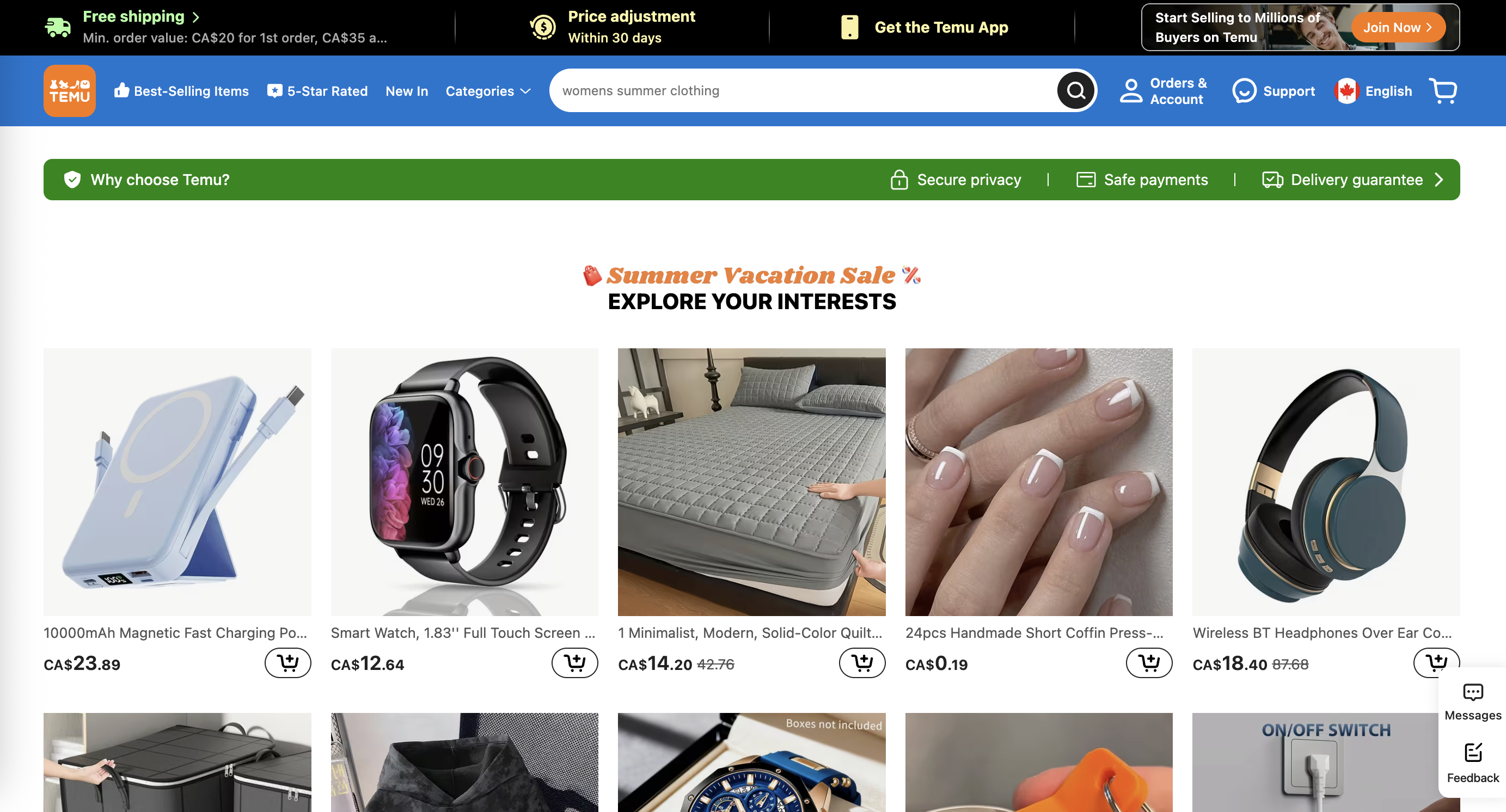
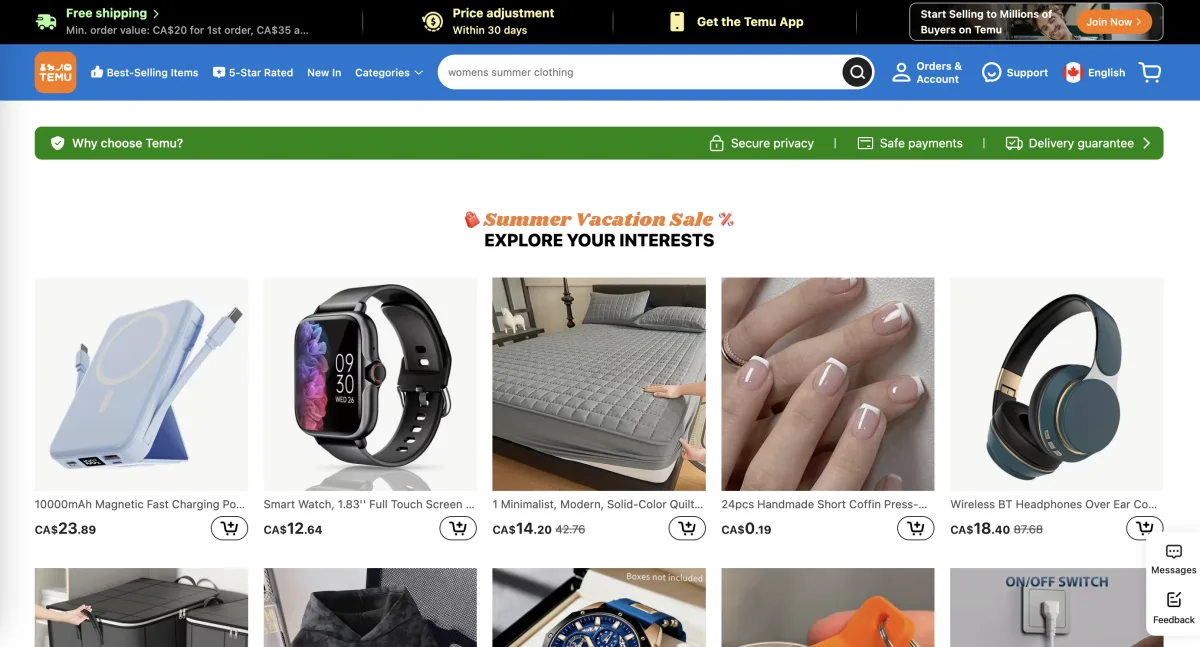
Verdict up front: Temu is a real, operating marketplace — not a scam. But "legit" doesn't mean risk-free. Whether Temu is worth using in 2026 depends almost entirely on what you're buying. For non-safety-critical commodity items, it can be a genuinely good deal. For children's toys, car seats, or anything safety-regulated, the evidence is alarming. Read on before you click "add to cart."
Reviewed by Claire Whitford, Staff Writer. Trusted Buyer Report may earn a commission from purchases made through links on this page. This article was drafted with AI assistance and fact-checked by our editorial team before publishing.
Quick Facts
| Platform type | Direct-to-consumer marketplace (Chinese manufacturers → US buyers) |
| Parent company | PDD Holdings (also owns Pinduoduo) |
| Founded | September 2022 |
| Countries | 79 (as of available data) |
| Customer service ranking | USA TODAY America's Best Customer Service 2026 (2nd consecutive year) |
| Typical delivery (US) | 7–20 days |
| Data privacy status | Active lawsuit alleging malware; EU Digital Services Act preliminary breach found (July 2025) |
You've seen the ads. A phone case for $0.49. A set of garden tools for under $5. You've probably clicked, scrolled the prices in disbelief, and then hesitated. Is this real? Will it actually ship? And what happens to my data when I download the app?
Those are exactly the right questions. This review answers all three — using verified data, not guesswork or hype.
How this guide was researched: This analysis draws on manufacturer information, third-party market data, regulatory filings, and aggregated customer research. It does not reflect hands-on testing by Trusted Buyer Report. All claims are sourced and linked to primary or authoritative sources below.
What Temu Claims vs. What the Evidence Actually Shows
The most useful thing to do upfront is put Temu's marketing directly next to what independent research has found. Here's that comparison across five dimensions:
| Dimension | What Temu Claims | What the Evidence Shows |
|---|---|---|
| Price | Dramatically lower than Western retailers | Confirmed for commodity items. A knife sharpener or bathroom mat priced at $15–$25 on Amazon can cost under $3 on Temu, per Business of Apps. |
| Product quality | Factory-direct value | Highly category-dependent. Documented failures in safety-critical goods, including car seats and children's toys. |
| Safety | Standard marketplace protections | In March 2025, experts identified fake car seats on Temu failing US safety standards. EU consumer testing found 95% of toys purchased on Temu violated safety regulations, per European Business Magazine. |
| Data privacy | Standard app data practices | Active lawsuit alleges Pinduoduo (Temu's parent) embedded malware and spyware. Proceedings were ongoing as of mid-2025, per Norton. |
| Customer service | Responsive and buyer-friendly | Independently verified — Temu made USA TODAY's America's Best Customer Service 2026 list for the second consecutive year, per Yahoo Finance. |
The platform operates legally in 79 countries and faces active regulatory scrutiny in both the US and EU. Neither "total scam" nor "perfectly safe" captures the reality — it depends heavily on what you're buying and how you manage your privacy settings.
What Is Temu and Who Actually Runs It?

Temu launched in September 2022. Within 15 months, it had been downloaded more than 250 million times and was the most downloaded shopping app in 15 countries simultaneously — including the US, UK, Germany, Japan, and Brazil — according to European Business Magazine.
The parent company is PDD Holdings, which also owns Pinduoduo, China's dominant social commerce platform. PDD Holdings reported total revenue of $17 billion in fiscal 2024 — a 59% increase year-over-year — with net income of $6.4 billion. This is not a startup. It's one of the most capitalized technology companies in the world, with a business model deliberately engineered to undercut Western retail pricing.
Here's the mechanism that matters:
Traditional e-commerce routes a product from a Chinese manufacturer → freight forwarder → US customs → Amazon warehouse → your door. Every step adds cost. Temu compresses that chain by connecting buyers directly to manufacturers, shipping packages individually from China. The result is the $0.49 phone case. The tradeoffs are longer delivery times, reduced quality vetting, and a supply chain operating largely outside the oversight structures US consumers expect from domestic retailers.
Understanding PDD Holdings is also critical for the data privacy discussion below. Pinduoduo's legal history and the active allegations against it are directly relevant to how you should think about installing Temu on your phone.
How Fast Has Temu Grown? The Numbers in Context

Temu's growth between 2022 and 2024 set records most e-commerce analysts hadn't modeled as possible. According to DataGlobeHub:
- Mobile app users grew 614% between 2022 and 2023, reaching 167 million monthly active users
- Gross merchandise value grew 5,400% over the same period, reaching $20 billion in the first half of 2024
- Monthly downloads hit 47.21 million in September 2024
- Website traffic reached 565.2 million visits — 40% growth in the 2023–2024 period
That answers the natural question: Is this just Wish 2.0? Wish peaked and collapsed partly because it couldn't sustain user retention after quality complaints mounted. Temu has structural advantages Wish never had — a parent company with vastly deeper pockets, a more sophisticated logistics operation, and a more aggressive customer service posture.
The advertising scale also explains why Temu feels inescapable. The Wall Street Journal reported, as cited by DAC Group, that Temu was Meta's top advertiser by revenue in 2023 and among Google's top five advertisers by spend. When a single brand is buying that volume of digital inventory, nearly every US internet user will see the ads repeatedly.
Growth is slowing in 2026, though. EMARKETER reported in March 2026 that PDD Holdings' Q4 revenue grew just 12% — solid, but a sharp deceleration from the triple-digit rates of 2022–2023 — with tariffs, price wars, and supply chain investment costs compressing margins. Temu is maturing, not collapsing. But the era of explosive expansion appears to have peaked.
Product Quality on Temu: An Honest, Category-by-Category Assessment
Here's the honest answer: category matters more than platform.
Temu sells thousands of product types, and the risk profile varies dramatically across them.
For non-safety-critical commodity goods — phone accessories, basic home organization, decorative items, simple hand tools — the quality-to-price ratio can be genuinely reasonable. If a $2 phone stand breaks after three months, you've lost $2. The risk is proportionate to the price. Business of Apps notes that Temu is as close to a direct link with Chinese manufacturers as is currently possible for Western consumers — meaning the same factories producing goods for premium brands sometimes sell near-identical items through Temu at a fraction of the price.
Safety-regulated categories are a different story entirely.
In March 2025, experts identified fake car seats on Temu that failed US safety standards, using substandard materials that posed serious risks to consumers, according to Norton. EU consumer testing found that 95% of toys purchased on Temu violated safety standards, per European Business Magazine. Ninety-five percent isn't a rounding error — it reflects a structural problem with how products in regulated categories are listed and sold on the platform.
The direct-from-manufacturer model that creates Temu's price advantage also removes the vetting layers that catch these failures. Amazon has its own quality control problems, but it has invested heavily in brand registry programs, product authenticity guarantees, and safety recall infrastructure. By available evidence, Temu's infrastructure for preventing unsafe products from reaching consumers is substantially weaker.
Practical category guide:
- ✅ Lower risk: Phone cases and accessories, basic kitchen gadgets, home décor, craft supplies, non-electrical tools, clothing accessories, seasonal decorations
- ❌ Higher risk: Children's toys, car seats and child safety equipment, electrical goods, anything requiring a safety certification, supplements or health products
Data Privacy and Security: What's Proven vs. What's Alleged
This section requires precision. The data privacy situation involves active legal proceedings, and conflating allegations with proven facts does you a disservice.
What is alleged: A lawsuit claims that Pinduoduo deliberately embedded malware and spyware into its apps. As of publication, those proceedings remain ongoing, according to Norton. Allegations in a lawsuit are not convictions — but they are serious enough that security researchers and cybersecurity firms have flagged them as warranting attention.
What is documented: The European Commission found Temu in preliminary breach of the Digital Services Act in July 2025, per European Business Magazine. The DSA breach finding relates to platform obligations around illegal content and product safety — not specifically to spyware — but it confirms that regulators in a major jurisdiction have found Temu's practices materially non-compliant with consumer protection law.
What you can do regardless of how the legal proceedings resolve:
- Review app permissions before installing. Temu doesn't need access to your contacts, microphone, or camera to work as a shopping app. If it requests these, decline them.
- Avoid social sign-on. Logging in with Google or Facebook shares additional profile data beyond what Temu needs.
- Use a credit card, not a debit card or bank transfer. Credit cards offer chargeback rights that debit cards don't — your strongest financial protection if something goes wrong.
- Consider shopping through the mobile browser rather than the native app. The browser version limits data collection compared to an installed app.
The broader regulatory environment around Chinese-owned apps has intensified in both the US and EU since 2023. That context doesn't make Temu uniquely dangerous — but the scrutiny is real, ongoing, and backed by regulatory action in multiple jurisdictions.
Customer Service: The One Area Where Temu Consistently Earns Credit
Temu's customer service track record deserves honest acknowledgment, because the evidence supports it.
The platform was named to USA TODAY's America's Best Customer Service 2026 list — its second consecutive year on the ranking — according to Yahoo Finance. Separately, Temu was named to USA TODAY's inaugural "Brands Most Trusted by Parents 2026" list in the Mass Merchant and Variety category within general merchandise.
These are not self-reported metrics. The Parents list was developed in collaboration with research firm Plant-A Insights Group, based on an independent nationwide survey of more than 5,000 US parents conducted between September and October 2025. An initial pool of more than 20,000 brands was reviewed; 350 made the final list. Temu was among them, per PR Newswire.
What this means practically: if you receive the wrong item, a damaged item, or something that doesn't match its listing, Temu's refund process has been independently rated as performing well relative to competitors. That's a meaningful data point for low-stakes purchases. It doesn't offset the product safety risks in regulated categories — a refund doesn't undo a safety incident — but for most commodity purchases, accessible resolution matters.
The Regulatory Shift That's Changing Temu's Pricing in 2026
Temu's pricing model was built on a specific regulatory gap: the de minimis exemption, which allowed packages valued under $800 to enter the US without import duties. When Temu ships a $3 item directly from a Chinese manufacturer to a US consumer, that package historically paid no tariff. Amazon's supply chain, by contrast, imports goods in bulk and pays duties on those shipments — a cost that flows through to retail prices.
That gap is closing. Legislative pressure on de minimis thresholds has intensified in the US, and the tariff environment has shifted materially. EMARKETER reported in March 2026 that PDD Holdings' Q4 results showed 12% revenue growth alongside margin compression from tariffs, price wars, and supply chain investment costs. The pricing advantage Temu enjoyed in 2022–2023 is narrowing as regulatory arbitrage closes.
In Europe, the European Commission's July 2025 preliminary DSA breach finding represents a more direct challenge. A preliminary breach finding can lead to formal enforcement action and substantial fines under EU law.
The practical implication for shoppers: Temu in 2026 is not the same platform it was in 2023. Prices may rise modestly as regulatory costs are absorbed. Platform behavior around product listings and seller vetting may improve under compliance pressure. The long-term availability of Temu in certain markets is not guaranteed.
None of this means you shouldn't use Temu today — but decisions made on 2022 assumptions about price advantage and regulatory environment may need revisiting.
If you want broader context on how to save money across platforms — not just Temu — our US Shopping Money-Saving Guide for 2026 covers tactics that work regardless of which marketplace you prefer.
Temu vs. Amazon vs. Shein: A Practical Comparison for 2026
| Criterion | Temu | Amazon | Shein |
|---|---|---|---|
| Price (commodity goods) | Lowest | Moderate to high | Low (apparel focus) |
| Delivery speed | 7–20 days typical | 1–2 days (Prime) | 7–14 days typical |
| Product range | Broad general merchandise | Broadest, including branded goods | Primarily apparel and accessories |
| Product safety vetting | Weak in regulated categories | Stronger, with brand registry and recalls | Similar concerns in tested categories |
| Return policy | Independently rated positively | Industry benchmark | More complex; varies by item |
| Data risk profile | Active legal allegations; ongoing scrutiny | Extensive data collection; US-regulated | Similar Chinese-ownership scrutiny |
The clearest framing: use Amazon when delivery timing matters, when you're buying a safety-regulated product, or when you need accountability for a branded item. For a broader look at how Amazon stacks up in 2026, see our Amazon review and our best Amazon alternatives if you're actively looking to diversify where you shop.
Use Temu when you're buying a non-critical commodity item, can wait 7–20 days for delivery, and the price difference is substantial enough to justify the quality variability.
For fashion specifically, Shein occupies a narrower lane — primarily apparel — and its quality and regulatory issues in that category are well documented. Our Shein review for 2026 covers that in detail.
If you're comparing across the full range of Chinese-origin marketplaces, AliExpress is also worth evaluating — it has a longer track record in the US market and a different seller vetting model than Temu.
Who Is Actually Shopping on Temu?

Temu's user base skews toward value-conscious shoppers across a wide age range. The platform's 167 million monthly active users as of available data, per DataGlobeHub, represent a broad demographic cross-section.
Behaviorally, Temu shoppers tend to buy in categories where brand identity matters less than function: home organization, basic tools, phone accessories, seasonal decorations, craft supplies, and clothing basics. The platform's gamified shopping interface — spin wheels, flash deals, referral rewards — is designed to increase session time and impulse purchasing. Being aware of that design choice helps you shop more deliberately and avoid spending more than intended.
The platform's recognition on USA TODAY's "Brands Most Trusted by Parents" list — based on a survey of more than 5,000 US parents — suggests meaningful penetration among household decision-makers, not just younger bargain hunters. That's consistent with Temu's positioning as a general household merchandise platform rather than a niche deal site.
Should You Shop on Temu? The Verdict by Use Case
Shop on Temu if:
- You're buying a non-safety-critical commodity item (phone accessory, home décor, craft supply, basic organizing tool)
- The price difference vs. Amazon is $10 or more and the item isn't urgent
- You're comfortable reviewing app permissions and using a credit card for payment protection
Skip Temu if:
- You need the item within a week — the 7–20 day shipping window is real
- You're buying anything in a safety-regulated category: children's toys, car seats, electrical goods, supplements
- You're concerned about app-level data collection and prefer not to install it (shopping via mobile browser is an option)
- You need a branded item with guaranteed authenticity
Worth knowing: Temu's return and refund process has been independently rated as functioning well, so low-stakes commodity purchases carry relatively manageable downside risk. The category-specific safety issues are where the real risk concentrates.
Frequently Asked Questions
Is Temu a legitimate website or a scam?
Temu is a legitimate, operating marketplace owned by PDD Holdings, one of the world's largest technology companies. It is not a scam in the sense of taking money without shipping goods. However, documented issues with counterfeit products, substandard safety-regulated items, and active legal allegations around data practices mean "legitimate" doesn't mean "risk-free." The platform operates legally in 79 countries and has received independent customer service recognition.
Is it safe to use a credit card on Temu?
Using a credit card is the safest payment method on Temu. Credit cards offer chargeback rights that debit cards and bank transfers don't. Avoid storing payment details in the app longer than necessary. The active legal allegations about Pinduoduo's data practices have not been proven in court, but limiting your financial data exposure is a reasonable precaution.
Why are Temu prices so low?
Temu connects buyers directly to Chinese manufacturers, eliminating the distribution, warehousing, and import markup costs that flow through traditional Western retail supply chains. A bathroom mat that costs $18 on Amazon reflects the cost of freight forwarding, Amazon warehouse fees, and seller margin on top of the manufacturing cost. On Temu, you're closer to paying the manufacturing cost plus direct shipping. Regulatory advantages around import duty exemptions have also historically contributed, though those advantages are narrowing in 2025–2026.
How long does Temu delivery actually take?
Typical delivery windows in the US range from 7 to 20 days for standard shipping. Temu has improved its logistics infrastructure since launch, but it cannot match Amazon Prime's 1–2 day delivery. If you need something quickly, Temu is the wrong choice regardless of price.
Should I be worried about Temu spying on my phone?
A lawsuit alleges that Pinduoduo, Temu's parent company, embedded malware and spyware into its apps. As of publication, those legal proceedings are ongoing — allegations are not convictions. The prudent steps are practical: review app permissions before installing, avoid social sign-on, use a credit card, and consider whether shopping via mobile browser rather than the native app meets your needs. Those steps protect you regardless of how the legal proceedings resolve.
How does Temu compare to Walmart's online store?
Walmart's online platform offers faster shipping (often same-day or next-day with Walmart+ or store pickup), stronger product safety vetting, and the accountability of a US-based retailer. Temu wins on price for commodity goods. Our Walmart Online review for 2026 goes into detail if you're deciding between the two.
Trusted Buyer Report may earn a commission when you use our links to make a purchase. Our editorial scores and recommendations are finalized before any affiliate link is applied and are never influenced by commercial relationships. Read our full affiliate disclosure → | Editorial standards →