Bottom line up front: If you're hoping 2026 travel prices will drop the longer you wait, the data says otherwise. Hotel rates are climbing 2–4% a year and airfares 2–3%, and neither trend is reversing. The travelers who come out ahead this year aren't the ones who wait the longest — they're the ones who price the true all-in cost (not the advertised one), pick the right rate type for their flexibility needs, and book inside the windows that actually move the needle. This guide walks through flights, hotels, vacation packages, luxury travel, and travel insurance using current 2026 data from Phocuswright, NerdWallet, Engine.com, Condé Nast Traveler, and Statista.
Quick facts
| Global travel market size (2026) | $1.67 trillion, still growing |
| Average U.S. summer trip budget | $2,940 |
| Hotel rate growth (2026) | +2–4% annually |
| Airfare growth (2026) | +2–3% annually |
| Americans who'd rather skip a trip than book the cheapest option | 42% |
| Americans who say refundable flights are worth the extra cost | 67% |
Methodology note: This guide is researched and drafted with AI assistance, then reviewed and fact-checked by a human editor before publishing. It synthesizes current industry data and reporting from Phocuswright, NerdWallet, Engine.com, Condé Nast Traveler, and Statista — it does not reflect hands-on testing of specific bookings by Trusted Buyer Report.
Is it true that travel prices will drop if you wait? (No — here's the 2026 data)

Most travelers operate on an outdated assumption: wait long enough, and prices fall. In 2026, that habit is costing people real money. According to Phocuswright's Travel Forward: Data, Insights and Trends for 2026, the global travel market is valued at $1.67 trillion and is still expanding, not contracting. Hotel rates aren't returning to 2019 levels, and airfares aren't drifting back to pandemic-era lows. Waiting was a sound strategy in a buyer's market. 2026 isn't one.
This guide isn't a list of destinations or a roundup of deal alerts — it's a decision framework for how to buy travel in 2026, covering flights, hotels, vacation packages, luxury options, and travel insurance. If your 2026 plans involve any paid lodging or a flight, how you structure the purchase matters as much as what you book.
What's actually driving 2026 travel prices
Before opening a single booking tab, it helps to understand the market you're buying into — these numbers translate directly into what you'll pay and when.
NerdWallet's 2026 Summer Travel Report found that nearly 45% of Americans plan a summer 2026 vacation requiring a flight, paid lodging, or both, at an average expected spend of $2,940 per trip. Multiplied across the population, that's well over $110 billion in collective summer travel spending — which is exactly why airlines and hotels feel little financial pressure to discount.
Travelers aren't spending carelessly, though. The same NerdWallet survey found 42% of Americans would rather skip a vacation entirely than book the cheapest available airfare or lodging. That's a meaningful signal: most travelers have a quality floor. They're price-sensitive, but not willing to trade away the experience just to hit a lower number.
On the supply side, Engine.com's 2026 business travel forecast projects hotel rates will keep growing 2–4% annually, building on sharp increases in 2023–2024, while airfares rise a more moderate 2–3%, driven by sustained demand and fuel costs. Major conventions, the FIFA World Cup cycle, and large sporting events will push prices well above baseline on specific routes and dates. Statista's 2026 travel and tourism trends analysis confirms that overall demand for travel remains as high as ever, with global travel and tourism revenue forecast to keep growing. None of this points to a slowdown — your budget and booking strategy need to assume rising prices, not falling ones.
How to set a realistic travel budget before you book anything

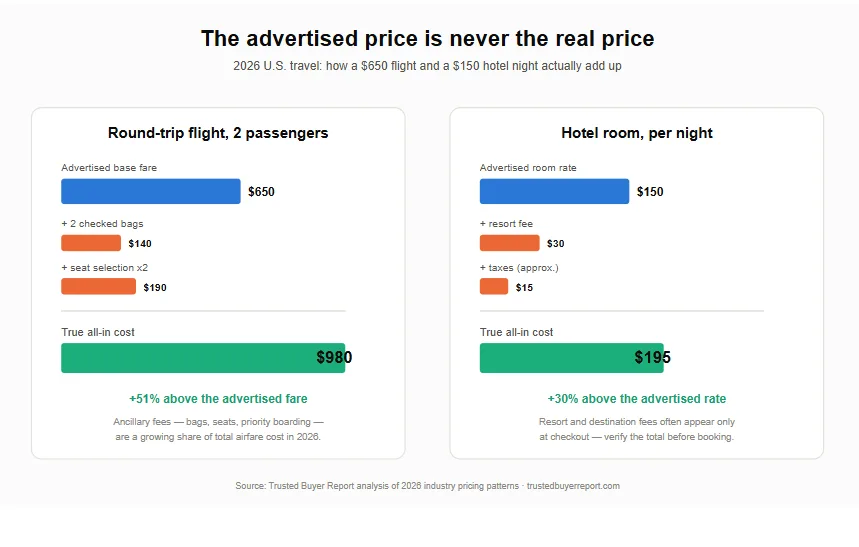
The single most common travel-budgeting mistake is confusing the advertised price with the actual cost. A $650 round-trip fare can become $980 once two checked bags and seat selection are added for two passengers. A hotel listed at $150 a night can total $195 after a $30 resort fee and taxes. These aren't edge cases in 2026 — they're standard practice across the industry.
Start every trip with a true all-in cost estimate before comparing options:
- Base airfare plus baggage fees plus seat selection
- Hotel room rate plus resort or destination fees plus taxes
- Ground transportation at both ends of the trip
- Meals and activities
- Travel insurance
Ancillary airline fees in particular are no longer minor line items. Engine.com reports that seat selection, baggage, and priority boarding will make up a larger share of total trip cost in 2026 than in previous years — for a family of four flying economy, that gap alone can reach $400–$800 on a single round trip.
Credit card data adds another layer worth taking seriously. NerdWallet found that in 2025, 74% of summer travelers who paid with a credit card didn't pay off the balance immediately, and 35% still carried an unpaid balance when surveyed. Travel debt is real, and the interest it generates is an effective add-on cost to every trip — budget for the full cash price, not the minimum monthly payment.
Two budgeting approaches work well, depending on your style:
- Top-down: Set a total budget first (say, $4,000 for a family of four), then allocate roughly 35% to flights, 40% to accommodation, and 25% to everything else. Good for travelers prone to scope creep.
- Bottom-up: Price each component independently, then sum and adjust. Tends to produce more accurate totals, since it isn't anchored to a round number.
Whichever method you use, build in a 10–15% buffer for delays, itinerary changes, or surprises.
When should you book flights in 2026?

Quick answer: Domestic flights price best 4–8 weeks before departure; international flights, 3–6 months out — and on both, prices are trending up in 2026, so waiting carries more risk than it did a few years ago.
The most persistent myth in flight shopping is that fares follow a predictable pattern — that Tuesdays are cheapest, or that prices always dip six weeks out. In 2026, dynamic pricing algorithms have made those rules of thumb unreliable. What the data does support is a directional truth: fares are rising, not falling, and betting on a price drop is increasingly a losing bet.
Engine.com projects 2026 airfares will rise 2–3%, driven by fuel costs and sustained demand — neither of which is likely to reverse in the short term.
General booking windows that still hold up:
| Route type | Best booking window |
|---|---|
| Domestic | 4–8 weeks before departure |
| International | 3–6 months before departure (book earlier for high-demand summer routes to Europe/Asia) |
Use fare-tracking tools — Google Flights' price tracking, Hopper's price prediction, or Skyscanner's fare alerts — to watch specific routes without committing prematurely. These tools surface price history and trend direction, which is far more useful than a single snapshot.
When comparing fares across platforms, always compare total cost, not base fare. A $320 basic economy ticket can become $520 after a checked bag and seat assignment, while a $480 standard fare that already includes a bag and seat selection ends up cheaper. Most booking platforms show a fare breakdown, but it's rarely the default view — look for it before you compare.
Is a refundable flight worth the extra cost? According to NerdWallet, 67% of Americans say yes. If your trip carries any real uncertainty — work commitments, health considerations, family logistics — the premium for a refundable or changeable fare is often justified, since an abandoned non-refundable fare loses 100% of its value.
One 2026-specific note: global events create sharp price spikes on specific city pairs and dates. If your destination is hosting a major convention, sporting event, or international summit during your travel window, book earlier than you otherwise would — prices on those dates can run 40–80% above the surrounding days on the same route.
Hotel booking in 2026: direct, OTA, or short-term rental?

Hotel pricing in 2026 has a structural quirk worth understanding: rates are widely described as "stabilizing" after the surges of 2023–2024 — but stabilizing at a higher level while still growing 2–4% a year. That isn't stability in any consumer-meaningful sense; it means prices are high and getting slightly higher, not returning to pre-surge baselines.
Direct booking vs. OTA doesn't have one universal answer, but it does have a framework. Hotels typically offer rate-match guarantees and loyalty point accrual for direct bookings. If you're enrolled in a hotel loyalty program — Marriott Bonvoy, Hilton Honors, World of Hyatt — booking direct almost always wins over time, since points compound and offset future stays. OTAs like Expedia, Booking.com, and Hotels.com sometimes undercut direct rates with bundled discounts, particularly for non-loyalty travelers booking one-off stays. Check both before committing.
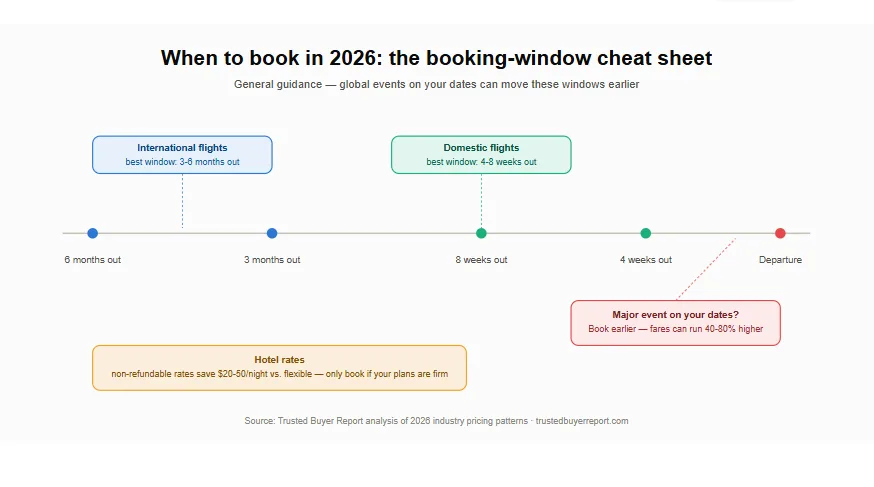
Rate type is one of the highest-leverage decisions in hotel booking. Non-refundable rates typically save $20–$50 per night versus flexible rates — $100–$250 over a five-night stay — but only if the trip proceeds exactly as planned. If there's any real chance of cancellation, the flexible rate is the financially rational choice, especially without travel insurance, since a cancelled non-refundable booking forfeits the full amount.
Resort fees deserve specific attention. These charges — commonly $25–$50 per night at resort properties, and increasingly at urban hotels too — are often invisible in OTA search results until checkout. A $150/night listing can become $195/night after a $30 resort fee plus taxes. Always verify the true total on the property's own website or at the final checkout screen before booking.
Statista reports that 40% of global hotel chains planned to use AI agents in 2026. One practical side effect of AI-driven dynamic pricing is that rates for the same room and dates can swing $30–$80 depending on when you check. Comparing morning vs. evening prices occasionally surfaces real savings — it isn't a reliable strategy, but it costs nothing to try.
Independent/boutique vs. chain: Boutique and independent hotels can offer stronger value and more distinctive stays in many markets, particularly Europe and Southeast Asia, at the cost of consistency and loyalty benefits. Frequent travelers who accumulate points get compounding value from chains; once- or twice-a-year travelers who prioritize experience over points should seriously consider independent properties.
Vacation packages vs. booking independently: which saves more?

Quick answer: Packages tend to win for all-inclusive resort trips and cruise-and-stay combos; independent booking tends to win when you have loyalty points, flexible plans, or multi-city itineraries.
Package deals — flight plus hotel bundled through a single platform — can deliver genuine savings, since OTAs negotiate bulk rates with airlines and hotels and sometimes pass part of that discount along. But the savings aren't always transparent, and the trade-offs are real.
Packages tend to offer the best value for:
- All-inclusive resort destinations (Cancun, Punta Cana, Jamaica), where hotel and flight are the primary costs
- Cruise-and-stay combinations
- Trips where ground transport is bundled in
For a family of four booking an all-inclusive resort, a package through Expedia or Apple Vacations can save $300–$600 versus booking each piece separately — but verify this by pricing both options rather than assuming the package wins.
Independent booking tends to be better when:
- You have airline or hotel loyalty preferences
- One component is already covered (e.g., you're using hotel points)
- Your itinerary is flexible and you want to adjust pieces independently
- You're visiting a city where you'll use multiple hotels or accommodations
A solo traveler holding 40,000 Hyatt points who books a bundled package forfeits those points entirely.
The risk profile of packages differs from independent booking, too: if the flight portion is cancelled, the hotel booking downstream may be affected, and refund terms across bundled components tend to be more complex than single-component cancellations. Read the cancellation terms of any package — specifically what happens if one piece is disrupted — before purchasing.
Phocuswright's Travel Forward 2026 report also covers the short-term rental sector as a third option. For groups booking five nights or more, a Vrbo or Airbnb rental can undercut hotel pricing while offering more space and a kitchen — at the cost of less consistency, no loyalty benefits, and variable cancellation policies. For a family of four on a week-long beach trip, a rental with a kitchen can cut food costs by $200–$400 compared with a hotel stay — a real number worth modeling before you decide.
Luxury travel in 2026: what's new, and is it worth it?

Luxury travel in 2026 isn't simply "more expensive hotels" — it's a structural expansion of what the category means, driven by hotel brands entering the cruise market and rail operators extending their networks.
According to Condé Nast Traveler, Four Seasons launched its first cruise ship, the Four Seasons I, in March 2026: a 679-foot vessel with 95 suites, starting at roughly $15,000 per suite for a week-long sailing. The ship includes an omakase restaurant and a water-sports marina — but food and drinks are not included in the fare, a meaningful additional cost at that price point. It's a narrow-market product, but it sets a new benchmark for hotel-branded ocean travel.
In June 2026, Orient Express launched the Orient Express Corinthian, a 721-foot ship with 54 suites, starting at €11,000 (roughly $12,000) per suite for a two-night voyage — about $6,500 per night per suite. At that rate, this isn't a value proposition, it's an experience proposition. Before booking any ultra-luxury product, ask: what specific elements of this experience can't be replicated at a lower price point?
On land, Belmond — the LVMH-owned leader in luxury rail — continues expanding its global footprint in 2026. Rail travel offers a different rhythm than cruising: slower, more scenic, with a fixed itinerary that removes decision fatigue. Travelers who find ocean cruises unappealing can look at Belmond's trains (the Venice Simplon-Orient-Express, Andean Explorer, British Pullman, among others) as the land-based equivalent of these new luxury products.
Condé Nast Traveler also notes a hyper-personalization trend at high-end properties, where consultations and genealogy-based trip planning mean "trips now start with a family tree" — the service itself, not just the property, is becoming the differentiator.
Phocuswright identifies loyalty and luxury as a converging trend in 2026. Premium travel credit cards — American Express Platinum, Chase Sapphire Reserve, and similar products — offer benefits (hotel upgrades, lounge access, travel credits, Fine Hotels & Resorts access) that can offset meaningful portions of a luxury trip's cost. Before paying full retail for premium amenities, audit the card benefits you may already have.
Do you need travel insurance in 2026?
Quick answer: If any meaningful share of your trip is prepaid and non-refundable — a vacation package, a non-refundable hotel rate, an international flight, a cruise, or a luxury booking — yes. The math is straightforward: a policy typically costs 4–10% of your trip cost, while walking away from a non-refundable trip costs you 100% of it.
Travel insurance spending is rising sharply alongside the booking trends covered earlier in this guide. According to travel insurance comparison site Squaremouth, the average comprehensive policy in 2026 costs roughly 6% of a traveler's insured trip cost, or about $307 per policy for a typical 15-day trip — works out to around $20 a day of coverage. NerdWallet's analysis puts the average closer to 7%, with a realistic range of 4–10% depending on provider, age, and coverage level. For context: insuring a $3,000 trip typically runs $120–$300; insuring a $10,000 trip — the range where many of the vacation packages and luxury bookings discussed earlier in this guide land — typically runs $400–$1,000.
Age and trip cost both move the price more than people expect. Forbes Advisor's analysis of 58 plans found that a 30-year-old insuring a $5,000 trip pays roughly $197, while a 75-year-old insuring the same trip pays $552 or more — age affects the premium more than the trip cost does at that point. International trips to destinations with weaker medical infrastructure also carry a premium of up to 45% over low-risk destinations like Canada or Western Europe.
What a standard comprehensive policy covers:
| Coverage | What it pays for |
|---|---|
| Trip cancellation | Typically reimburses 100% of prepaid, non-refundable costs if you cancel for a covered reason before departure |
| Trip interruption | Reimburses the unused portion of your trip, plus reasonable costs to get home, if you have to cut the trip short |
| Trip delay | Covers meals, hotel, and essentials during a covered delay — commonly $300–$1,000+ in benefits |
| Emergency medical | Covers treatment abroad, where most domestic U.S. health plans (including Medicare) provide little or no coverage — limits typically range $50,000 to $1 million+ |
| Emergency evacuation | Covers medical transport to the nearest adequate facility, which can run into six figures without coverage |
| Baggage delay/loss | Reimburses essentials and replacement items; this benefit is secondary to your homeowners or renters policy, not a full replacement for it |
What it doesn't cover by default — and the add-ons that close the gap:
A standard policy only reimburses cancellations for a specific list of "covered reasons" (illness, a death in the family, severe weather, and similar events) — voluntary changes of mind aren't on that list. Two optional upgrades are worth understanding before you buy:
- Cancel For Any Reason (CFAR): Lets you cancel for a reason your base policy doesn't list and still get back 50–75% of your insured trip cost. It must typically be purchased within 10–21 days of your first trip deposit, and it adds roughly 40–50% to the premium — Squaremouth reports the average CFAR policy in 2026 cost travelers $672.
- Pre-existing condition waiver: Waives the standard exclusion for medical conditions you had before buying the policy — but only if purchased inside the same early time-sensitive window, generally 14–21 days after your first payment.
If either of these matters to your trip, buy your policy early. Waiting past the window doesn't usually raise the price, but it does close off CFAR and pre-existing condition eligibility for good.
When travel insurance is worth it, based on this guide's framework:
- You booked a non-refundable hotel rate or non-refundable airfare (see the flight and hotel sections above) and there's any real chance your plans change.
- You booked a vacation package, where this guide already noted that refund terms across bundled components are more complex than single-component cancellations.
- You're traveling internationally, where standard U.S. health insurance plans typically provide minimal or no coverage for treatment abroad.
- You booked a luxury trip — a cruise suite, a rail journey, an all-inclusive resort — where the prepaid amount at risk is large enough that even a 6% premium is small next to a full loss.
- You have a pre-existing medical condition or are traveling at an age where premiums run higher, in which case shopping multiple providers (rather than buying the first quote) matters more, since age multipliers vary significantly by insurer.
If none of the above applies — a fully refundable domestic trip with no prepaid non-refundable components — a standalone policy is harder to justify, and the protections built into many travel credit cards (see the Luxury Travel section above) may already cover the basics.
Frequently asked questions
Will flight and hotel prices drop later in 2026? The data points the other way. Engine.com projects airfares up 2–3% and hotel rates up 2–4% for the year, and neither trend shows signs of reversing — waiting is a riskier strategy in 2026 than it was a few years ago.
Is it worth paying more for a refundable hotel or flight rate? It depends on how certain your plans are. 67% of Americans say refundable flights are worth the premium, and the same logic applies to flexible hotel rates: if there's a real chance your trip changes, the flexible rate protects against losing 100% of a non-refundable booking.
Are vacation packages actually cheaper than booking separately? Sometimes — mainly for all-inclusive resorts and cruise-and-stay trips, where packages can save $300–$600 for a family of four. Always price both options before assuming the package wins, since loyalty points and flexible itineraries often make independent booking the better deal.
What are resort fees, and why don't I see them until checkout? Resort fees are mandatory nightly charges ($25–$50 is typical) that many OTAs don't display in initial search results. Always check the property's own site or the final checkout screen for the true nightly total before booking.
How much does travel insurance cost in 2026? Most travelers pay 4–10% of their total trip cost, with the average comprehensive policy running about 6–7% (around $307 for a typical 15-day trip, per Squaremouth). A $5,000 trip typically costs $200–$350 to insure, depending on your age and the destination.
Does travel insurance cover a trip I just change my mind about? Not by default. Standard policies only reimburse cancellations for a specific list of covered reasons (illness, family emergency, severe weather, and similar). If you want the flexibility to cancel for any reason, you need to add a Cancel For Any Reason (CFAR) upgrade — typically within 10–21 days of your first trip deposit — which reimburses 50–75% of your insured cost and adds roughly 40–50% to the premium.
Key takeaways before you book
- Price the true all-in cost, not the sticker price, on every flight and hotel — bags, seat selection, and resort fees routinely add 30–50%.
- Book domestic flights 4–8 weeks out, international 3–6 months out — and earlier still if a major event is on your dates.
- Choose non-refundable rates only when your plans are firm. The savings are real ($20–$50/night on hotels), but a cancelled non-refundable booking loses 100% of its value.
- Price packages against booking separately before assuming the bundle is cheaper — and never bundle away loyalty points you'd rather keep.
- Insure what you'd lose. If a meaningful share of your trip is prepaid and non-refundable, a 4–10% premium is cheap insurance against losing all of it.
This article was researched and drafted with AI assistance, then reviewed and fact-checked by our editorial team before publishing. Trusted Buyer Report may earn a commission from purchases made through links on this page. How we review · How we use AI