

This guide was researched and drafted with AI assistance, then reviewed and fact-checked by our editorial team before publishing. Recommendations are based on manufacturer specifications, expert sources, and verified customer feedback — not hands-on testing by Trusted Buyer Report. We may earn a commission when you use our links to make a purchase. Full disclosure →
Quick Takeaways
- The U.S. pet market is projected to reach $272.6 billion in 2026 — more options, more marketing noise, not more quality.
- Pet food is the single most important purchase decision; format matters less than the AAFCO adequacy statement on the label.
- For dogs, the VOHC seal is the only dental product certification worth trusting; OTC joint supplements have weaker evidence than vet-prescribed options.
- Cats are obligate carnivores — dietary moisture is a clinically relevant factor, not a trend.
- Small pets are the most underserved segment; habitat size and species-appropriate nutrition matter far more than brand names.
- In pet tech, GPS trackers, automated feeders, and water fountains have the strongest real-world utility. Most "smart" toys do not.
Why Picking Good Pet Products in 2026 Is Genuinely Hard
Here's the uncomfortable truth: a market worth over a quarter of a trillion dollars does not automatically produce better products. It produces more products — and more marketing.
According to the American Pet Products Association (APPA), U.S. pet industry spending is projected to reach $272.6 billion in 2026, up from $261.4 billion in 2025. The APPA's 2025 National Pet Owners Survey also found that 95 million U.S. households now own at least one pet — meaning pet product marketing must simultaneously serve first-time hamster owners, performance sport dog handlers, and multi-cat households. It does this with the same "all-natural, vet-approved" language regardless of whether the formulation or materials actually justify it.
The signals consumers traditionally rely on — price tier, packaging language, brand recognition — have become unreliable. Packaged Facts' 2026–2027 Pet Market Outlook describes a market under "dual demand for both premiumization and affordability," where the middle-ground segment is shrinking. The word "premium" now appears at every price point.
This guide does not give you a ranked product list. It gives you an evaluation framework for each pet type and product category — so you can make a confident decision regardless of which brand happens to be trending.
Here's what we'll cover:
- How the 2026 pet market is structured and what that means for where you shop
- Dog product evaluation: food formats, gear, and OTC health products
- Cat product evaluation: the moisture question, enrichment, and litter
- Small pet and exotic pet needs (the most under-covered segment)
- 2026 pet food trends: what the nutrition shift actually means for your budget
- Pet tech: which "smart" products deliver real value and which are gimmicks
- A practical decision framework to use before any pet product purchase
How the 2026 Pet Market Is Structured — and What It Means for Shoppers
Understanding where the marketing pressure is heaviest helps you shop more strategically.
The APPA breaks 2026 projected U.S. pet spending across four categories:
| Segment | 2026 Projected Spend |
|---|---|
| Pet food & treats | $58.7 billion |
| Veterinary care & product sales | $38.4 billion |
| Supplies, live animals & OTC medicine | $31.6 billion |
| Other services (grooming, boarding, insurance, training) | $11.9 billion |
Food is the largest category by a wide margin — which is exactly why the pet food aisle is the most confusing place to shop. Every dollar of that $58.7 billion represents a brand fighting for your attention.
Where You Buy Shapes What You Get
Future Market Insights identifies the main U.S. sales channels as specialty pet stores, supermarkets, online retailers, veterinary clinics, and direct-to-consumer brands. Each has real tradeoffs:
Specialty pet stores (Petco, PetSmart, Pet Supplies Plus) stock a wider range of product tiers and often carry brands with stricter ingredient standards than grocery store shelves. Staff training varies by location, but the overall selection is more curated. You can read independent store reviews for Chewy, PetSmart, and Petco on Trusted Buyer Report.
Supermarkets prioritize shelf-stable, high-volume products. The ingredient quality floor is lower, and prescription or specialty therapeutic diets are rarely available here.
Online retailers and DTC brands offer convenience and often lower per-unit cost, but you lose the ability to inspect packaging freshness dates, and prescription diet verification is less rigorous than through a vet clinic.
Veterinary clinics carry therapeutic and prescription diets unavailable elsewhere. If your pet has a diagnosed health condition — kidney disease, IBD, urinary crystals — this channel is worth the higher price. The formulations are clinically validated in ways OTC "health support" products are not.
One broader market shift worth noting: dogs account for roughly 50% of pet market revenue per Future Market Insights, but cat-focused products are the fastest-growing segment by household adoption. That is actively reshaping what manufacturers are investing in — and it means cat product quality has meaningfully improved over the past three years.
Dog Products: What to Prioritize Across Food, Gear, and Health

Dog Food: Format Matters Less Than You Think
Dog food is the most marketed pet purchase and the most consequential. The format debate — dry kibble vs. wet vs. fresh vs. raw — generates enormous online discussion. But here's what the data actually shows: format matters less than formulation quality and life-stage appropriateness.
That said, format trends in 2026 are worth understanding. Clarkston Consulting's 2026 Pet Care Industry Trends report found that refrigerated and frozen dog food grew sales by 13.4% compared to -0.2% growth for the total dog food category. Freshpet has expanded its premium all-natural line, and major CPG companies including General Mills and Nestlé Purina have entered the fresh pet food space.
More competition generally benefits consumers — but rapid category growth also attracts underdeveloped products riding the trend. Here's how to evaluate any dog food format:
The one signal that matters most: An AAFCO nutritional adequacy statement specifying your dog's life stage. This is the minimum credible signal that a food is complete and balanced, not just well-photographed. If a bag lacks this statement, move on.
A practical middle ground: Kibble-plus or gently cooked toppers. If you want to improve your dog's nutrition without committing to the cost and handling requirements of full fresh feeding, adding a topper of gently cooked food to a high-quality dry base is a legitimate approach. The key is that the base kibble carries that AAFCO statement.
Air-dried food occupies an interesting middle position between raw and kibble. The low-temperature drying process preserves more heat-sensitive nutrients than extrusion while eliminating raw food's handling and storage complexity. Brands like Ziwi Peak and Addiction Foods operate here. The tradeoff: air-dried food runs approximately $8–$12 per day for a medium-sized dog, compared to $2–$4 for a quality kibble — a meaningful difference at scale.
Dog Gear: Fit and Durability Beat Brand Every Time
For harnesses, collars, and leashes, the right fit for your specific dog's body structure matters more than brand recognition.
A no-pull harness only works if it fits your dog's chest and shoulder proportions — a broad-chested Bulldog and a deep-chested Greyhound require completely different harness geometries. Look for products that publish a detailed size chart based on girth measurements, not just weight ranges. Weight-based sizing is a common shortcut that leads to poor fit and returns.
Materials for longevity:
- Nylon webbing degrades faster than biothane in wet or muddy conditions
- Hardware quality (D-rings, buckles) is typically the first failure point on budget gear — inspect the gauge of metal hardware before purchasing
- Reflective stitching on leashes and harnesses is a genuine safety feature, not a marketing add-on
Dog Health and OTC Products: Three Categories, One Rule
Flea/tick prevention, dental products, and joint supplements are the three OTC categories where marketing claims diverge most sharply from clinical evidence.
Dental products: The Veterinary Oral Health Council (VOHC) seal is the only independent third-party certification worth trusting. A product displaying the VOHC seal has been tested and shown to reduce plaque or tartar. A product labeled "supports dental health" without the seal has not cleared that bar. This distinction alone filters out the majority of dental products on the shelf.
Joint supplements: Glucosamine and chondroitin supplements are widely sold but have mixed clinical evidence in dogs. If your dog has diagnosed osteoarthritis, a veterinary-prescribed NSAID or a product like Librela (licensed in the U.S. in 2023) has a substantially stronger evidence base than any OTC supplement. Use OTC joint products as supportive additions alongside veterinary care — not as primary treatment.
Flea and tick prevention: OTC topicals and collars vary widely in efficacy and active ingredient safety profiles. Prescription-grade isoxazoline class products (Bravecto, NexGard, Simparica) have the strongest published efficacy data for most regions of the U.S. Consult your vet to match prevention to your local parasite pressure.
Cat Products: Why Cats Finally Have a Market Built Around Their Actual Biology
For decades, cats were treated as an afterthought in pet product design — smaller versions of dog products or generic designs that ignored feline biology. That is changing.
Packaged Facts reports that cat households grew 4.1% from 2019 to 2025 while dog households declined 4.2% over the same period. Approximately 45.3 million U.S. households now own at least one cat, according to data cited by GM Insights. The industry has noticed — cat-first product design is now a genuine investment priority.
For a deep dive into the cat food decision specifically, see our companion guide: Best Cat Food 2026: Wet vs Dry — Vet Expert Analysis.
Cat Food: The Moisture Question Is Not a Trend

Cats are obligate carnivores with a naturally low thirst drive — they evolved to obtain most of their hydration from prey. Dry kibble typically contains 8–10% moisture, which runs counter to this biology. For cats with a history of urinary tract issues, struvite crystals, or kidney disease, increasing dietary moisture through wet food, a combination approach, or a pet water fountain is not a lifestyle preference. It is a clinically supported recommendation.
When evaluating any cat food:
- Check the guaranteed analysis for moisture content
- Look for named protein sources (chicken, salmon, turkey) rather than generic "meat by-products"
- Understand life stage labeling: a food formulated for "all life stages" must meet the nutritional requirements of kittens, which means it may be calorie-dense for an adult indoor cat prone to weight gain
Cat Enrichment: The Underrated Category
Puzzle feeders are among the highest-value, lowest-cost enrichment tools available. Feeding a cat from a puzzle feeder rather than a bowl slows eating, reduces boredom-related behaviors, and engages natural foraging instincts. Entry-level options from brands like Doc & Phoebe's or Nina Ottosson cost $15–$35 and have a meaningful positive impact on behavioral health.
Outdoor enclosures (catios) address a genuine behavioral and safety problem simultaneously. A cat that wants outdoor access but lives near traffic or wildlife benefits from a well-constructed catio that provides fresh air and physical challenge without the risks of free roaming. As Gingr's 2026 pet industry trends analysis notes, catios are increasingly customizable — ranging from window-mounted boxes to elaborate multi-level garden structures.
Litter and Litter Box Design: What Actually Matters
Clumping clay litter remains the most widely used format because it works reliably. Key signals when evaluating:
- "99% dust-free" labeling matters if you or your cat has respiratory sensitivities
- Silica gel litters last longer between full changes but have a different texture that some cats reject — transition slowly if switching
- Self-cleaning automated litter boxes (the Litter-Robot 4 at ~$700 being the most discussed) are a genuine convenience for multi-cat households, but require a cat that is comfortable with mechanical noise and movement. Not all cats adapt. Plan for a transition period before committing.
A common oversight: litter box size. Most commercially sold boxes are too small for adult cats. A correctly sized box should be at least 1.5 times the length of your cat from nose to tail base.
Small Pet Products: Real Needs That Are Consistently Ignored

Rabbits, guinea pigs, hamsters, gerbils, birds, reptiles, and fish collectively represent a significant share of U.S. pet ownership — yet they receive a fraction of the consumer-facing product guidance available for dogs and cats.
Future Market Insights tracks birds, fish, small mammals, and reptiles as distinct market segments. The APPA's research pipeline now includes dedicated quarterly reports on fish, reptiles, birds, and small animals — a signal the industry is beginning to take these segments more seriously. But that research doesn't yet translate into widespread product quality improvement at the retail level.
Habitat Quality: The Most Consequential Purchase for Small Pets
For small mammals, birds, and reptiles, habitat quality directly determines lifespan and behavioral health — more so than any other product category.
- A Syrian hamster requires a minimum of 600 square inches of unbroken floor space. Most cages sold in pet stores fall short, including many products marketed specifically for hamsters.
- Wire-bottom cages cause bumblefoot (pododermatitis) in rabbits and guinea pigs. Solid-floor enclosures with appropriate substrate are not optional — they are a health requirement.
- Reptile enclosures require species-specific temperature gradients, UVB lighting, and humidity control. A bearded dragon and a ball python have fundamentally different environmental needs. Invest in a thermostat-controlled heating system and a UVB meter to verify output — UVB bulbs degrade before they visibly dim, and an expired bulb is a common cause of metabolic bone disease in reptiles.
Nutrition for Small Pets: Where Pet Store Products Often Fail
Generic "small animal mix" foods sold in supermarkets are among the most problematic products in the pet industry. These mixes typically contain seeds, dried corn, and colorful pellets that are inappropriate for rabbits (who need 80% hay by volume) and guinea pigs (who cannot synthesize Vitamin C and require fresh leafy greens daily).
A rabbit fed primarily on commercial pellets and seed mixes is at elevated risk for GI stasis and dental disease. The right species-appropriate diet is typically less expensive than premium branded mixes — and dramatically more beneficial.
For fish: Automated feeders prevent overfeeding — the leading cause of aquarium water quality problems. A programmable feeder like the Eheim AutoFeeder ($40–$60) and a basic digital water test kit give you actionable data instead of guesswork.
Pet Food Trends in 2026: What the Nutrition Shift Means for Your Budget

Pet food and treats are projected at $58.7 billion in 2026 U.S. sales. Fortune Business Insights projects the pet food segment to hold a 52.60% share of the broader pet care market, growing at a 7.00% CAGR through 2034.
The most important structural shift: the middle-ground price segment is shrinking. Clarkston Consulting is direct about this — brands are choosing between premium and budget lanes. For buyers, the $45–$65 range for a 25-pound bag of dog food — historically the "good but not extravagant" zone — is becoming less populated with genuinely well-formulated options.
How to Evaluate Any Pet Food Label (Dogs or Cats)
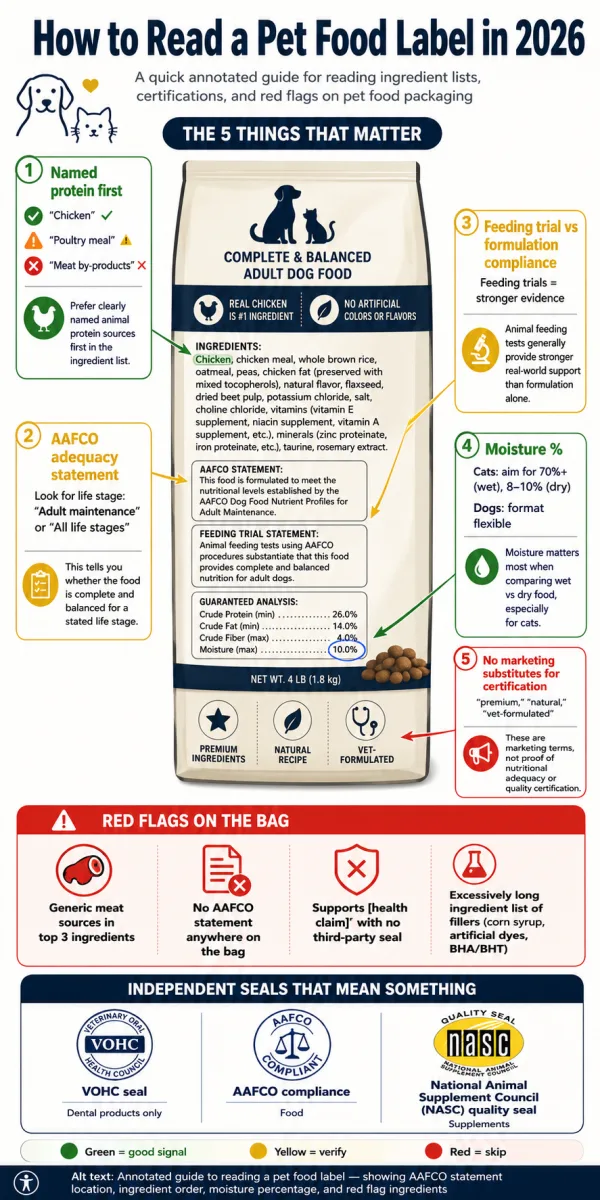
Look for these three signals in order:
- Named protein source as the first ingredient — "chicken," "salmon," "turkey," not "poultry meal" or "meat by-products"
- AAFCO nutritional adequacy statement specifying life stage — "complete and balanced for adult maintenance" or "all life stages"
- Published batch testing or feeding trial history — brands that disclose this are demonstrating accountability that "premium" labeling alone does not
Transparency is becoming a real differentiator. Brands that publish third-party nutritional analysis, name their ingredient suppliers, and provide batch-specific testing results are meaningfully differentiated from the mass of premium-labeled competitors.
Pet Tech in 2026: Which Smart Products Are Worth It

The pet tech market is growing on the back of the broader "pets as family" mindset, according to GM Insights. But the category is new enough that marketing is well ahead of product maturity in many subcategories.
Here's a practical breakdown:
Pet Tech Worth Buying
GPS and activity trackers (Tractive, Fi Series 3, Whistle Go Explore): Genuinely useful for dogs that roam or are prone to escape. Real-time location data has a clear, verifiable use case. Battery life and subscription cost vary — factor both into total cost of ownership.
Automated feeders and timed dispensers: Valuable for regulated feeding schedules, weight management, and multi-pet households. A programmable feeder removes human inconsistency from meal timing. Solid options exist at $40–$120.
Pet water fountains: For cats especially, a circulating fountain encourages higher water intake, which is directly relevant to urinary health. Worth the $30–$80 investment for cats with a history of urinary issues.
Pet cameras with two-way audio (Furbo, Petcube): Provide genuine peace of mind for owners of anxious pets and a verified behavioral monitoring function. Not a primary welfare tool, but a useful supplement.
Pet Tech to Approach with Skepticism
Automatic laser toys and solo interactive devices: Behavioral research suggests that laser play without a physical "catch" can increase frustration in some cats. The research on whether automated toys meaningfully substitute for interactive play with a human is thin.
"Health monitoring" wearables for cats and small dogs: Sensor accuracy for smaller body weights is inconsistent, and the clinical utility of most consumer-grade vitals data without veterinary context is limited.
Smart treat dispensers with voice control: A convenience feature, not a welfare or health tool. The utility scales inversely with how much you're already home.
A Practical Decision Framework Before Any Pet Product Purchase
Here are five questions to apply before buying any pet product — particularly in the food, health, and habitat categories:
- Is there an independent certification or adequacy standard? (AAFCO for food, VOHC for dental, UL for electronics) — If yes, use it as your filter. If no third-party standard exists for the category, apply more skepticism to marketing claims.
- Is this species-appropriate? — Many products are designed for the market segment (dogs), not adapted for actual biological needs. A "small animal" product isn't automatically appropriate for your specific species.
- What is the ingredient source transparency? — Brands that name suppliers and publish batch tests are making a verifiable commitment. Brands that only offer "premium" language are not.
- What does the independent research say — not the brand's research? — For joint supplements, flea prevention, and dental products, clinical evidence exists and is publicly available. Check VetFolio or VOHC.org before defaulting to packaging claims.
- Does the product serve your pet's specific life stage and health status? — "All life stages" is a catch-all designed to broaden a product's market appeal. It may not be optimal for your adult indoor cat or senior dog.
Where to Buy Pet Products in the U.S.: Retailer Comparison
| Retailer | Best For | Potential Drawback |
|---|---|---|
| Chewy | Auto-ship savings, prescription diet access | No in-store browsing or same-day pickup |
| PetSmart | Grooming, vet services, in-store selection | Inconsistent staff training by location |
| Petco | Nutrition-focused product curation | Premium pricing on mid-tier products |
| Amazon | Price competition, selection breadth | Counterfeit risk; no prescription verification |
| Vet clinic | Prescription diets, clinical nutrition | Higher price, limited SKU range |
See our full store reviews: Chewy review · PetSmart review · Petco review. For a broader deal overview, browse the Pets category on Trusted Buyer Report.
Frequently Asked Questions
What is the most important thing to look for on a pet food label? The AAFCO nutritional adequacy statement, specifying your pet's life stage. This is the minimum credible signal that a food is complete and balanced. Without it, no other packaging language — "premium," "natural," "vet-formulated" — carries independent verification.
Is fresh or raw pet food better than kibble? Not universally. Fresh and raw diets offer potential benefits in moisture content and nutrient preservation, but also carry higher cost, handling requirements, and — for raw feeding — documented pathogen risks (Salmonella, Listeria). For most pet owners, a high-quality kibble with an AAFCO statement plus a moisture-rich topper is a practical and nutritionally sound approach.
Are pet subscription boxes worth it? It depends on your pet's profile. For high-chew dogs or cats with enrichment needs, well-matched subscription boxes can be excellent value. See our guide to the best pet subscription boxes in 2026 for a breakdown by pet type and box type.
Are expensive pet toys worth the price? For dogs, durability is the primary value driver — a $25 chew toy that lasts three months beats a $10 toy replaced weekly. For cats, novelty and interaction type matter more than price. The $15–$35 puzzle feeder category consistently outperforms expensive electronic toys on behavioral benefit per dollar.
How do I know if a pet health product is clinically validated? For dental products, check VOHC.org. For joint and mobility supplements, consult the Canine Arthritis Resources and Education (CARE) database or your veterinarian. For flea/tick products, your vet can match prevention to your regional parasite data — something no product label does for you.
Reviewed by the Trusted Buyer Report editorial team. This article was researched and drafted with AI assistance, then reviewed and fact-checked by a human before publishing. Our reviews are research-based — we synthesize manufacturer specs, independent sources, and verified buyer feedback, and cite our sources. We don't accept payment for rankings. How we review → · How we use AI →