
Researched and drafted with AI assistance, fact-checked by our editorial team before publishing. This guide is based on publicly available industry reports, regulatory publications, and verified consumer data — not hands-on financial product testing. We may earn a commission if you purchase through links on this page. Full disclosure →
TL;DR — What You Need to Know in 60 Seconds
- Credit cards have shifted from fixed reward categories to AI-personalized reward structures that adapt to your real spending. If your card still asks you to fit its categories, it's behind.
- Insurance now prices you continuously — via telematics, wearables, and property sensors — instead of once a year. Good behavior is rewarded faster. Bad periods hit faster too.
- Investing has moved from quarterly robo-advisory to real-time autonomous AI agents that execute harvesting, rebalancing, and hedging without waiting for your sign-off.
- Cybersecurity is now a product evaluation criterion, not just an IT concern. The weakest app connected to your bank account is your biggest vulnerability.
- The biggest risk in 2026: carrying products built for a 2022 market because no one told you they were outdated.
Your credit card renewal notice arrived. Your auto insurance premium jumped — again — with no explanation. A friend mentioned their robo-advisor started executing trades on its own and you're not sure if your brokerage does that.
Here's the uncomfortable reality: the financial products most Americans are holding right now were designed for a market that no longer exists. The shift from 2024 to 2026 isn't cosmetic. AI moved from chatbots into core decisioning. Insurance underwriting went from annual snapshots to continuous behavioral models. Investment platforms crossed from rule-based rebalancing into autonomous execution.
This guide maps exactly what changed across the three pillars of personal finance — credit cards, insurance, and investing — and gives you a framework to evaluate whether what you currently own still works in your favor.
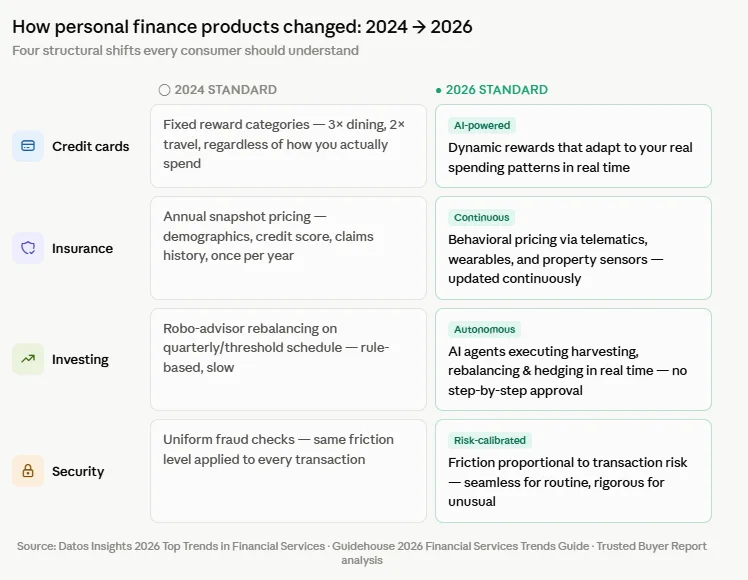
How Credit Cards, Insurance & Investing Changed: 2024 vs. 2026
| Category | 2024 Standard | 2026 Standard |
|---|---|---|
| Credit Cards | Fixed reward categories (3x dining, 2x travel) | AI-adjusted dynamic rewards that shift with real spending |
| Insurance | Annual snapshot underwriting — demographics + credit score | Continuous behavioral pricing via telematics, wearables, sensors |
| Investing | Robo-advisor rebalancing on quarterly/threshold schedule | Autonomous AI agents executing harvesting, rebalancing, hedging in real time |
| Fraud Security | Uniform friction on all transactions | Risk-calibrated friction — proportional to the actual threat signal |
| Regulation | General data privacy frameworks (GDPR, CCPA) | AI-specific explainability requirements + consumer redress rights for algorithmic decisions |
According to Datos Insights' 2026 Top Trends in Financial Services, institutions now compete on experience delivery as much as product features — with hyperpersonalization, friction-right security, and expanded advisory capabilities separating leaders from followers across banking, insurance, and wealth management. That gap shows up directly in what consumers receive.
The Three Forces Driving Every Change in Your Financial Products

Three structural shifts explain almost everything that has moved in consumer finance since 2024. Once you understand them, you can anticipate what's coming next rather than react to it.
1. AI Crossed a Category Line — From Information to Execution
The AI operating in financial services today is not the chatbot that answered balance questions in 2022. Guidehouse's 2026 Financial Services Trends Guide puts it directly: "AI is moving into core systems, digital currencies are changing how money moves, and cyber threats aren't slowing down."
Autonomous agents — systems that execute financial decisions rather than just informing them — are now live at leading institutions. An autonomous agent managing a brokerage portfolio can execute a tax-loss harvest, rebalance across asset classes, and adjust a currency hedge within a single market session, without pausing for human approval at each step.
The institutions that treated AI as an experimental layer on top of legacy infrastructure are now measurably behind. That gap shows up in your actual product: pricing accuracy, reward personalization, fraud response, and claim processing speed.
Moody's May 2026 research specifically identifies AI as reshaping credit risk assessment — which has direct downstream effects on the interest rates and credit limits you receive. If your lender is still using pre-2022 scoring models, you may be paying a rate that reflects their analytical lag, not your actual risk.
2. Cybersecurity Became a Consumer Problem, Not Just a Bank Problem
The same AI capabilities improving financial products are being weaponized against them. Deepfake voice fraud, AI-generated phishing at scale, and credential-stuffing attacks moved from theoretical threat to documented 2025–2026 reality.
This changes how you should evaluate financial products. A card with a 2% reward rate but weak security infrastructure exposes you to losses that no reward program can offset. Security quality is now a legitimate product selection criterion — not just an IT department concern.
Here's what that means practically: the fitness app connected to your health insurer, the budgeting tool with read access to your checking account, and the browser extension that autofills payment details are all potential entry points. Attackers map the chain of connected services to find the weakest link.
3. Regulation Is Catching Up — and Creating New Rights You Should Know About
Regulatory bodies in the US and EU have responded to AI-driven financial decisions with new frameworks requiring explainability and consumer redress. In practical terms: if a credit card issuer uses an AI model to reduce your credit limit, or an insurer uses behavioral data to increase your premium, you now have a stronger basis — and in some jurisdictions a legal right — to request an explanation and formally challenge the decision.
Knowing this before you need it matters. Most consumers don't ask because they don't know they can.
Credit Cards in 2026: What the Personalization Era Means for You

The core logic of credit card selection has changed. In 2020, you matched your spending profile to a fixed reward category — heavy restaurant spending meant you picked the highest dining multiplier. That logic still applies at a basic level. But the best cards in 2026 don't require you to fit their categories. Their categories fit you.
According to Datos Insights' 2026 trends analysis, hyperpersonalization is now a primary competitive differentiator in banking and credit. Leading issuers use spending data to dynamically adjust reward rates — a cardholder who shifts from frequent travel to primarily grocery and pharmacy spending will see their reward structure update accordingly, rather than earning suboptimal rates in categories they no longer use.
What "Friction-Right Security" Actually Feels Like
Friction-right security is worth understanding because it directly affects your daily card experience.
Under this model: a $4 coffee at a merchant you visit weekly generates no friction — no confirmation prompt, no SMS. A $1,400 electronics purchase at a new merchant in an unfamiliar city triggers multi-factor verification. The security layer scales with the actual risk signal.
This contrasts with older uniform-friction models that either blocked legitimate transactions too aggressively or applied the same light-touch verification to genuinely suspicious activity. If your current card still generates false declines on routine purchases, or fails to catch genuinely unusual transactions, that's a signal the issuer has not modernized its fraud infrastructure.
How Annual Fees Have Bifurcated
The fee structure in 2026 has split sharply in two directions:
Ultra-premium tier (Amex Platinum, Chase Sapphire Reserve) has increased fees while adding AI-curated benefit packages that adapt to cardholder behavior. Both cards now include benefit optimization tools that help cardholders extract value from credits they previously ignored. The math works — if you use the benefits.
Mid-tier segment ($95–$150 annual fee) has moved the opposite direction. Competition among Capital One, Citi, and Discover has pushed this tier toward better baseline rewards with less complexity. For cardholders who don't travel frequently enough to justify premium fees, the mid-tier market in 2026 is genuinely competitive.
No-fee cards have also improved meaningfully. The gap between a good no-fee card and a mid-tier card is narrower than it was three years ago.
5 Questions to Ask Before Choosing a Card in 2026
- Does the reward structure adapt to your actual spending, or does it require you to change behavior to earn optimally?
- What data does the issuer collect for personalization, and what are your opt-out rights?
- If an AI model changes your credit limit or APR, what's the recourse process — and how long does it take?
- Does the card offer real-time fraud alerts with transaction-level detail, not just daily summaries?
- Is there full digital wallet integration (Apple Pay, Google Pay, Samsung Pay) with tokenization?
Warning signs a card hasn't kept pace: static reward categories with no personalization mechanism, no explanation process for limit changes, no real-time transaction alerts, and no digital wallet support. These are not minor inconveniences — they represent real gaps in value and security by 2026 standards.
Related: Best Balance Transfer Credit Cards 2026: 0% APR Compared · Best Student Credit Cards 2026: No Credit History Required
Insurance in 2026: Why Your Premium Keeps Moving — and What You Can Do About It

Most policyholders haven't fully processed what happened to insurance pricing. The annual renewal cycle — where an insurer assessed your risk profile once a year based on demographic data, claims history, and credit score — is being replaced by continuous underwriting models that update based on real-time behavioral data.
That's a structural change in how risk is measured, priced, and communicated to you.
Auto Insurance: Telematics Is Now the Standard, Not the Option
Progressive's Snapshot, State Farm's Drive Safe & Save, and Allstate's Drivewise have moved from optional discount programs to primary pricing mechanisms at forward-looking carriers. Your acceleration patterns, braking frequency, nighttime driving percentage, and phone usage behind the wheel now feed directly into your premium calculation.
The upside: good driving behavior is rewarded faster than under annual review cycles. The downside: a temporary period of adverse driving — high-stress commuting after a move, night shifts for a few months — can affect your rate within months rather than at the next renewal.
What you can do: ask your insurer specifically what data feeds their pricing model and what your recourse is if that data is inaccurate. That's not a hypothetical question — telematics data errors are a documented issue.
Home Insurance: Sensors Are Changing Underwriting

Smart home sensors that detect water leaks, smoke, carbon monoxide, and unusual entry patterns are now factored into underwriting by carriers including Hippo and Openly. A home with comprehensive sensor coverage and a documented maintenance history can qualify for meaningfully lower premiums than an identical home without that data trail.
This creates an actionable opportunity: installing basic sensors and documenting your home's condition isn't just good risk management — it's now a pricing lever.
Personal Cyber Insurance: A New Category Worth Understanding
Standard homeowners or renters insurance typically covers physical property and some identity theft expenses. It does not cover direct financial losses from account takeover fraud, ransomware demands on personal devices, or the full cost of identity restoration.
Personal cyber insurance — available as standalone policies from Chubb and Nationwide, or as endorsements to existing homeowners policies — covers those gaps. As cyber incidents have become more financially damaging, the gap between what standard policies cover and what personal cyber policies cover has widened significantly.
If you've never audited whether your existing coverage includes cyber losses, 2026 is the year to ask.
4 Questions to Ask Your Insurer Now
- What specific data feeds into my premium calculation, and can I access a summary of that data?
- How is AI used in claims processing — and what is the review process if an AI-driven decision seems wrong?
- Does my policy include wellness, preventive care, or risk-reduction services? How do I access them?
- What is the recourse process if continuous underwriting data about me is inaccurate?
The NAIC Financial Analysis Handbook provides the regulatory framework US insurers must follow. Referencing NAIC standards when questioning a data-driven premium increase gives you a formal basis for your inquiry.
Related: Best Home Insurance Companies 2026: Rates & Coverage Compared · Best Renter's Insurance 2026: Cheap & Comprehensive
Investing in 2026: Robo-Advisors Are Already Outdated

Here's a distinction that actually matters: the difference between a robo-advisor and an autonomous AI investing agent is not semantic.
A 2020-era robo-advisor — Betterment, Wealthfront — rebalanced your portfolio when allocations drifted beyond a threshold and harvested tax losses when opportunities crossed a predefined trigger. You set parameters. The system executed within them on a relatively slow cycle.
Autonomous AI agents in 2026 operate differently. They can execute multi-step strategies — simultaneous rebalancing, tax-loss harvesting, options overlay adjustments, and currency hedging — across a portfolio without requiring human approval for each action. Some platforms now offer this at account minimums that previously qualified only for basic robo-advisory services.
The democratization is real. But it comes with a question you need to answer honestly: how much autonomous execution are you comfortable delegating, and what oversight mechanisms does the platform provide?
Digital Assets: What the Risk Data Actually Shows
Moody's May 2026 research on stablecoins identifies three specific vulnerabilities worth understanding:
- Policy risk — regulatory frameworks remain unsettled across major jurisdictions
- Liquidity risk — stablecoin redemption mechanisms have not been stress-tested at scale during a genuine market dislocation
- Price risk — the "stable" label masks meaningful volatility in some structures
For a retail investor considering a stablecoin allocation as a cash equivalent or yield-generating position, these are not abstract risks. A stablecoin that loses its peg during a market stress event — as has happened historically with algorithmic stablecoins — can generate losses at precisely the moment you need liquidity.
Digital assets are not inherently unsuitable for a retail portfolio. But position sizing and product selection require the same due diligence as any other asset class. The regulatory environment is still evolving in ways that can directly affect asset values.
The Integration Problem Most Investors Miss
The First Citizens 2026 Wealth Planning Guide illustrates the integrated advisory model leading institutions now offer: brokerage services, asset management, insurance, and financial planning operating under a single advisory umbrella.
Siloed approaches leave coordination gaps that cost money. A tax-loss harvest that creates a short-term gain in one account while ignoring a loss opportunity in another account at the same institution is a failure of integration — not a failure of individual components.
For self-directed investors: the practical question is whether your current platform gives you visibility across your full financial picture, or only within its own product set.
Choosing the Right Level of Autonomy: A Decision Framework
| If you want... | Consider... |
|---|---|
| Full control, no automation | Self-directed brokerage (Fidelity, Schwab) |
| Basic auto-rebalancing | Traditional robo-advisor (Betterment, Wealthfront) |
| Tax-optimized autonomous execution | AI-agent platform (check current offerings from your existing brokerage) |
| Integrated financial planning + investing | Wealth management service with unified dashboard |
Cybersecurity in 2026: Why Your Financial Security Posture Matters as Much as Your Product Choices

Choosing the right card, policy, and investment platform is only half the equation in 2026. How you protect access to those accounts has become equally consequential.
A 2026 security analysis from Datos Insights specifically identifies attack path analysis as a critical priority — the idea being that attackers increasingly map the chain of connected services to find the weakest entry point, rather than attacking the primary target directly.
The fitness app connected to your health insurer, the budgeting app with read access to your bank account, the browser extension autofilling payment details — all are potential attack surfaces.
A 30-Minute Permission Audit That Meaningfully Reduces Your Risk
- Open your Google or Apple account settings → review every third-party app with financial account access
- Revoke access for any service you no longer actively use
- Confirm remaining connections use read-only access where write access isn't required
- Repeat within your bank and brokerage under their "Connected Apps" or "Third-Party Access" settings
That's it. Thirty minutes. Meaningfully reduced attack surface.
Practical Security Checklist for 2026
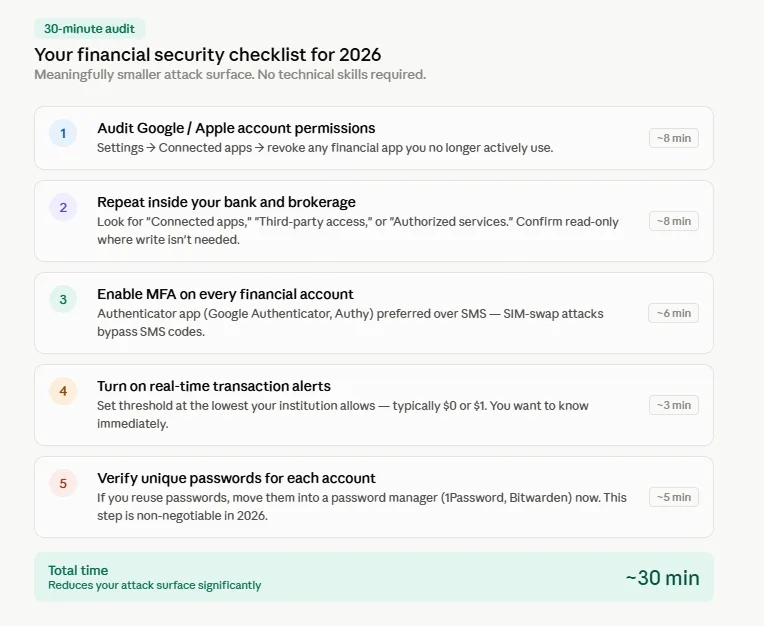
- Enable multi-factor authentication on every financial account (authenticator app preferred over SMS)
- Audit third-party app permissions quarterly; revoke unused connections
- Set real-time transaction alerts at the lowest threshold your institution allows
- Use unique strong passwords for each financial account (a password manager is required at this level of hygiene)
- Review your institution's AI decision recourse process before you need it
- Evaluate whether personal cyber insurance fills gaps in your existing coverage
Financial Inclusion in 2026: Who Is Being Left Behind — and Why It Affects Everyone

World Bank financial inclusion data shows global account ownership rose from 51% in 2011 to 76% in 2021, but more than one billion people remain financially excluded. In low-income economies, 65% of adults lack access to even a basic transaction account.
This matters to US consumers for two reasons.
First, the regulatory priorities shaped by inclusion gaps — AI fairness, algorithmic bias in lending, access to basic financial services — directly affect the products available to everyone. Regulatory pressure is already shaping how lenders deploy AI underwriting, which affects the rates and terms consumers at all income levels receive.
Second, AI-driven personalization carries a genuine risk of deepening exclusion. Hyperpersonalization optimizes for profitable customers with rich data histories. Consumers with thin credit files, limited digital footprints, or inconsistent income streams may find AI-driven underwriting less favorable — even if their actual creditworthiness is sound. That gap between policy intent and product reality remains significant in 2026.
Frequently Asked Questions
How do I know if my credit card is still competitive in 2026?
Compare your actual reward earnings over the last 12 months against what you'd earn with a current AI-personalized card from a major issuer. If your top spending categories aren't earning at least 2–3% back, and your card has no mechanism to adjust to your spending, it's likely underperforming. Also check for real-time fraud alerts and digital wallet support — absence of either is a meaningful gap by 2026 standards.
Is continuous insurance underwriting always worse for consumers?
Not inherently. If your driving record is clean, your home is well-maintained, and your health behaviors are positive, continuous underwriting can lower your premiums faster than annual review cycles. The risk is for consumers who experience temporary adverse periods — a stretch of high-stress commuting, a health event, a maintenance backlog — that get captured in real-time pricing. The key is understanding what data your insurer uses and what your recourse is if that data is inaccurate.
What's the difference between a robo-advisor and an autonomous AI investing agent?
A robo-advisor executes preset rules — rebalance when drift exceeds X%, harvest losses when threshold Y is crossed — on a relatively slow cycle. An autonomous AI agent executes multi-step strategies in real time, including simultaneous rebalancing, harvesting, hedging, and options adjustments, without requiring human approval at each step. The practical difference: autonomous agents react to market conditions in minutes rather than days, and can coordinate across multiple strategies simultaneously.
Do I need personal cyber insurance if I already have homeowners insurance?
Probably yes, at least worth checking. Standard homeowners insurance typically covers physical property damage and some identity theft expenses. It generally does not cover direct financial losses from account takeover fraud, ransomware demands on personal devices, or the full cost of professional identity restoration services. Check the exact language in your current policy, then compare it against what a standalone cyber endorsement would add.
How do I challenge an AI-driven financial decision that seems wrong?
Start by requesting a formal explanation from the institution — in writing. Under current US and EU frameworks, consumers have increasingly explicit rights to request explanations for automated credit and underwriting decisions. Reference the institution's AI ethics policy if they publish one, and reference CFPB guidelines for credit decisions. For insurance, reference NAIC standards. If the institution is unresponsive, filing a complaint with the CFPB (for banking/credit) or your state insurance commissioner (for insurance) creates a formal record.
How This Guide Was Researched
This guide is based on publicly available industry reports (Datos Insights, Guidehouse, Moody's, World Bank, First Citizens, NAIC), regulatory publications, and verified consumer data aggregated from multiple sources. It does not reflect hands-on testing of specific financial products by Trusted Buyer Report. Where claims are specific, sources are linked directly. We do not accept payment for coverage positions. Read our full methodology →
Reviewed by the Trusted Buyer Report editorial team. This article was drafted with AI assistance and fact-checked before publishing. Trusted Buyer Report may earn a commission from purchases made through links on this page — our editorial positions are finalized before any affiliate link is placed. Full affiliate disclosure →