We may earn a commission when you use our links to make a purchase. This guide was researched and drafted with AI assistance, then reviewed and fact-checked by our editorial team before publishing. Scores and rankings are finalized before any affiliate relationship is established.
The Real Reason Most People Pick the Wrong TV Stand
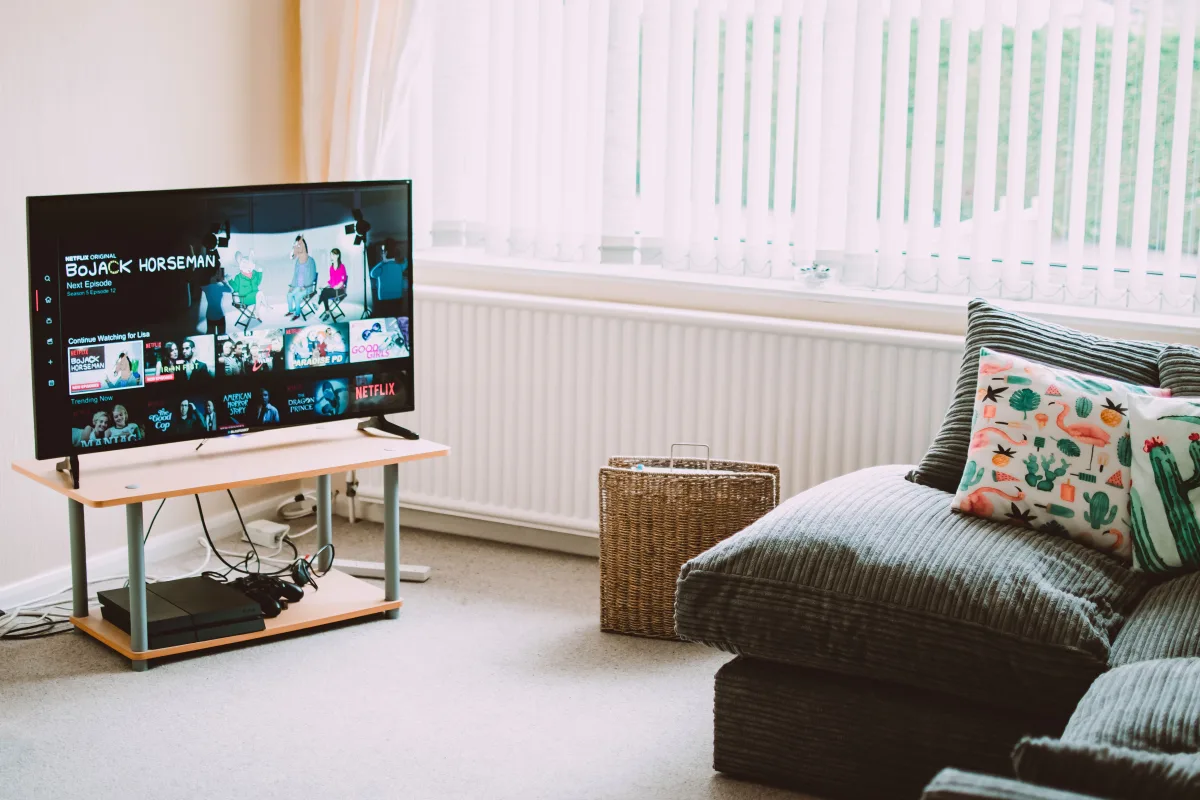
Most buyers treat choosing a TV stand as a purely aesthetic decision: find something that looks good in the product photo, confirm it clears the TV size, hit Add to Cart. That assumption is the single most expensive mistake you can make in living room furniture.
Here's what actually happens: a renter in a 400-square-foot apartment orders a large enclosed entertainment center because it looks stunning online — warm wood, ample storage, a built-in media niche. They spend three hours assembling it, step back, and discover it consumes an entire wall, blocks natural light from a side window, and turns the room into a hallway. Six months later, moving day arrives and the unit won't clear the door without full disassembly — and particleboard panels rarely survive that process.
The cost of the stand is only part of the loss. The months of living in a room that doesn't work, then the replacement purchase — that's where the real money goes.
This guide gives you a decision framework that eliminates roughly 80% of options before you look at a single product page — then ranks the best TV stands and entertainment centers of 2026 across four measurable dimensions so you can match the right unit to your actual situation.
How This Guide Was Researched
This is a research-based guide, not a hands-on test. Our rankings draw from a detailed expert scoring review published by HERNEST's editorial team, which evaluated each console across four dimensions — Design (D), Storage & Functionality (SF), Sturdiness (S), and Cable Management (C), each rated out of 5. We also incorporated market sizing data from Business Research Insights and Coherent Market Insights, and product specs from manufacturer pages. We haven't personally assembled or lived with these units; where that distinction matters, we say so.
Why the TV Stand Market Is Changing Faster Than Most Buyers Realize
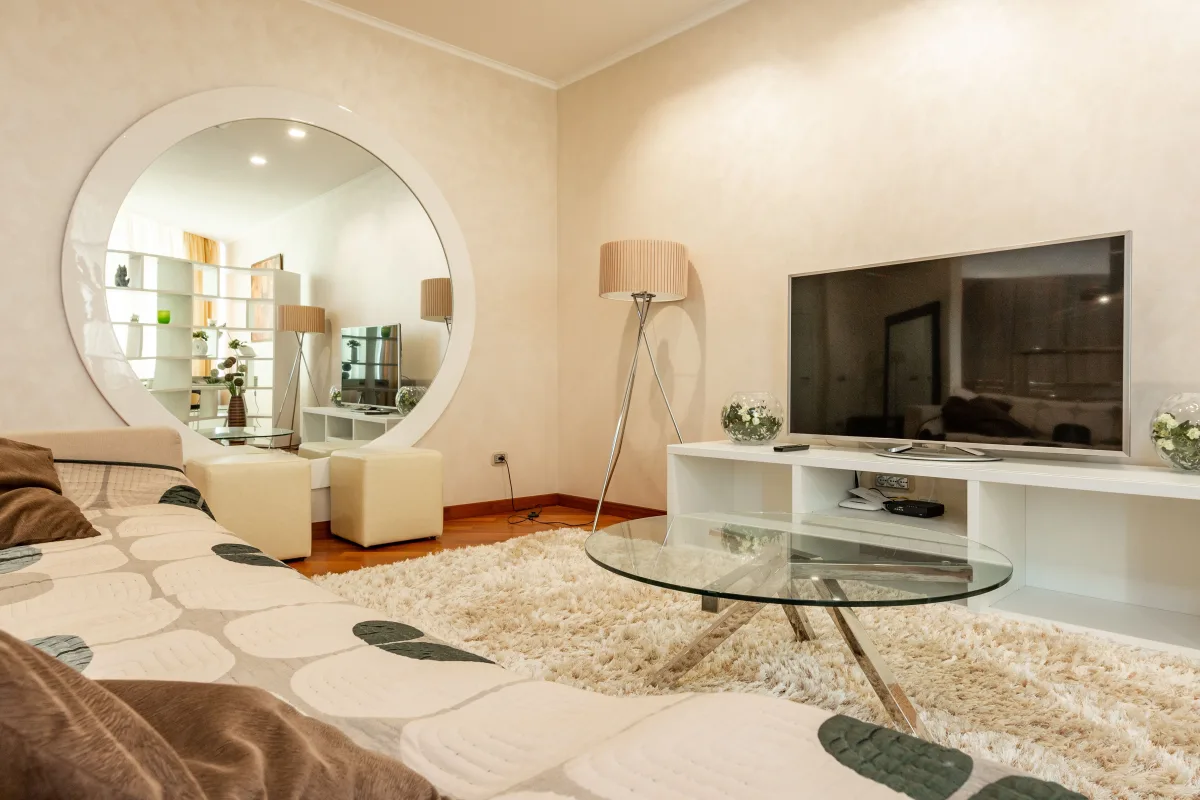
The volume of TV stand formats available in 2026 isn't accidental. According to Business Research Insights, the global entertainment centers and TV stands market is valued at USD 3.47 billion in 2026 and is projected to reach USD 5.09 billion by 2035 — a compound annual growth rate of 4.3%. Manufacturers are launching new form factors, materials, and price tiers at a pace that simply wasn't happening five years ago.
Within that market, floor-standing TV stands dominate. Coherent Market Insights reports floor-standing units will account for 46.2% of total market share in 2026 — primarily because they require zero wall modifications, making them the practical default for renters and frequent movers.
For buyers, the consequence of this market expansion is decision fatigue. Swivel stands, rolling stands, fireplace-integrated consoles, credenza-style media units, and modular wall systems are all competing for the same living room real estate. The framework below is designed to cut through that noise before you lose hours comparing finishes.
5 Questions to Answer Before You Open a Single Product Page
Work through these in order. If you're honest with each answer, you'll eliminate most of what's on the market before spending any time on product details.
1. What's your TV's actual width — not diagonal screen size?
A 65-inch TV has an actual width of approximately 57–58 inches. Your stand should be at minimum that width and ideally within a few inches in either direction. A stand dramatically wider than the TV makes the TV look like an afterthought. A stand narrower than the TV's base creates visual instability — and sometimes structural instability, depending on the base design.
Check the TV's actual width in the spec sheet, not the diagonal size. Then compare that number directly to the stand's rated width.
2. What's your room's square footage?
A lower-profile console in a room under 250 sq ft keeps the visual center of gravity low and makes the space feel larger. A tall, enclosed entertainment center in the same room pushes the walls in. In larger rooms — 400 sq ft or more — a wider, more substantial console reads as grounding rather than overwhelming. Proportion is the single most overlooked variable in this purchase.
3. Do you need closed storage or open display?
Closed-door cabinets hide clutter effectively, but restrict airflow. If you're storing an AV receiver, gaming console, or streaming hub inside an enclosed cabinet during extended use, heat buildup becomes a real concern. Open shelving solves the airflow problem but requires ongoing organization. Be honest about which type of person you are before committing to a format.
4. Are you a renter or a homeowner?
The 46.2% floor-standing market share exists because the answer to this question matters. Renters need a unit that doesn't require drilling and can leave through a standard door in one piece. Homeowners designing a permanent media room have more latitude — though if you plan to sell within five years, consider resale neutrality. A highly specific industrial concrete console may not appeal to the next buyer.
5. How many devices are you managing?
A typical 2026 media setup includes a soundbar, streaming device, gaming console, smart home hub, and possibly a cable or satellite box — each with its own power cable and at least one HDMI or optical connection. Built-in cable management channels are a functional necessity at this point, not a premium feature. A stand without them will look chaotic within a week of setup regardless of how attractive the piece itself is. When you're evaluating ergonomic seating options for your media room, cable management matters there too.
2026 Expert Rankings: Top TV Stands Scored Across 4 Dimensions
The scores below come from HERNEST's editorial review, which rated each unit on Design (D), Storage & Functionality (SF), Sturdiness (S), and Cable Management (C), each out of 5. The overall score is a weighted composite.
Important: A higher overall score doesn't automatically mean the right choice for you. If your top priorities are sturdiness and cable management specifically, a unit with perfect 5/5 scores in those two dimensions may be the functionally superior pick even if its overall composite is marginally lower.
| Rank | Product | Overall | D / SF / S / C | Best For |
|---|---|---|---|---|
| 1 | CB2 Alpena Dark Acacia Wood Credenza | ★★★★☆ (4.6) | 5 / 5 / 4 / 4 | Best Overall Statement Piece |
| 2 | HERNEST Valborg Oak Media Console | ★★★★☆ (4.5) | 4 / 5 / 5 / 5 | Best Mid-Century Modern Value |
| 3 | RH Modern Cast Concrete Media Console | ★★★★☆ (4.5) | 4 / 4 / 5 / 5 | Best for Industrial Luxe Interiors |
| 4 | HERNEST Lira Media Console | ★★★★☆ (4.4) | 5 / 5 / 4 / 4 | Best for Open & Airy Display |
| 5 | Arhaus Caden Media Console | ★★★★☆ (4.3) | 4 / 5 / 5 / 4 | Best Rustic Modern Warmth |
| 6 | West Elm Mid-Century Wood Media Unit | ★★★★☆ (4.3) | 4 / 4 / 4 / 5 | Best Authentic Mid-Century Style |
| 7 | HERNEST Thursen Chevron Media Console | ★★★★☆ (4.2) | 4 / 5 / 4 / 4 | Best Artisan Statement Design |
| 8 | HERNEST Skimra 84" Oak Media Console | — | — | Best Wide-Format for Large Rooms |
Deep Dives: The Top 3 Picks and What Each One Actually Gets Right
#1: CB2 Alpena Dark Acacia Wood Credenza — Overall 4.6
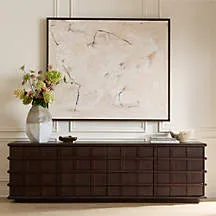
The Alpena earns its top ranking through a combination of visual impact and genuine storage utility. The dark acacia wood grain is distinctive — this isn't a piece that blends into the background, and that's intentional. Perfect 5/5 scores in both Design and Storage & Functionality reflect its dual role as a furniture centerpiece and a practical media hub.
The trade-off: Sturdiness and Cable Management both score 4/5, not 5/5. This piece prioritizes how it looks and how much it holds over raw structural robustness and wire-hiding precision.
Who it's right for: Larger rooms — open-plan living areas, formal living rooms, or spaces with high ceilings where the credenza's horizontal mass reads as grounding rather than overwhelming. In a room under 250 sq ft, it risks dominating the space entirely.
One maintenance note: Acacia wood requires more upkeep than engineered alternatives. Occasional oiling keeps the grain from drying out over time — factor that into your decision if low-maintenance furniture is a priority.
Pros:
- Best-in-class design score; genuine statement piece
- Top storage capacity and interior organization
- Works in multiple aesthetic directions — contemporary, transitional, rustic modern
Cons:
- Not the sturdiest pick in this ranking
- Acacia requires ongoing maintenance
- Scale requires a large room to land correctly
#2: HERNEST Valborg Oak Media Console — Overall 4.5
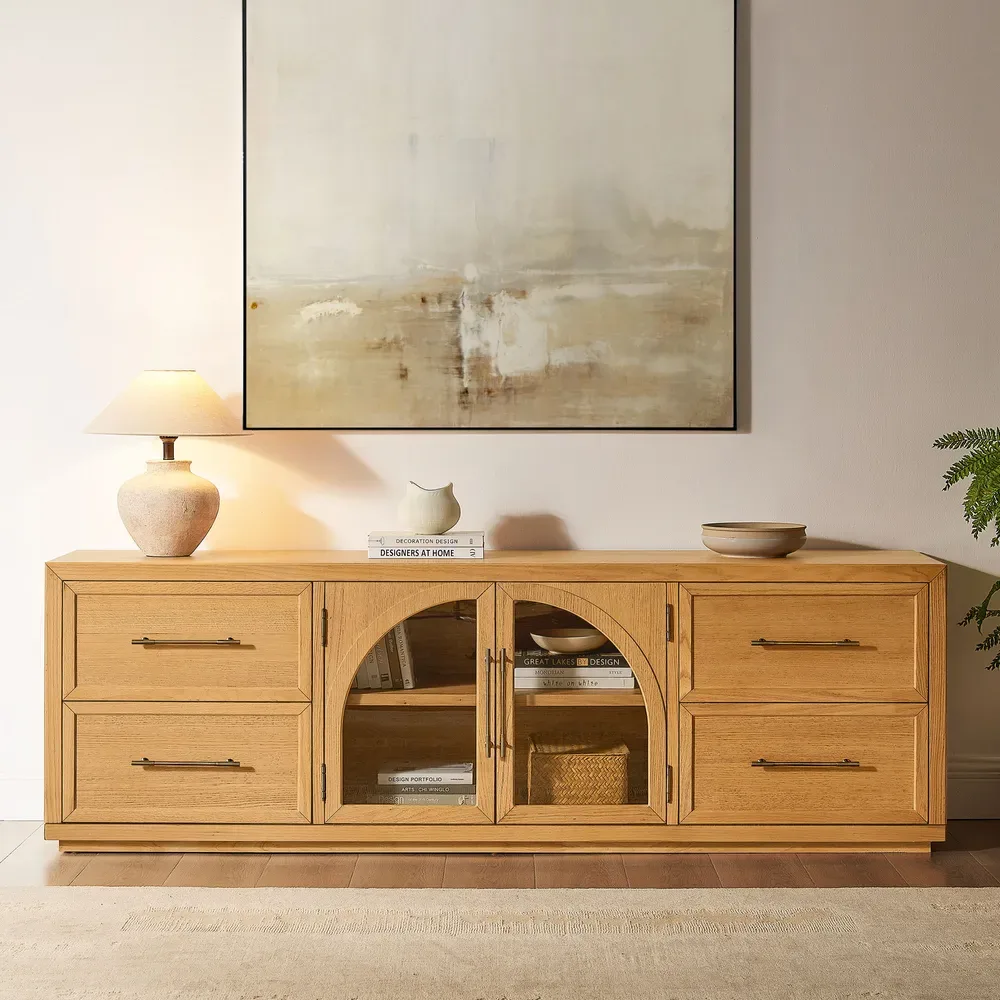
The Valborg is the most practically functional pick in the top three. Its 5/5 in both Sturdiness and Cable Management make it the strongest performer on the dimensions that affect day-to-day usability over first impressions. The oak finish works across multiple interior styles — mid-century modern, Scandinavian, transitional — which means it won't become a design liability if you redecorate around it.
The value angle: Buyers who want near-top performance without the CB2 or RH price tag will find the Valborg delivers on what matters most for long-term satisfaction. Its 4/5 Design score isn't a weakness — it reflects a deliberately restrained aesthetic that ages well rather than making a bold statement that could feel dated in three years.
Who it's right for: Renters who move every 2–3 years but don't want to compromise on build quality. Also strong for homeowners who want versatility over a statement piece and households with complex multi-device setups.
Pros:
- Best sturdiness and cable management in the ranking
- Aesthetic versatility across multiple interior styles
- Better long-term value than alternatives at the same price tier
Cons:
- Restrained aesthetic — not the piece that anchors a room visually
- Doesn't have the premium material feel of acacia or concrete options
#3: RH Modern Cast Concrete Media Console — Overall 4.5
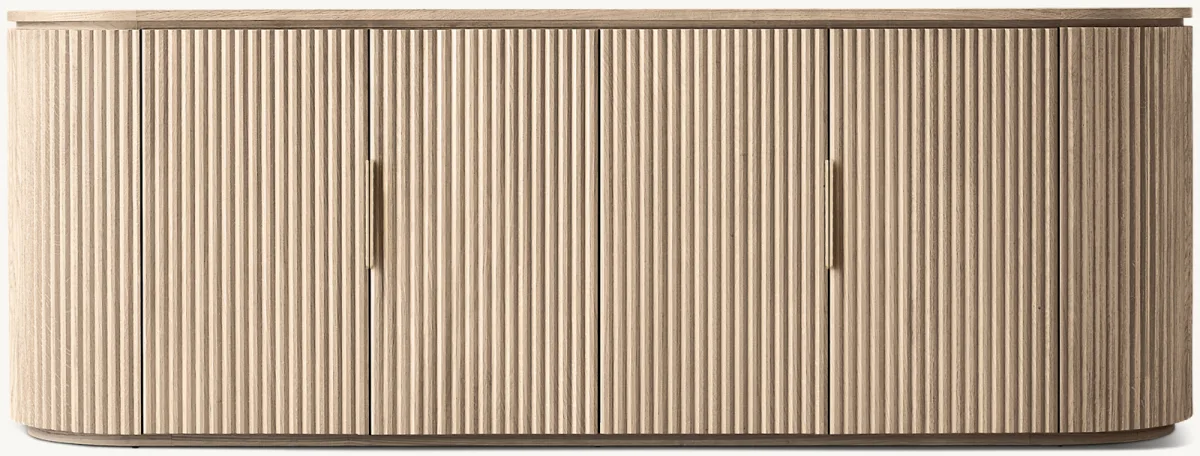
Cast concrete is not a material choice for the indecisive. The RH Modern console is genuinely heavy, genuinely permanent, and genuinely durable — and those three qualities are inseparable. Its 5/5 scores in both Sturdiness and Cable Management reflect a build quality designed to outlast multiple TV upgrades and several rounds of interior redesign.
The hard truth: This console is explicitly not for renters. Moving it requires significant effort and planning. The industrial aesthetic — concrete, clean lines, minimal ornamentation — suits loft apartments, contemporary homes, and dedicated media rooms rather than traditional or transitional interiors.
Who it's right for: Homeowners renovating a permanent media space with an industrial or contemporary design direction. If you're committing to a space for 10+ years, this is the most defensible long-term investment in the ranking.
Pros:
- Most durable material in the ranking — will outlast multiple TV generations
- Outstanding cable management
- Industrial aesthetic is difficult to replicate at lower price points
Cons:
- Completely impractical for renters or anyone who moves
- Industrial aesthetic has a narrow fit — doesn't adapt to style changes
- Highest price point in the ranking
Beyond the Credenza: 3 Specialty TV Stand Types and When They Actually Make Sense
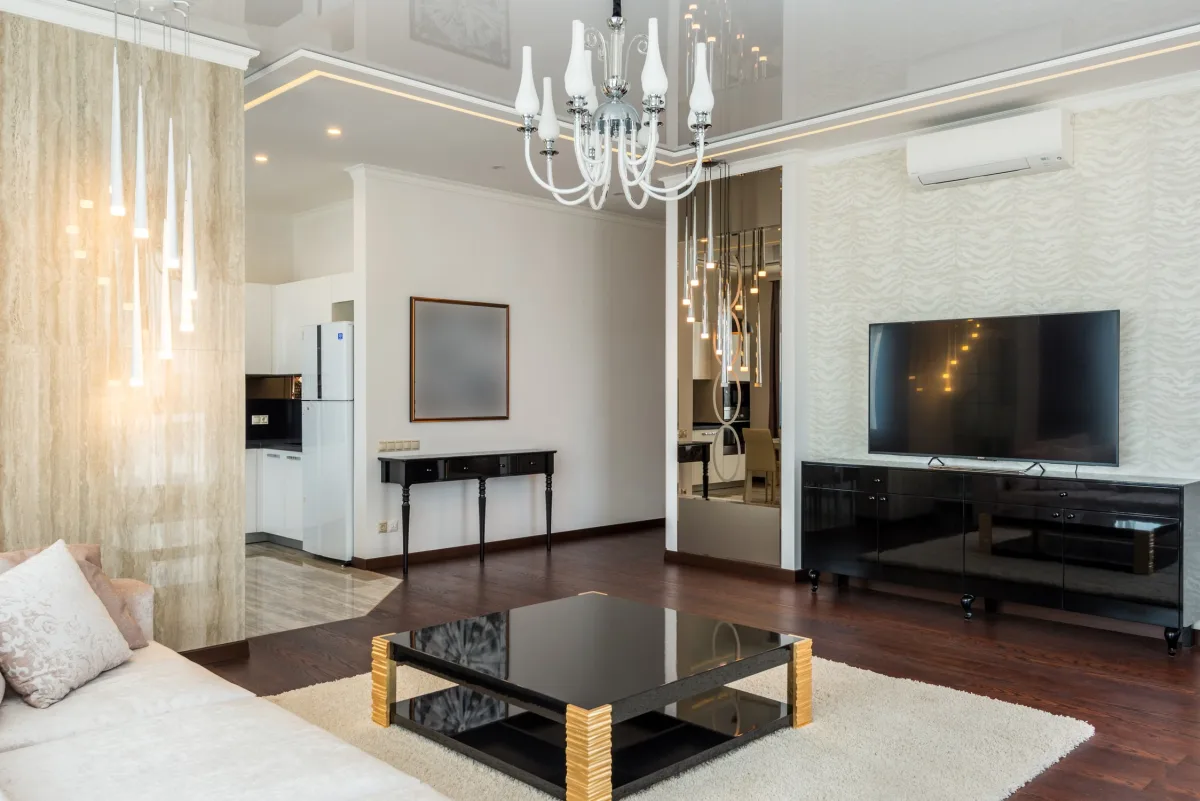
The credenza format is only the right tool when it's the right tool. Three specialty categories deserve direct attention.
Rolling TV Stands
Rolling stands are not a compromise — they're the correct solution when mobility is the primary requirement. The Pearl Gear rolling stand, for example, supports TVs from 32 to 82 inches, holds up to 100 pounds via a heavy-duty steel frame, offers 11 height adjustment levels, and provides 360-degree rotating wheels with a built-in shelf for soundbars or gaming consoles. That specification set makes it genuinely useful for home offices, gyms, multi-room households, or any situation where the TV needs to move regularly.
Swivel TV Stands
Tabletop swivel stands allow angle adjustment without repositioning the entire unit. In open-plan spaces where the viewing angle shifts depending on whether you're on the sofa, at the dining table, or in the kitchen, a swivel base solves a real ergonomic problem that a fixed console cannot. These typically sit on top of an existing surface rather than functioning as freestanding furniture.
Fireplace-Integrated TV Stands
Fireplace-integrated consoles consolidate two furniture functions into one footprint — useful in apartments or rooms where a traditional fireplace isn't possible. Models like the Jumico Farmhouse TV Stand support TVs up to 65 inches and incorporate an electric fireplace insert that adds ambient heat. The trade-off is added complexity: there's more to maintain, the unit is less flexible if design preferences shift, and the farmhouse aesthetic limits which interior styles it fits naturally.
Are Traditional Entertainment Centers Outdated in 2026?
The short answer: not outdated, but significantly evolved.
The floor-to-ceiling entertainment center with enclosed cabinetry on all sides — designed to house a bulky CRT television — has declined sharply in relevance. Flat-panel TVs eliminated the need for a deep central niche. Streaming services have reduced physical media collections for most households. The format that dominated living rooms in the 1990s and early 2000s no longer fits the technology or the lifestyle it was built around.
What has replaced it is a spectrum: lower-profile credenzas, modular wall systems, floating media shelves, and open-frame consoles. The market data confirms this shift while showing the broader category remains healthy — floor-standing units still hold 46.2% of global market share in 2026, meaning consumers haven't abandoned the format, they've become more selective about which version they buy.
Large entertainment centers still make sense in specific contexts:
- Households with significant AV equipment requiring organized storage
- Collections of physical media (vinyl, Blu-rays, gaming cartridges)
- Rooms large enough to absorb the visual weight of a substantial piece
They're a poor fit for: small apartments, minimalist interiors, households that have fully moved to streaming, and renters who need to move the piece in one piece.
The question isn't whether entertainment centers are outdated as a category — it's whether a specific piece is proportional, flexible, and adapted to how you actually live. A well-chosen 84-inch console like the HERNEST Skimra in a large room is exactly right. The same piece in a studio apartment is a mistake regardless of how well it scores on paper.
If you're also working through a broader home setup — including where you sleep, sit, and spend time outdoors — the comprehensive furniture and appliances buyer's guide covers all of these categories with the same framework.
What to Pair with Your TV Stand: A Complete Living Room Approach
Your TV stand doesn't exist in isolation. Once you've picked the right media console, a few adjacent decisions will determine whether the living room actually works as a system.
Seating and viewing distance: The standard recommendation is to sit at a distance of 1.5 to 2.5 times the TV's diagonal screen size. A 65-inch TV works best at 8 to 13 feet. If your sofa-to-stand distance falls outside that range, you either need a different stand position or a different TV size — not just a different stand. If you're also considering updating your seating at the same time, our picks for the best dining room tables and chairs use the same proportion-first framework.
Room decor cohesion: The stand you pick will anchor the aesthetic direction of the room. If you're planning a broader home refresh, our guide to the best home decor online stores covers where to source complementary pieces without overpaying.
Where you shop: For mid-range media consoles, Wayfair and IKEA are the two most common starting points. Both have real strengths and real limitations — our detailed Wayfair review for 2026 covers what their furniture quality and delivery experience actually looks like in practice, and our IKEA US review breaks down assembly reality, material quality, and long-term value for their media furniture specifically.
Indoor plants as a finishing element: A floor plant near the TV stand softens the hard corner and adds visual balance, especially if the console is a low-profile credenza. Our picks for easy-care, air-purifying indoor plants work particularly well in media room setups where you want minimal maintenance.
Frequently Asked Questions
What size TV stand do I need for a 65-inch TV?
A 65-inch TV has an actual width of approximately 57–58 inches. Your stand should be at minimum that wide to support the TV safely and ideally within a few inches of that measurement in either direction. A stand significantly wider than the TV makes the screen look small; a stand narrower than the TV's base creates top-heavy instability.
Is a floor-standing TV stand better than a wall-mounted unit?
Neither is universally better — they solve different problems. Floor-standing units require no wall modifications, making them the practical default for renters and frequent movers. Wall-mounted units free up floor space and create a cleaner visual line, but they require drilling, may not be permitted in rental properties, and are difficult to relocate after installation. Your housing situation should drive this decision more than aesthetics.
How much weight can a typical TV stand hold?
Weight capacity varies significantly by construction. Budget engineered-wood stands typically support 50–80 lbs. Mid-range solid wood consoles often support 100–150 lbs. Heavy-duty steel-frame rolling stands are typically rated around 100 lbs for large TVs. Always check the manufacturer's stated weight capacity against your TV's actual weight (listed in its spec sheet).
Do TV stands need cable management features in 2026?
Yes. A modern media setup with multiple devices generates a tangle of power cables, HDMI connections, and optical cables that will create visual clutter without built-in management. Look for rear cable channels, grommet holes, or internal routing paths. This feature consistently differentiates mid-range from budget options more reliably than material quality alone.
Are entertainment centers a good investment in 2026?
A well-chosen solid wood or concrete piece will hold its functional value for a decade or more and may retain resale value as used furniture. Particleboard or MDF units at the budget end are consumable purchases — useful for a defined period, not durable investments. The global market for entertainment centers is projected to reach USD 5.09 billion by 2035, according to Business Research Insights, which reflects sustained consumer demand rather than a category in decline.
What's the difference between a media console and an entertainment center?
A media console (or TV stand/credenza) is a lower, horizontal piece typically 16–24 inches high that the TV sits on top of. An entertainment center is a larger, often taller unit — sometimes floor-to-ceiling — that surrounds or frames the TV with additional cabinetry. Media consoles dominate the 2026 market because flat-panel TVs no longer require the deep central niche that traditional entertainment centers were built around.
Final Decision Framework: Match the Stand to Your Actual Life
If you rent and move every 1–3 years: The HERNEST Valborg Oak Media Console is your best combination of sturdiness, cable management, and aesthetic versatility. If mobility between rooms is a genuine requirement, the Pearl Gear rolling stand is the functionally correct choice, not a compromise.
If you own your home and want a long-term statement piece: The CB2 Alpena Dark Acacia Wood Credenza earns its #1 ranking for rooms large enough to support it. For a permanent industrial or contemporary media room, the RH Modern Cast Concrete Console is the most defensible long-term investment in this ranking.
If budget and versatility are both priorities: The HERNEST Valborg delivers near-top performance at a more accessible price point. Its 5/5 scores in sturdiness and cable management reflect the dimensions that affect how you'll feel about this purchase in year three, not just week one.
If you're in a small space under 250 sq ft: Avoid any unit wider than your TV by more than 8–10 inches. Consider a rolling stand or wall-mount setup to preserve floor space — the proportions matter more than any single product's score on an expert rubric.