
Researched and drafted with AI assistance; reviewed and fact-checked before publishing. We may earn a commission from purchases made through links on this page — commissions are added after our editorial assessment is complete and never influence rankings. Full disclosure →
Bottom line up front: Philips Hue with the Bridge Pro is the best smart lighting system for most homeowners in 2026. WiZ LED is the best hub-free option for renters and first-time buyers. IKEA Varmblixt with the Dirigera hub is the best value entry point for design-conscious buyers. If you're building from scratch, prioritize Matter-certified systems above everything else — it's the only way to protect your investment against ecosystem changes.
Quick Comparison: Best Smart Lighting Systems 2026
| System | Best For | Hub Required | Matter | Approx. Per-Bulb Cost |
|---|---|---|---|---|
| Philips Hue + Bridge Pro | Whole-home automation | Yes | Yes (via Bridge) | $25–$55 |
| WiZ LED | Renters, 1–8 bulbs | No | Limited | $10–$18 |
| LIFX A19 | No-hub buyers who want quality | No | Yes | $30–$45 |
| IKEA Varmblixt + Dirigera | Design-forward, budget hub | Yes | Yes | $15–$30 |
| Nanoleaf Essentials | Accent + Matter-native | No | Yes | $20–$35 |
| Govee (basic) | Budget accent lighting | No | No (most) | $8–$15 |
Why 2026 Is the Right Year to Upgrade Smart Lighting
You've probably looked at smart lighting before and put it off. The ecosystem felt fragmented, the prices seemed high for what you got, and there was always a nagging sense that whatever you bought might not work with something else you'd want later.

That calculation has changed — and here's why it matters now rather than next year.
Matter 1.4 finally solved the compatibility problem. Matter is an open-source interoperability standard backed by Apple, Google, Amazon, and Samsung. A Matter-certified bulb you buy today is contractually required to work with any Matter-compatible controller, regardless of brand. That's not marketing language — it's enforced by the Connectivity Standards Alliance. The fragmented Zigbee-vs-Wi-Fi-vs-Z-Wave era that frustrated buyers for a decade is effectively over for new purchases.
Energy rebates have gotten meaningfully better. Utility rebate programs now cover 30–50% of retrofit capital costs in many U.S. states. That dramatically changes the math on payback periods for households upgrading from incandescent or halogen bulbs.
Hardware prices are lower than they've been. Asia-Pacific manufacturing scale — anchored by China and India — has driven down smart lighting component costs globally. Starter kits that cost $80–100 three years ago now land at $50–70 for equivalent or better hardware.
AI-driven dimming is now in the hardware itself. Edge-AI dimming — processed locally on the device rather than in a manufacturer's cloud — is being embedded directly into 2025–2026 hardware. Your bulbs can now learn and adapt to your routines without manual programming or subscription fees.
If you're building a complete smart home setup, lighting is the category where the investment-to-impact ratio is highest. Done right, it touches every room, every day.
What Makes a Smart Lighting System Actually Smart in 2026
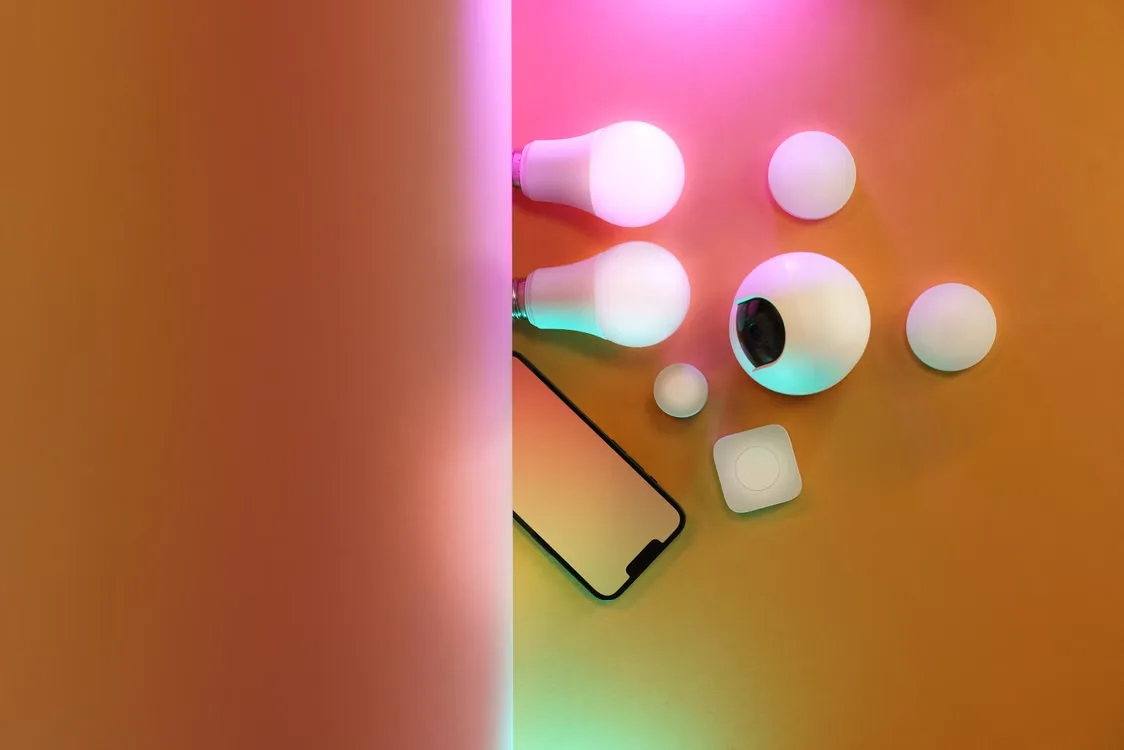
Remote on/off from your phone is the floor, not the ceiling, of what a capable system does. Here's what genuinely separates good systems from basic ones:
Occupancy sensing — detecting whether a room is occupied and adjusting automatically, without a separate motion sensor. The Philips Hue Bridge Pro does this by reading Wi-Fi signal patterns across connected bulbs. Most hub-free systems don't offer this at all.
Daylight harvesting — automatically dimming when natural light is sufficient. This is where real energy savings happen, particularly in rooms with significant window exposure.
Behavioral learning — adapting to your patterns over time without manual reprogramming. This is increasingly edge-AI driven in 2026 hardware.
Local processing — the ability to function normally during internet outages. Hub-based systems with local processing keep working when your router or ISP goes down. Cloud-dependent Wi-Fi systems go dark.
Color temperature adjustment — shifting from warm (2700K) in the evening to cooler (5000K+) in the morning to support circadian rhythms. This is a standard feature in mid-range and up systems.
Connectivity Types Explained Simply
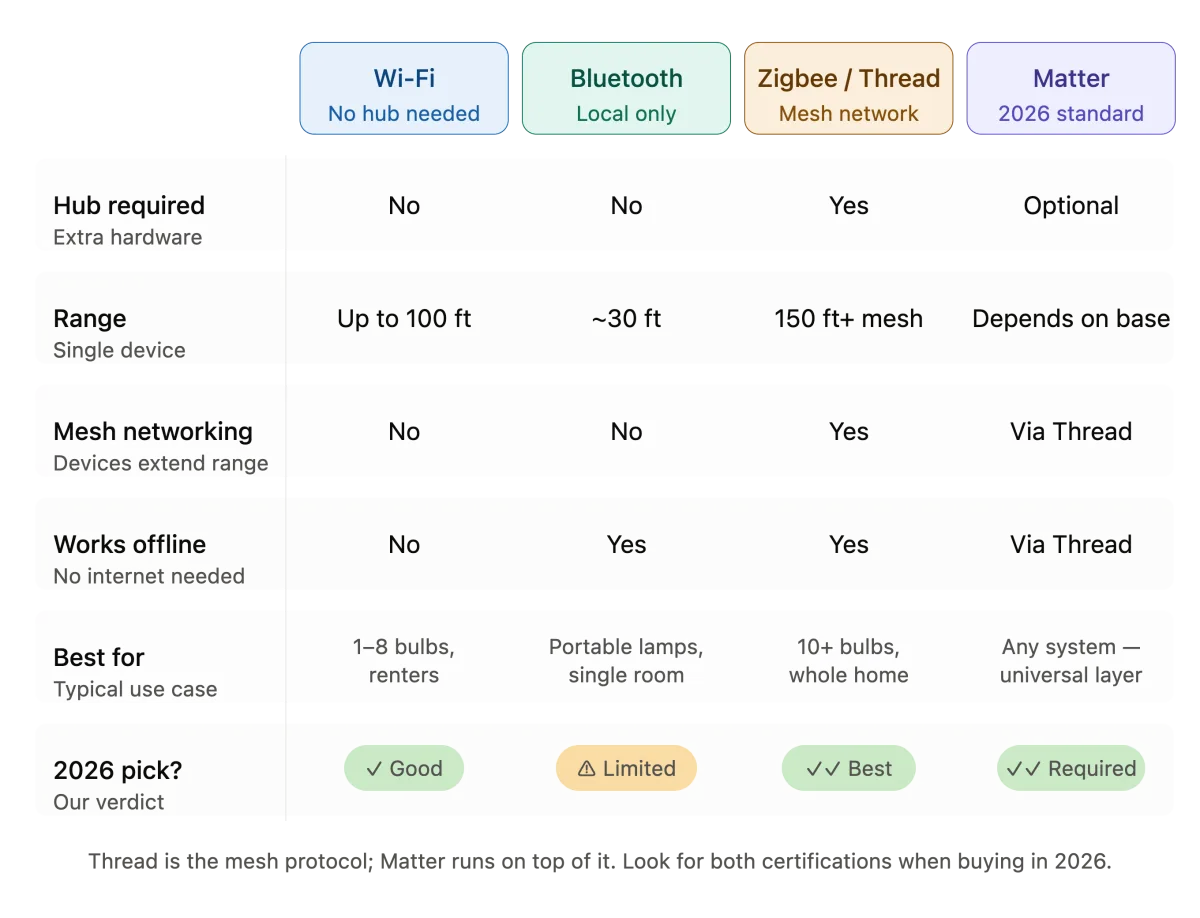
Wi-Fi — connects directly to your router, no hub needed. Easy setup, but each bulb is a device on your network. Fine for 1–8 bulbs; can degrade network performance at scale.
Bluetooth — low-latency, works without internet. Limited range, no mesh networking.
Zigbee / Thread — low-power mesh networking where each device extends the range for others. Requires a hub, but far more reliable at scale (10+ bulbs across rooms). Thread is the forward-looking choice for new purchases in 2026.
Matter — the application-layer standard that runs on top of Thread (and Wi-Fi). Think of Thread as the road and Matter as the traffic rules everyone agrees to follow.
The 2026 Connectivity Landscape: What You Need to Know Before Buying
The single most important thing: check for Matter certification before purchasing any smart lighting system in 2026.
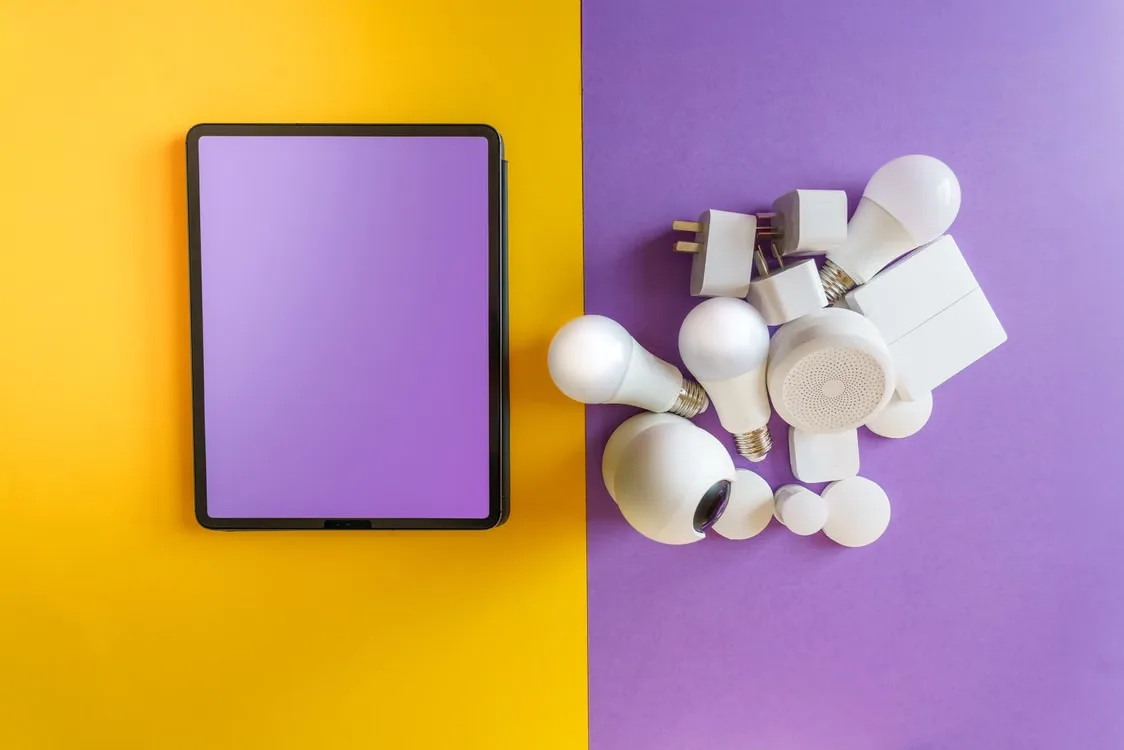
A Matter-certified device works with Apple Home, Google Home, Amazon Alexa, and Samsung SmartThings. Switching ecosystems doesn't require replacing your bulbs. That's the protection Matter provides.
Thread vs. Wi-Fi for your home:
Thread creates a self-healing mesh network — adding more devices makes it more reliable, not more congested. A 20-bulb Thread network is more stable than a 5-bulb one, because each device acts as a repeater. For whole-home installations, Thread is the better long-term investment.
Wi-Fi systems genuinely shine for simple setups. No hub to configure, no separate app ecosystem, connects to infrastructure you already own. For 1–8 bulbs in a single space — a bedroom, home office, or rental apartment — Wi-Fi is perfectly adequate.
What about Zigbee? Zigbee systems already installed are worth maintaining — the protocol is stable and widely supported in commercial buildings and large pre-2024 residential installations. For new purchases in 2026, Thread/Matter is the cleaner path: Zigbee lacks native Matter support and requires a translation layer that adds latency and failure points.
Practical shortcut: If you already own an Apple HomePod mini, Amazon Echo (4th gen), or another Matter-compatible controller, you may not need a brand-specific hub for basic lighting control. Check your existing devices before buying a proprietary hub.
Best Smart Lighting Systems 2026: Honest Profiles

🏆 Best Overall: Philips Hue with Bridge Pro
Best for: Homeowners wanting real automation, 6–30+ bulbs across multiple rooms.
Philips Hue is the benchmark by which every other residential smart lighting system is measured — and the Bridge Pro, which launched in September 2025, is why. It enables presence sensing across three or more connected bulbs by reading Wi-Fi signal patterns, without any dedicated motion sensor hardware. It supports up to 150 devices (vs. 50 for the original Bridge), integrates with every major voice assistant, and offers the deepest residential automation library available.
What reviewers say: Wirecutter has named Hue the best smart bulb system five years running. CNET's Spring 2026 expert-tested update added the Bridge Pro specifically for presence sensing. T3's long-term testing found "99.8% uptime over 18 months," making it the most reliable system in residential use. TechRadar notes that Hue bulbs are "brighter than most competitors and offer highly accurate colours."
The honest drawbacks: Per-bulb cost runs $25–$55 depending on type, and the Bridge Pro hub adds approximately $65–$80 to your initial outlay. Philips discontinued its v1 bridge in 2023 — a reminder that hub-dependent systems carry long-term support risk. Before buying: verify the Bridge Pro supports Matter (it does) and that the system offers local processing independent of Philips' cloud (it does, via the Bridge).
Who should skip it: Renters, anyone installing 5 or fewer bulbs, or budget-conscious buyers who don't need automation beyond scheduling.
✅ Best Hub-Free: WiZ LED (Philips Smart Lighting)
Best for: Renters, first-time smart home adopters, 1–8 bulbs in a single space.
WiZ LED is the practical choice when you want smart lighting without infrastructure complexity. It's Wi-Fi native, requires no hub, and the WiZ app is genuinely simple to use. Bulbs cost $10–$18 each, support color temperature adjustment, scheduling, and basic scenes.
One important note: WiZ is now marketed as "Philips Smart Lighting" — a separate product line from Philips Hue that uses the WiZ app, not the Hue app, and doesn't require a bridge. The Philips name on the box doesn't mean the two systems work together. They don't share an app or a bridge.
What it doesn't offer: Presence sensing, local processing during internet outages, advanced home automation platform integration. For a bedroom or home office, this doesn't matter. For a whole-home system with 20+ bulbs, these limitations become significant.
Genuine advantage: Portability. WiZ LED bulbs pack up and move with you. No hub to leave behind, no infrastructure investment lost.
✅ Best No-Hub with Matter: LIFX A19
Best for: Buyers who want hub-free simplicity but won't compromise on Matter compatibility.
LIFX is PCMag's Editor's Choice for the no-hub category in 2026. The A19 produces up to 800 lumens, is Matter-compatible natively (no hub required), and offers accurate color reproduction across the full RGB spectrum. At $30–$45 per bulb it costs more than WiZ, but you get genuine Matter interoperability without a bridge — meaning you can add a smart home hub later and your existing LIFX bulbs slot in seamlessly.
Trade-off vs. Hue: LIFX gives up the ecosystem depth (50+ Hue device types vs. LIFX's smaller catalog) and presence sensing. For buyers who want high-quality hub-free bulbs with a clear upgrade path, it's the most future-proof non-hub option.
✅ Best Value Hub System: IKEA Varmblixt + Dirigera Hub
Best for: Design-conscious buyers wanting aesthetic lighting as a statement piece, with hub-based reliability at accessible prices.
CNET added IKEA's Varmblixt line to its recommended smart lamp picks in Spring 2026, and it earns the spot for a reason most smart lighting brands ignore: aesthetics. Most smart bulbs are designed to disappear inside conventional fixtures. The Varmblixt lamps are the fixture — sculptural, design-forward pieces that happen to be smart.
The Dirigera hub provides Zigbee connectivity and Matter support, and IKEA's pricing makes this one of the most accessible entry points into hub-based smart lighting. A Varmblixt lamp with Dirigera hub runs significantly less than a comparable Hue setup.
Trade-offs: Narrower product range than Hue. IKEA's automation features are less sophisticated — scheduling and basic scenes are solid; behavioral learning and presence sensing are not on the table.
Who it's for: Buyers who want smart lamps as statement pieces rather than utility infrastructure. If you're already interested in smart home displays for kitchen or living room control, Varmblixt lamps pair naturally with a visible hub like the Dirigera.
✅ Best for Accent and Ambient Lighting: Nanoleaf Essentials
Best for: Accent, bias, and ambient lighting with native Matter support and no hub required.
Nanoleaf's Essentials lightstrips and bulbs ship Matter-native firmware — no hub, no translation layer. For under-shelf lighting, TV bias lighting, and accent applications, they're the most future-proof option in the budget-to-mid-range without a hub investment.
Note: Nanoleaf Shapes (panels) also ship Matter-native. The Govee DreamView ceiling-light update shown at CES 2026 is not yet Matter certified as of mid-2026, making Nanoleaf the stronger choice for buyers who prioritize interoperability in accent categories.
ℹ️ Enterprise / Commercial: Siemens Smart Lighting
Not a residential product, but worth naming for completeness. Siemens delivers IoT-integrated lighting controls with occupancy-based management and Building Management System (BMS) integration for commercial, office, and institutional environments. If you're evaluating smart lighting for an office, retail space, or multi-unit building, Siemens represents the enterprise standard. For a home, it's not the right tool.
Hub or No Hub: The Decision Framework
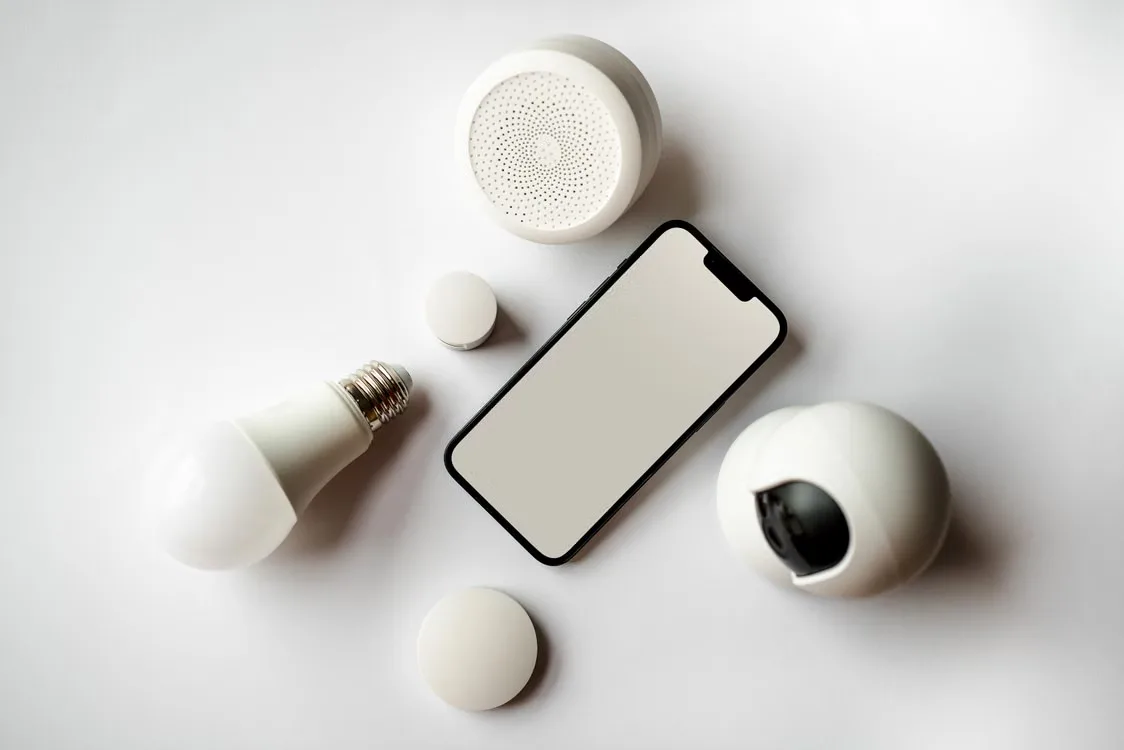
This is the question that trips up more buyers than any other in smart lighting. Here's the clear version:
Hub-free is right if you:
- Are renting and can't leave hardware behind
- Are installing 5 bulbs or fewer in a single room
- Want the simplest possible setup with no infrastructure learning curve
- Don't need presence sensing or local processing
Hub-based is right if you:
- Own your home and are planning a whole-home installation (10+ bulbs)
- Want presence sensing without separate motion sensors
- Need local processing — lights that work during internet outages
- Plan to integrate with a broader smart home ecosystem including smart thermostats or home security systems
The hidden risk of hubs — be honest with yourself about this:
Philips discontinued its v1 bridge in 2023. Insteon's 2022 shutdown rendered thousands of users' systems non-functional overnight. Before committing to any hub-based system, get answers to these three questions:
- Is the hub Matter-certified? (Allows migration to a different controller if needed.)
- Does the system offer local processing independent of the manufacturer's cloud?
- Does the hub have an open API accessible by third-party platforms like Home Assistant?
If the answer to all three is yes, you have meaningful protection against vendor decisions. If the answer to #2 or #3 is no, you're more exposed than the marketing suggests.
Energy Savings: The Honest Numbers
Smart lighting reduces energy consumption through three mechanisms:
1. LED efficiency — LED bulbs use 75–80% less energy than incandescent equivalents and last 15–25 times longer. This is baseline, not a smart-lighting exclusive — any LED upgrade delivers this.
2. Occupancy-based auto-shutoff — lights that turn off automatically when a room is empty. This is where smart lighting earns its premium over basic LEDs. Commercial spaces can cut lighting energy use by 30–60% with occupancy sensing, because offices are frequently lit when empty.
3. Daylight harvesting — automatic dimming when sufficient natural light is present. Meaningful savings in rooms with significant window exposure.
Realistic household payback calculation:
Replacing 20 bulbs with smart LED equivalents at average U.S. electricity rates (~$0.16/kWh), with occupancy sensing reducing active hours by 25%, typically yields payback within 2–4 years before rebates.
With a 40% utility rebate applied to hardware costs — which is available in many U.S. states — that window compresses to 12–18 months.
How to find your rebates: Start with the ENERGY STAR Rebate Finder, then check your utility company's website directly. Many utilities offer instant rebates at point of purchase through participating retailers. Don't leave this money on the table.
Ecosystem Lock-In: How to Protect Yourself
The most experienced smart home buyers think about lock-in first. First-time buyers almost never do — until they're stuck.
Lock-in happens when your lighting system only works fully within one brand's app, hub, or voice assistant. Switching becomes expensive and disruptive. The worst-case version is Insteon 2022: complete shutdown, systems rendered non-functional with no warning.
Three protections against lock-in, in order of accessibility:
1. Matter certification — the strongest general protection. A Matter-certified device works with any Matter-compatible controller. Verify certification through the Connectivity Standards Alliance product database, not manufacturer marketing claims.
2. Open API — check whether the hub has a documented local API. Philips Hue has one. Systems with open APIs can be controlled by third-party platforms even if the manufacturer changes its terms or shuts down.
3. Home Assistant — for technically confident users, Home Assistant is an open-source platform that runs locally on your own hardware, integrates with most major smart lighting protocols, and has zero dependency on any manufacturer's cloud. If Philips shuts down its cloud tomorrow, a Home Assistant user's Hue system continues functioning. Requires setup effort, but provides genuine independence.
How Smart Lighting Integrates with the Rest of Your Smart Home
Smart lighting doesn't live in isolation. Done well, it connects with the broader ecosystem you're building:
- Smart thermostats: Occupancy data from smart lighting can feed into thermostat automation — rooms the lights identify as empty can automatically have their temperature adjusted. See our smart thermostat comparison for the systems that accept this kind of input.
- Security systems: Lighting automation is a core component of presence simulation for home security — randomizing on/off patterns when you're away is more convincing than static timers.
- Pet cameras and baby monitors: If you're monitoring pets remotely or using baby monitors, smart lighting that activates automatically when motion is detected in those rooms adds a layer of passive monitoring.
- Smart displays: Voice-controlled lighting is most useful when your smart display is in a central location like the kitchen — the Echo Show 15 or Nest Hub Max can serve as the dashboard for your whole lighting setup.
Frequently Asked Questions
Which smart lighting system is best for a first-time buyer in 2026?
For most first-time buyers, a hub-free Wi-Fi system like WiZ LED offers the lowest barrier to entry — no hub to configure, straightforward app setup, and competitive per-bulb pricing at $10–$18. If you're willing to invest slightly more upfront for significantly better automation, the Philips Hue Starter Kit with Bridge Pro is the most feature-complete residential option, as confirmed by CNET's Spring 2026 expert testing. For a no-hub option with future-proofing, LIFX A19 with native Matter support is the stronger choice over WiZ.
Do I need a hub for smart lighting to work?
No — Wi-Fi and Bluetooth systems work without a hub. However, hubs unlock features that hub-free systems can't replicate: presence sensing without motion detectors, local processing during internet outages, and reliable mesh networking for large installations. For 5 bulbs or fewer in a single room, hub-free is sufficient. For whole-home automation with 10 or more bulbs, a hub-based system is worth the investment.
What is Matter, and do I actually need it?
Matter is an open-source interoperability standard backed by Apple, Google, Amazon, and Samsung. A Matter-certified device works with any Matter-compatible controller, regardless of brand. In 2026, it's the single most important feature to check when buying smart lighting. You don't strictly need it for a basic two-bulb setup you plan to keep simple — but for any system you plan to expand or keep long-term, it's strongly advisable.
How much can smart lighting actually save on my energy bill?
A household replacing 20 incandescent or halogen bulbs with smart LED equivalents, with occupancy sensing reducing active hours by 25%, typically sees payback within 2–4 years at average U.S. electricity rates. With utility rebates (30–50% in many states), that payback window often compresses to 12–18 months. Commercial installations with consistent occupancy patterns can achieve 30–60% reductions in lighting energy use.
Is Zigbee still worth buying in 2026?
Zigbee systems already installed are worth maintaining — the protocol is stable and well-supported. For new purchases in 2026, Thread/Matter is the more future-proof choice for residential use. Zigbee lacks native Matter support and requires a translation layer. The exception: commercial and large-scale installations where existing Zigbee infrastructure is already in place.
What are the risks of buying a hub-dependent system?
Primary risks: hub discontinuation (Philips ended v1 bridge support in 2023) and manufacturer shutdown (Insteon's 2022 closure). Mitigate these by choosing Matter-certified hubs, verifying local processing independent of manufacturer cloud services, and checking for open APIs accessible by third-party platforms like Home Assistant.
Does smart lighting work with Alexa, Google Home, and Apple HomeKit?
Yes — if it's Matter-certified. Philips Hue (via Bridge), LIFX, and Nanoleaf Essentials all work with Alexa, Google Home, and Apple HomeKit. WiZ LED works with Alexa and Google Home but has more limited HomeKit support. For any system you plan to control via voice assistant, verify compatibility before purchasing rather than assuming it from brand recognition.
Final Decision Framework: Which System for Which Buyer
No single smart lighting system is best for everyone. Here's the clear mapping:
| Your Situation | Best Pick | Why |
|---|---|---|
| Renter, 1–5 bulbs, minimal setup | WiZ LED | No hub, portability, low cost |
| Homeowner, 6–20+ bulbs, wants real automation | Philips Hue + Bridge Pro | Presence sensing, local processing, deepest automation |
| No-hub buyer who wants Matter now | LIFX A19 | Native Matter, no hub required, upgrade path clear |
| Design-forward buyer, budget-conscious | IKEA Varmblixt + Dirigera | Aesthetic lamps, hub reliability, accessible price |
| Accent / bias / ambient lighting only | Nanoleaf Essentials | Matter-native, no hub, good strip options |
| Commercial / enterprise | Siemens | BMS integration, occupancy control at scale |
One last check before you buy: Visit the Connectivity Standards Alliance's certified product database and confirm Matter certification. Don't rely on "Matter ready" or "Matter compatible" language on packaging — "certified" is the only designation that carries the technical guarantee.
How This Guide Was Researched
This guide is based on manufacturer specifications, independent expert reviews (CNET Spring 2026 expert-tested update, Wirecutter, TechRadar, T3, PCMag), market research from Mordor Intelligence, SNS Insider, and Research and Markets, and verified buyer feedback. It does not reflect hands-on testing by Trusted Buyer Report. External links to market research reports are provided for source transparency; linked pages may require registration or purchase to access in full.
Reviewed by the Trusted Buyer Report editorial team. This article was drafted with AI assistance and fact-checked before publishing. How we review →