
We may earn a commission when you use our links to make a purchase. This article was researched and drafted with AI assistance, then reviewed and fact-checked by our editorial team before publishing. How we review · AI ethics
Quick Verdict
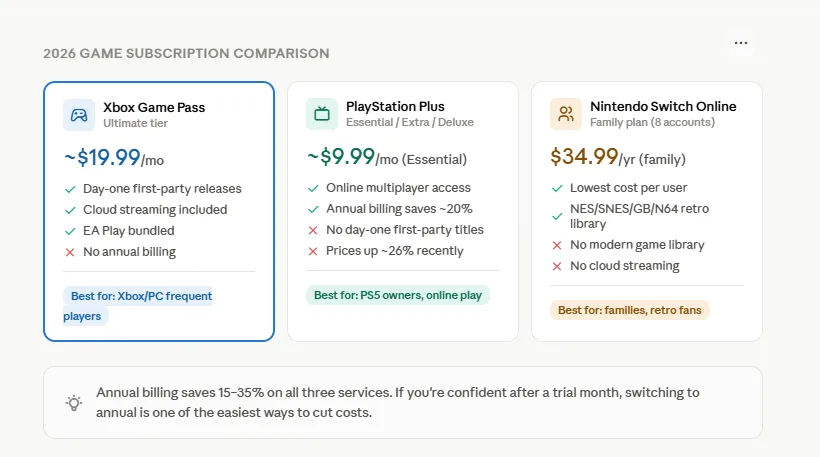
Xbox Game Pass Ultimate is the strongest value if you own an Xbox or gaming PC and play several hours a week. PS Plus Essential is the smart minimum for PS5 owners who mainly need online multiplayer. Nintendo Switch Online Family Plan is the best deal per user in all of gaming — period — if multiple people in your household own a Switch.
Not sure which console or platform you're on yet? Start with the 2026 Gaming Buyer's Guide: Consoles, PCs & Accessories before committing to a subscription.
Why Most People Pick the Wrong Game Subscription
Here's the mistake most people make: they choose the service with the biggest library.
That sounds logical until you realize the average gamer finishes about six titles per year — and yet Game Pass alone has over 400. You could subscribe to every service simultaneously and never come close to using what you're paying for. The real question isn't "which is biggest?" It's which service fits how you actually play, on the hardware you already own, at a price that makes sense for your household.
That framing matters even more in 2026. Gaming subscriptions have gone mainstream: Newzoo's 2025 Global Games Market Report notes that subscription-based gaming revenue continues to grow as platforms compete for recurring spend. These aren't niche products anymore — they're serious recurring expenses with real trade-offs, and picking the wrong one costs real money every month.
This guide breaks down Xbox Game Pass, PlayStation Plus, and Nintendo Switch Online across the factors that actually matter: pricing tiers, library quality, cloud streaming, and practical fit.
How Game Subscriptions Actually Work (Before You Subscribe)

Before comparing prices, there's one thing every first-time subscriber gets wrong: these are access licenses, not purchases.
Cancel your subscription and your "library" disappears. Games can also leave the catalog when licensing agreements expire — sometimes before you finish them. Microsoft typically gives 14 days' notice when a title is exiting Game Pass. Sony and Nintendo have their own policies. If you're the type who plays one game for six months before moving on, this matters more than the library size.
There are also two distinct ways games are delivered:
- Download-and-play: The game installs locally on your console or PC. Performance is native; no internet required once downloaded.
- Cloud streaming: The game runs on a remote server and streams to your device. Lets you play on a phone, tablet, or underpowered PC — but requires a stable broadband connection and is only available on higher (read: more expensive) tiers.
One more thing worth knowing upfront: online multiplayer is paywalled on all three platforms. Even if you have no interest in a game library, you're still paying a baseline subscription just to play your existing games online with other people. That entry-level cost is built in regardless of which tier you choose.
2026 Pricing: What Each Service Actually Costs
Pricing varies by region. Here's a transparent breakdown of current tiers across all three services.
Xbox Game Pass — 2026 Pricing
| Tier | US (Monthly) | Europe (Monthly) |
|---|---|---|
| Game Pass Standard | ~$14.99/mo | — |
| Game Pass Ultimate (console + PC + cloud) | ~$19.99/mo | €20.99/mo |
| PC Game Pass | ~$9.99/mo | — |
The headline pricing change in 2026: Xbox Game Pass Ultimate dropped to €20.99/month in Europe in April — a roughly 22% decrease from its previous price, according to Spliiit's Cloud Gaming Guide 2026. In the US, Wirecutter confirms Ultimate sits at approximately $19.99/month. There is no annual billing option for Game Pass in most markets.
PlayStation Plus — 2026 Pricing
| Tier | US (Monthly / Annual) | Europe (Monthly / Annual) |
|---|---|---|
| Essential (online play + monthly games) | ~$9.99/mo · ~$59.99/yr | €9.99/mo · €71.99/yr |
| Extra (+ game catalog) | ~$14.99/mo · ~$99.99/yr | — |
| Deluxe (+ classics + streaming) | ~$17.99/mo · ~$119.99/yr | — |
Annual billing saves meaningful money across all PS Plus tiers — roughly 15–20% versus paying month-to-month. Sony increased annual prices by as much as 26% across all tiers in a recent adjustment, per Statista, which makes the annual-vs-monthly decision more important than ever.
Nintendo Switch Online — 2026 Pricing
| Plan | US (Annual) | Europe (Annual) |
|---|---|---|
| Switch Online — Individual | $19.99/yr | — |
| Switch Online + Expansion Pack — Individual | $49.99/yr | — |
| Switch Online — Family (up to 8 accounts) | $34.99/yr | €34.99/yr |
| Switch Online + Expansion Pack — Family | $79.99/yr | — |
The standout number here: the Family Plan at €34.99/year for up to 8 accounts works out to roughly €4.37 per person per year in a household of eight — or €8.75 per person in a family of four. That's less than a single month of PS Plus Essential. No other major gaming subscription comes close on a per-user basis, per IGN's subscription comparison.
Xbox Game Pass in 2026: The Power Player's Pick
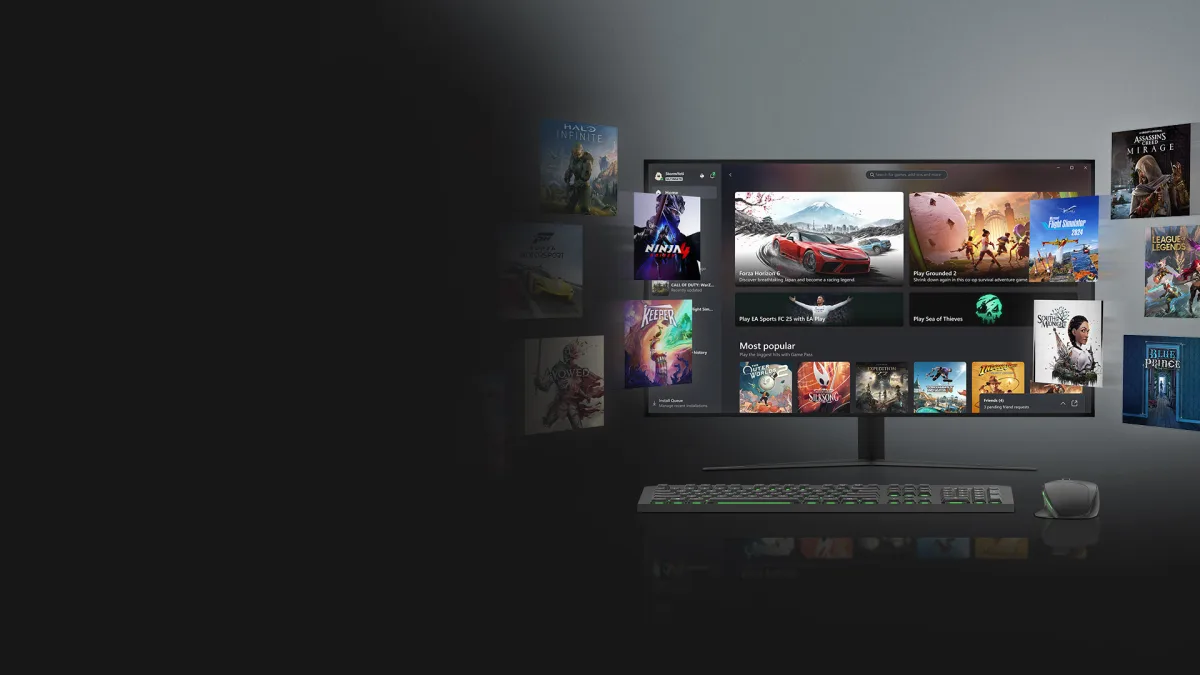
Xbox Game Pass Ultimate is the most ambitious gaming subscription on the market. At ~$19.99/month, it delivers access to over 400 games on Xbox consoles, Windows PC, and cloud streaming — and every game Microsoft publishes launches on the service the same day it hits retail, per Wirecutter.
That day-one promise is Game Pass's biggest differentiator. Every Forza title, every Halo entry, every Gears of War game, plus most of Bethesda's catalog — including Diablo IV via the Activision Blizzard deal — available at no extra charge from day one. PCMag rates Game Pass Ultimate 4.0 Excellent, and CNET notes it has "evolved far beyond its Xbox-bound origins" into a service that works across consoles, PCs, and nearly any device via cloud.
There is one notable 2026 change: New Call of Duty titles will no longer launch day one on Game Pass. Microsoft has committed to adding them "the following holiday season" instead. For CoD players, this removes one of Game Pass's most compelling selling points. For everyone else, it's a minor footnote.
The cloud streaming tier breakdown:
- Essential: ~50 streamable titles
- Standard/Premium: 200+ streamable titles
- Ultimate: 500+ streamable titles (the full catalog)
Ultimate also includes EA Play at no extra cost — adding Electronic Arts' back-catalog including FIFA, Madden, and Mass Effect titles.
If you're putting together your full gaming setup alongside a subscription, our Best Gaming Controllers 2026 guide covers whether third-party or official controllers make more sense for Game Pass play on different devices.
Who Game Pass Ultimate is for: Frequent players (several hours a week minimum) who own an Xbox or a Windows 10/11 PC, want variety across genres, and value cloud streaming on the go. The math gets harder to justify at $19.99/month if you finish two or three games a year and stick to the same franchise.
Who should look elsewhere: Casual players who buy the games they care about at launch and only need online multiplayer. Standard PS Plus Essential at $9.99/month likely serves them better.
PlayStation Plus in 2026: Three Tiers, One Core Limitation
PS Plus is the most misunderstood of the three services — largely because its three tiers serve very different purposes and the marketing doesn't always make that clear.
PS Plus Essential: Online Multiplayer, Not a Game Library
At ~$9.99/month (or ~$59.99/year), PS Plus Essential is primarily an online multiplayer paywall. It adds two to three monthly "free" games — but those games disappear the moment your subscription lapses. PCMag rates Essential 3.0 Average, reflecting that it's functional but unremarkable for players who mainly want online access and aren't interested in a rotating library.
If you're a PS5 owner who buys most games at launch and only needs online play, Essential is all you need. Don't upgrade unless you genuinely want the catalog.
PS Plus Extra: The Closest Sony Gets to Game Pass
Extra adds a catalog of hundreds of PS4 and PS5 titles — Sony's version of a Netflix-style game library. Here's the critical caveat that Game Pass marketing has made people forget: Sony does not release first-party titles on PS Plus on day one.
A PS5 owner who wants God of War Ragnarök, Marvel's Spider-Man 2, or any major Sony exclusive the week it launches still pays full retail price — regardless of their PS Plus tier. Extra is for players catching up on a back-catalog, not for staying current with new releases.
PS Plus Deluxe: Hard to Recommend for Most
Deluxe adds classic PlayStation titles (PS1, PS2, PSP) and game streaming. The streaming library is smaller and less consistent than Game Pass's cloud offering. Unless you have a specific interest in PlayStation classics from those eras, the additional monthly cost over Extra is difficult to justify for most players.
The bottom line on PS Plus: It's the right choice for dedicated PS5 owners. But the core limitation — no day-one first-party releases at any tier, combined with recent price increases of up to 26% — makes it harder to recommend at face value compared to a few years ago.
Nintendo Switch Online in 2026: The Underrated Family Value
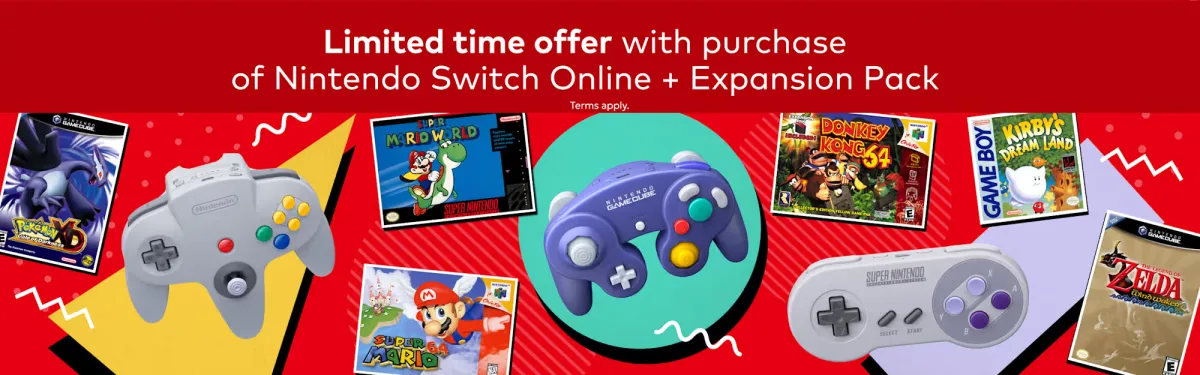
Nintendo Switch Online doesn't try to be Game Pass. It doesn't offer a rotating library of new releases or cloud streaming of modern titles. What it offers is online multiplayer, cloud saves, and a curated retro game collection — and it does all of that at a price no other service can match.
The base tier includes NES, SNES, and Game Boy libraries. The Expansion Pack adds Game Boy Advance, N64, and Sega Genesis titles, plus access to Nintendo's music streaming service (launched late 2024). PCMag rates Nintendo Switch Online 4.0 Excellent — the same rating as Game Pass Ultimate — largely because it delivers exactly what it promises at a price that's genuinely hard to argue with.
But you need to be honest about what it doesn't offer:
- No day-one Nintendo first-party releases. Zelda, Mario, Metroid — all still cost full retail at launch.
- No cloud streaming of modern Switch titles.
- No library of new or recent games comparable to Extra or Game Pass.
Nintendo Switch Online is for players who primarily buy Nintendo games outright and need online access plus retro content on top — not for players expecting a modern rotating library.
If you're evaluating whether the Switch itself is worth it alongside the subscription costs, our Best Retro Gaming Consoles 2026 guide covers how official retro hardware like the NES Classic and Sega alternatives compare to the retro offerings within Nintendo's subscription.
Library Quality: What You're Actually Getting
Raw game counts mislead. Here's what matters:
| Xbox Game Pass | PS Plus Extra | Nintendo Switch Online | |
|---|---|---|---|
| Library size | 400+ (500+ streamable on Ultimate) | Hundreds of PS4/PS5 titles | NES, SNES, GB, GBA, N64, Genesis |
| Day-one first-party | ✅ Yes (Xbox/Bethesda) | ❌ No | ❌ No |
| New releases | Strong — rotating monthly adds | Back-catalog focused | Retro only |
| Catalog churn | Moderate — 14-day exit notice | Lower churn | Very stable |
| Indie selection | Excellent | Good | Limited |
The practical difference: Game Pass lets you play new Microsoft titles on day one and graze across a wide indie library. PS Plus Extra lets you catch up on PlayStation's excellent first-party back-catalog — God of War, Horizon, Ghost of Tsushima — at a fraction of the retail price. Nintendo Switch Online gives you decades of curated retro history at a price nothing else matches.
Cloud Gaming: Which Service Lets You Play Anywhere?
If you don't always have access to a dedicated console or gaming PC, cloud streaming is the tiebreaker.
Xbox Game Pass Ultimate has the most developed cloud offering. You can stream 500+ titles to phones, tablets, browsers, and smart TVs. Uniquely, Ultimate subscribers can also stream games they own from Microsoft — not just titles in the Game Pass catalog — per Wirecutter's cloud gaming guide. This makes Ultimate genuinely useful for travel or shared-TV households.
PS Plus Deluxe includes game streaming, but the catalog is smaller and the experience less consistent than Xbox's offering. Sony has improved, but streaming remains a secondary feature.
Nintendo Switch Online has no cloud streaming of modern games. The Switch is itself portable, which partially addresses the on-the-go use case — but there's no mechanism to stream Switch titles to a non-Nintendo device.
If you're building a cloud-focused gaming setup and considering a streaming-capable laptop alongside a subscription, see our Best Gaming Laptops 2026 guide for machines that pair well with Game Pass Ultimate streaming.
Is Game Pass Worth It in 2026?
Yes — for the right type of player. Game Pass Ultimate's day-one library, EA Play inclusion, and cloud streaming make it the most feature-complete gaming subscription available. At ~$19.99/month, you need to be playing regularly to justify the cost. For players finishing six or more games a year across multiple genres, it's exceptional value. For someone who plays one franchise casually and mostly needs online multiplayer, it's overkill.
Is PS Plus still worth it? For PS5 owners, Essential remains a necessary overhead cost for online play — there's no way around it. The question is whether Extra adds enough value for your specific back-catalog interests. Given the recent price increases, the answer is genuinely player-dependent.
Is Nintendo Switch Online worth it? At $19.99/year for an individual or $34.99/year for a family, it's almost impossible to argue it isn't worth it if you own a Switch and play anything online. The Expansion Pack is a reasonable add-on for retro enthusiasts; the base tier is near-mandatory for Switch owners at essentially negligible cost.
Who Should Get Which Service: A Direct Decision Framework

You own an Xbox or gaming PC and play several hours a week:
→ Xbox Game Pass Ultimate at ~$19.99/month. Day-one first-party releases, EA Play, and 500+ cloud-streamable titles justify the cost for frequent players. PC-only players who don't need cloud streaming can opt for PC Game Pass at ~$9.99/month instead.
You own a PS5 and mainly need online multiplayer:
→ PS Plus Essential at ~$9.99/month. Upgrade to Extra only if you have a genuine backlog of PS4/PS5 titles you want to catch up on — don't pay for back-catalog access you won't use.
You own a PS5 and already buy most games at launch:
→ PS Plus Essential only. The higher tiers add catalog value, but if you're already buying Sony's exclusives at retail, Extra and Deluxe mostly overlap with what you're already paying for.
You have a Nintendo Switch and multiple people in your household:
→ Nintendo Switch Online Family Plan at $34.99/year for up to 8 accounts. Add the Expansion Pack ($79.99/year family) if retro gaming is a genuine interest. The per-user cost is unmatched by any competitor.
You play casually, mostly Nintendo exclusives, and buy outright:
→ Nintendo Switch Online base tier at $19.99/year. You don't need a broader library subscription if you're already buying the titles you care about.
You own multiple platforms:
Most players are better served by one strong subscription than splitting budget across two. Game Pass Ultimate covers Xbox and PC comprehensively. PS Plus Essential covers PlayStation multiplayer at low cost. Combining both only makes sense if you actively play on both platforms several hours a week.
One Practical Money-Saving Tip for All Three Services
Annual billing consistently saves 15–35% versus monthly billing across all three services. If you're confident after a trial month, switching to annual is one of the simplest ways to cut your gaming subscription costs without giving anything up.
For players looking to stretch their gaming budget further — including cheaper ways to buy individual titles outside of subscriptions — our Cheap Game Keys 2026 Guide covers where to find legitimately discounted Steam, PlayStation, and Xbox keys.
And if you're evaluating whether a brick-and-mortar option like GameStop makes sense alongside a subscription for physical purchases, the GameStop 2026 Review gives an honest look at where it still fits in 2026's gaming landscape.
FAQ
Can I use Xbox Game Pass on PS5?
No. Game Pass is exclusive to Xbox consoles, Windows PC, and cloud streaming via browser or the Xbox app on supported devices. There's no native PS5 integration.
Does PS Plus include cloud gaming on all tiers?
Only PS Plus Deluxe (the top tier) includes game streaming. Essential and Extra do not include cloud streaming access.
Can Nintendo Switch Online members play online with friends who have different accounts?
Yes. Nintendo Switch Online is required for online multiplayer, but players with different subscription tiers (individual vs. family) can still play together online.
Is it worth getting both Game Pass and PS Plus?
Only if you actively use both an Xbox/PC and a PS5 regularly. Most players who own both consoles are better served by Game Pass Ultimate for Xbox/PC and PS Plus Essential (minimum tier) for PS5 online access.
Do game subscription services work outside the US?
Yes, all three are available in most major markets, but pricing and library availability vary by region. Cloud streaming may also have geographic restrictions.
What happens to my game progress if I cancel a subscription?
Cloud saves typically remain stored for a limited time after cancellation (PlayStation keeps them for up to 6 months; Xbox varies by game). You'll lose access to play games until you resubscribe, but your save data is usually recoverable.
Reviewed by the Trusted Buyer Report editorial team. This article was drafted with AI assistance and fact-checked by a human editor before publishing. Trusted Buyer Report may earn a commission from purchases made through links on this page. Our editorial recommendations are finalized before any affiliate link is applied. Full disclosure · Review methodology