Buy vs. Skip: The Direct Comparison Before You Read Another Word
You have a browser tab open, a list of things you've been meaning to buy, and a Prime Day countdown timer somewhere on your screen. The question isn't whether Amazon Prime Day 2026 will have deals — it will. The question is whether the specific items you're eyeing are actually cheaper than they were last month, or whether you're looking at a price that was quietly inflated before the sale began. That distinction matters more than any product list.
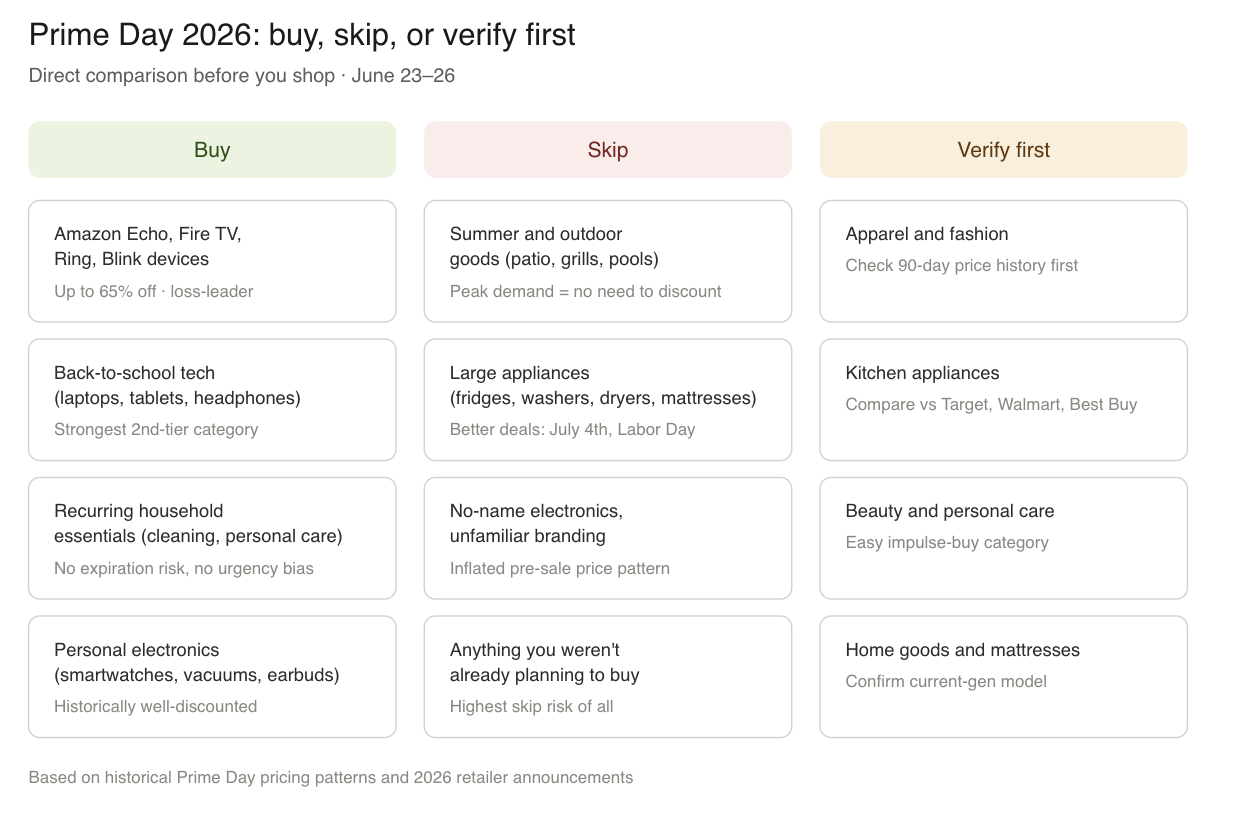
Before diving into the reasoning, here's the direct comparison. Every recommendation below is grounded in historical pricing data and documented patterns — not Amazon's marketing materials.
| Buy | Skip | Verify First |
|---|---|---|
| Amazon Echo, Fire TV, Ring, Blink devices | Summer and outdoor goods | Apparel and fashion |
| Back-to-school tech (laptops, tablets, headphones) | Large appliances (refrigerators, washers, dryers) | Kitchen appliances |
| Recurring household essentials (cleaning supplies, personal care) | No-name electronics with unfamiliar branding | Beauty and personal care |
| Personal electronics (smartwatches, robotic vacuums, Bluetooth headphones) | Anything you weren't already planning to buy | Home goods and mattresses |
One important caveat: even within the "Buy" column, individual items can still be bad deals. Omnia Retail's pricing analysis found that a considerable number of Prime Day items either saw prices return to previously observed levels or experienced only marginal reductions from a recently adjusted base. In plain terms: some "deals" are just the normal price with a red badge on them. The price-verification framework later in this article gives you a way to catch those before you click buy.
When Is Amazon Prime Day 2026? Confirmed Dates and Format
Amazon has officially confirmed Prime Day 2026 will run June 23–26, starting at 12:01 a.m. PDT on June 23, according to Amazon's own announcement and confirmed independently by NBC News. That's a meaningful departure from the traditional July window Amazon used for years — the last time Prime Day landed in June was 2021. The event keeps the four-day format Amazon introduced in 2025, when Prime Day ran July 8–11 for the first time as a four-day event rather than the historical two-day format.
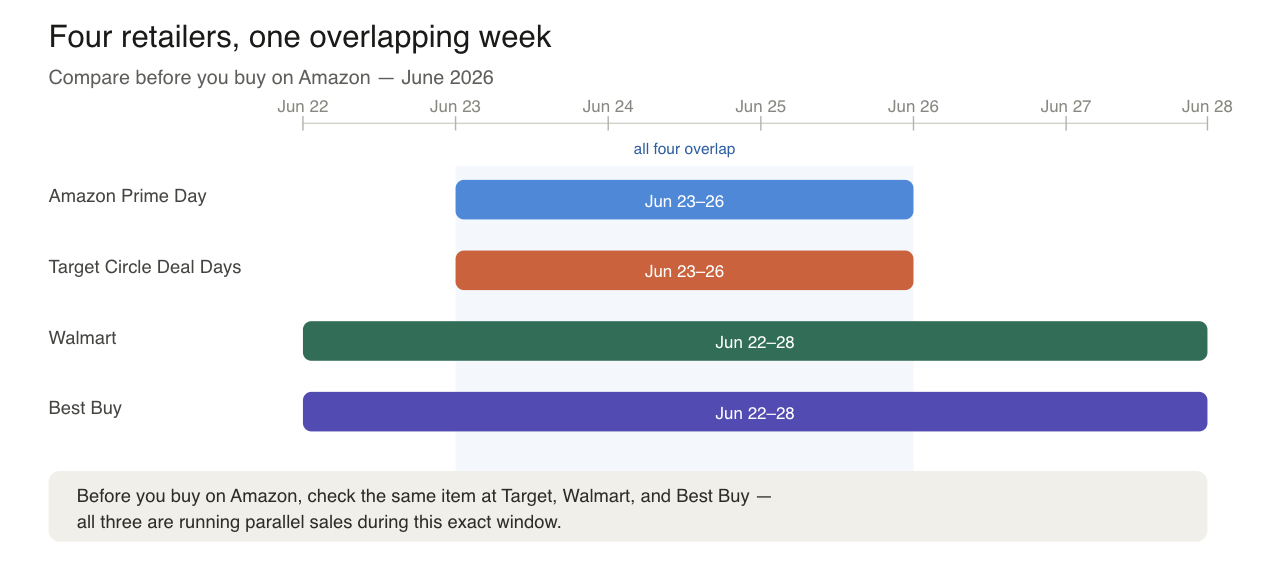
This year's shift to late June isn't an isolated Amazon decision — competing retailers are moving with it. NerdWallet reports that Walmart and Best Buy have announced competing sales running June 22–28, and Target's Circle Deal Days event runs the exact same dates as Prime Day, June 23–26. If you're not a Prime member and don't want another subscription, those parallel sales are worth checking before you sign up for a trial.
One source of confusion worth clearing up: Amazon also runs a Big Spring Sale that is entirely separate from Prime Day. According to Digital Commerce 360, the 2026 Big Spring Sale ran March 25–31, offering discounts up to 50% off on Amazon Outlet, 40% off fashion, and 35% off kitchen supplies. That event has already passed. Prime Day is the summer event — and the one with the deepest discounts on electronics and Amazon-branded hardware.
The June timing shift has a practical implication for back-to-school shoppers: it moves Prime Day earlier in the prep cycle, giving families more lead time before August. That's covered in more detail in a later section.
Who Can Shop Prime Day — and Whether a Membership Is Worth It
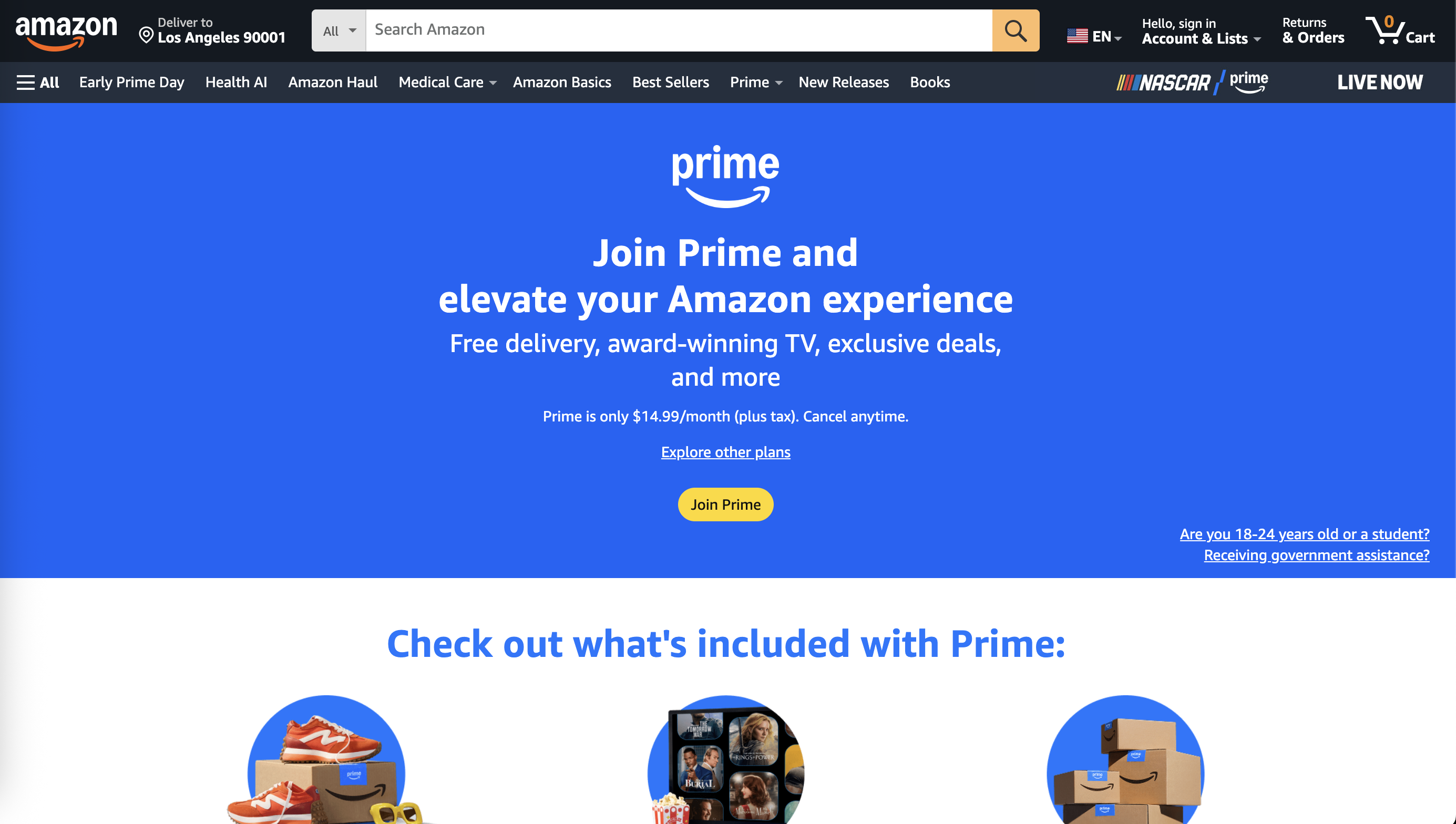
The deepest Prime Day discounts are exclusive to Prime members. Non-members can see some general price drops across Amazon during the event, but the headline deals — including Lightning Deals — require an active membership. A standard Prime membership costs $139 per year or $14.99 per month, and new members get a 30-day free trial, according to Amazon's official pricing and confirmed independently by NerdWallet.
Two discounted membership tiers are worth knowing about. Prime for Young Adults costs $7.49 per month (or $69 per year) for those aged 18–24 or enrolled college students, with a six-month free trial rather than the standard 30 days. Prime Access costs $6.99 per month for those who qualify for certain government assistance programs, such as SNAP, Medicaid, or SSI. If you fall into either category and haven't checked your eligibility, it's worth doing before Prime Day.
If your only goal is to shop Prime Day, signing up for the free trial and canceling before the billing date is a widely acknowledged and legitimate strategy. The math is straightforward: if you expect to save more than $14.99 on your planned purchases, the trial pays for itself even if you cancel immediately after. The break-even threshold is low enough that most shoppers with a concrete list will clear it easily.
Lightning Deals deserve a specific mention. These are flash sales with limited quantities and short purchase windows, and they're one of the most time-sensitive Prime Day features. They're Prime-exclusive, they move fast, and the best ones on high-demand items can sell out within minutes. If you're targeting a specific Lightning Deal, have your payment information saved and your cart ready before the event starts.
What to Buy on Prime Day 2026: Categories With a Proven Track Record
Amazon-branded devices are the single most reliable Prime Day category, and the reasoning is structural rather than speculative. Amazon uses its own hardware — Echo speakers, Fire TV sticks and televisions, Ring doorbells and cameras, Blink security systems — as a loss-leader to drive ecosystem adoption. Selling you an Echo at a steep discount is worth it to Amazon if it keeps you buying from Amazon for years afterward. That incentive structure produces the deepest and most consistent discounts of any Prime Day category. Amazon's own 2026 event materials point to up to 65% off Echo, Ring, Fire TV, and Blink devices as part of the headline early-deal lineup.
Back-to-school tech is the second strongest category, and the late June timing of Prime Day 2026 makes it more relevant than ever. Laptops, tablets, Bluetooth headphones, and accessories for students are all historically well-discounted, and buying in late June gives families a longer runway before school starts — enough time to return or exchange if something isn't right. Headphones, robotic vacuums, smartwatches, and personal electronics broadly tend to perform well during the event.
Recurring household essentials — cleaning supplies, personal care products, paper goods, pantry staples — are a smart buy for a different reason. These items have no expiration risk in the near term, you know you'll use them, and the purchase decision isn't driven by Prime Day urgency. Stocking up on things you buy every month anyway, at a genuine discount, is one of the lowest-risk ways to use Prime Day savings.
One emerging factor for 2026: Consumer Reports deals editor Samantha Gordon points to World Cup buzz as a reason to expect deeper-than-usual discounts on home entertainment gear this year — streaming devices, soundbars, surround speakers, and high-end headphones — since the tournament is based in North America for the first time in decades. If a TV or sound system has been on your list, 2026 may be a better-than-average year for that category specifically.
What to Skip on Prime Day 2026: Categories That Rarely Deliver Real Value
Summer and outdoor goods are a consistent skip, and the logic is simple supply-and-demand: these items are at peak demand during summer, which gives sellers almost no incentive to offer deep discounts. A retailer moving patio furniture or grills in late June doesn't need to cut prices to generate sales — the season is doing that work already. If you're researching gear for outdoor activities, the Outdoor & Sports Gear: The 2026 Buyer's Guide covers which products hold their value and which categories see better pricing in the off-season.
Large appliances deserve their own callout. Refrigerators, washers, dryers, and mattresses are a documented skip category for Prime Day specifically — money-saving expert Andrea Woroch notes that July Fourth sales typically bring better appliance pricing, and Labor Day sales bring better pricing still. If a major appliance is on your list, Prime Day is the wrong event to wait for; smaller kitchen gadgets like blenders and air fryers are a better fit for the format, since they're easier to ship and don't carry the same seasonal discount calendar.
No-name electronics deserve particular caution. There's a specific, well-documented pattern: differently-branded products that appear to be identical items, with inflated pre-sale prices creating the illusion of a discount. An unfamiliar brand selling headphones at "70% off" from a suspiciously high original price is a red flag, not a bargain. Stick to brands you recognize, or verify the product's price history before buying.
Anything you weren't already planning to buy represents the highest skip risk of all. Prime Day urgency — countdown timers, "only 3 left" warnings, Lightning Deal clocks — is a well-documented psychological trigger. If a deal doesn't feel like a deal, it probably isn't. The event's structure is designed to create urgency, but that urgency is often manufactured. Buying something you didn't need before Prime Day started is almost never a good financial decision, regardless of the listed discount percentage.
Getting too far ahead of yourself carries its own cost — buying items you won't need for months ties up money unnecessarily and can result in missing better deals closer to the actual point of need. If you're considering jewelry or accessories as gifts for future occasions, the Jewelry & Accessories Buyer's Guide 2026 offers a more structured framework for evaluating value outside of sale-event pressure.
How to Tell If a Prime Day Deal Is Actually a Good Price
This is the skill most Prime Day guides skip, and it's the most important one. A discounted price is only meaningful relative to what the item normally costs — and "normally" is harder to define than Amazon's marketing implies.
There's a specific and recurring pattern worth watching for: prices that get quietly raised in the weeks before Prime Day, then reinstated at that same elevated level during the event under a "deal" badge. The only way to catch this is to check the item's price before Prime Day begins. Price-tracking tools that show 90-to-180-day price history are freely available and take less than a minute to use. If the "Prime Day price" matches or exceeds the item's price from three months ago, the deal is largely theatrical.
Omnia Retail's analysis reinforces this. Their data shows that for a substantial segment of products, Prime Day deals did not represent significant discounts from the immediate pre-event price — instead, prices returned to previously observed levels after being quietly raised in the weeks before the event. This is not a fringe occurrence. It's a documented pricing strategy.
A practical verification checklist before you buy anything on Prime Day:
- Check the item's 90-day price history using a price-tracking tool before the event starts.
- Compare the Prime Day price against the same item at Walmart, Target, and Best Buy — all three are running competing sales over the same window in 2026.
- Confirm the model being discounted is current generation, not a previous-year version being cleared out.
- For electronics, check whether the discount applies to the base model or a configuration with meaningful specs.
- If the deal is a Lightning Deal, decide in advance whether you want it — don't make the decision under the countdown clock.
Amazon's own Rufus AI tool can track prices and set alerts during the event. It's a built-in resource that many shoppers overlook. Using it to set a target price before Prime Day means you're buying on your terms, not Amazon's.
One more data point worth internalizing: Incrementum Digital found that conversion rates dipped noticeably by Days 3 and 4 of the 2025 four-day event. Shoppers who didn't buy on Day 1 weren't rushing — they were comparing. That behavioral pattern suggests the urgency of Day 1 is real but often unnecessary. Many deals persist through the event, and taking a day to verify a price is almost always worth the wait.
Understanding Prime Day Spending Patterns: What the Data Says
Knowing how other shoppers behave during Prime Day helps you recognize the same patterns in yourself — and plan around them. The numbers from 2025 are instructive.
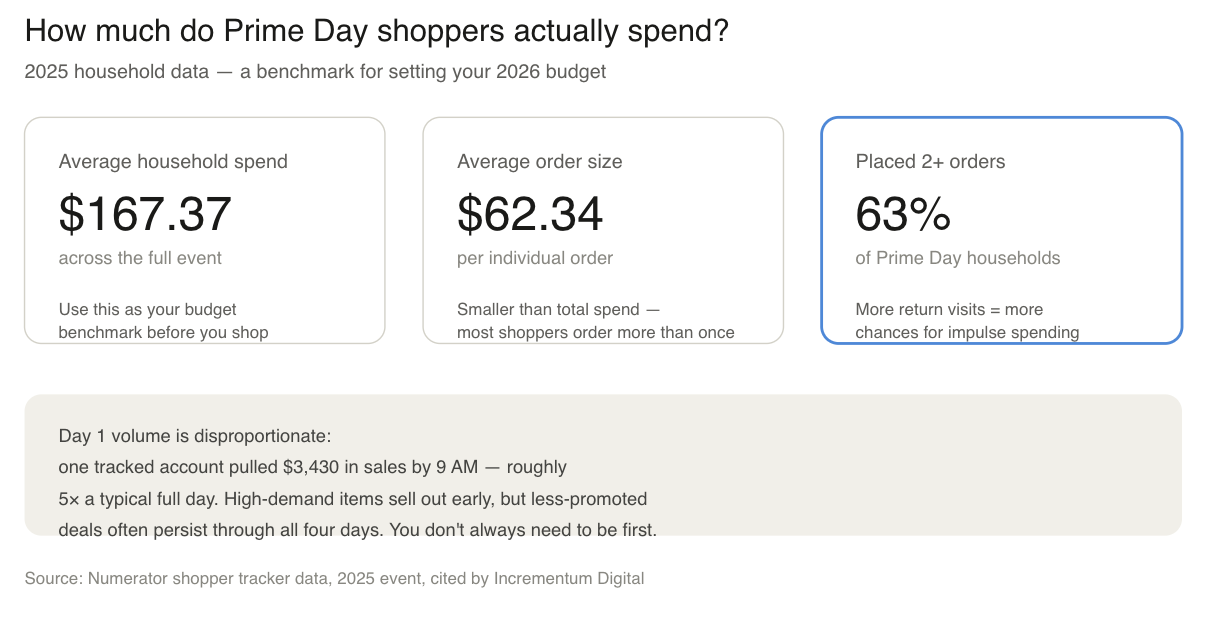
According to Numerator's shopper tracker data cited by Incrementum Digital, the average Prime Day household spent $167.37 across the event, with an average order size of $62.34. Critically, 63% of Prime Day households placed two or more separate orders. That multi-order pattern is worth pausing on: most shoppers don't make one deliberate purchase — they return to the site multiple times, which multiplies both the opportunity for good deals and the risk of impulse spending.
Day 1 drives disproportionate volume. One Incrementum-managed account pulled $3,430 in ordered product sales by 9 AM on Day 1 — roughly five times a typical full day's sales. For shoppers, this means two things: high-demand items and the most-publicized deals may sell out or lose deal status on Day 1, but less-promoted deals often persist through the event. You don't always need to be first.
Setting a budget before Prime Day starts — and tracking it across multiple sessions — is the most practical safeguard against the 63% multi-order pattern leading to overspending. The $167.37 average is a useful benchmark. There's also a broader cost-conscious backdrop to 2026 shopping worth noting: a NerdWallet survey found 45% of Americans say they want to cut back on nonessential spending, including shopping, this year. If your planned spend is significantly above the $167.37 average, it's worth reviewing your list against the buy/skip framework above before the event begins.
The June Timing Shift: What It Means for Back-to-School Shoppers
Moving Prime Day to late June changes the back-to-school math in a meaningful way. Historically, Prime Day in mid-July gave shoppers roughly four to six weeks before the August back-to-school rush. A late June date extends that window to closer to two months — enough time to research, order, receive, test, and return items if needed before school starts.
For families buying laptops, tablets, or accessories for students, this is a genuine advantage. You're not making a rushed decision in the final weeks of summer. You have time to compare a Prime Day price against the back-to-school sales that typically follow in July and August, rather than treating Prime Day as your only shot. Tax-free shopping weekends, which most states schedule in early August, are a second opportunity worth holding some budget back for — particularly for school supplies and clothing, which usually see deeper discounts during those windows than during Prime Day itself.
The practical sequencing for back-to-school shoppers: use Prime Day in late June for the big-ticket tech items (laptops, tablets, headphones) where Amazon's discounts are typically strongest, and hold off on clothing, notebooks, and other lower-cost school supplies until closer to August, when dedicated back-to-school sales and state tax-free weekends typically beat whatever is available in June.
Frequently Asked Questions
When exactly is Prime Day 2026?
Prime Day 2026 runs June 23–26, starting at 12:01 a.m. PDT on June 23. Amazon confirmed these dates officially, and the event keeps the four-day format introduced in 2025.
Do I need a Prime membership to shop Prime Day deals?
Yes, for the headline deals. Non-members can see some general price reductions across Amazon during the event, but Lightning Deals and the deepest discounts are restricted to active Prime members. A standard membership costs $14.99 per month or $139 per year, with a 30-day free trial for new members.
Is it worth signing up for a free trial just for Prime Day?
For most shoppers with a concrete purchase list, yes. If your planned savings exceed $14.99, the trial pays for itself even if you cancel immediately after the event. This is a widely acknowledged, legitimate strategy — just remember to cancel before the trial converts to a paid month if you don't intend to keep the membership.
How do I know if a Prime Day deal is actually a discount?
Check the item's price history over the past 90 to 180 days using a free price-tracking tool before the event starts. If the "Prime Day price" matches or is higher than the price from a few months ago, the discount is largely cosmetic. This single habit catches the majority of inflated "deals."
Should I buy appliances or mattresses on Prime Day?
Generally, no. Large appliances and mattresses see deeper, more reliable discounts around July Fourth and Labor Day than during Prime Day. If one of these is on your list, it's worth waiting unless you find an unusually steep, price-history-verified discount during the event itself.
Are other retailers running sales at the same time as Prime Day 2026?
Yes. Target's Circle Deal Days runs the same June 23–26 window, and Walmart and Best Buy have both announced competing sales from June 22–28. Comparing prices across all four retailers before buying is one of the simplest ways to confirm you're getting Amazon's best price, not just a price.
Final Recommendation
Prime Day 2026 runs June 23–26, and the deals will be real for some categories and theatrical for others — your job is telling the difference before you check out, not after.
Buy Amazon-branded devices without much hesitation. Echo, Fire TV, Ring, and Blink hardware get the deepest, most structurally reliable discounts of the entire event, because Amazon profits from your long-term ecosystem use more than from the device sale itself. Back-to-school tech and recurring household essentials are close seconds — both categories have a genuine track record of real Prime Day savings.
Skip large appliances, summer and outdoor goods, and no-name electronics making implausible discount claims. None of these categories play to Prime Day's structural strengths, and better pricing on appliances specifically is reliably available a few weeks later around July Fourth and Labor Day.
Verify everything else — apparel, kitchen appliances, beauty, home goods — against a 90-day price history before buying, and cross-check against Target, Walmart, and Best Buy, all of which are running parallel sales over the same four days in 2026. Set a budget before the event starts; the average Prime Day household spends $167.37 across multiple separate orders, and that multi-order pattern is exactly where overspending creeps in.
The shoppers who come out of Prime Day satisfied are, disproportionately, the ones who had a list before the countdown timer started and a price-history tool open before they clicked buy. Everyone else is mostly responding to the red badge.