
Here is the most common misconception about booking accommodation in 2026: that Airbnb is always cheaper than hotels. It is not. For a solo traveler booking a two-night city stay, a hotel will frequently beat an Airbnb on total cost once cleaning fees and service charges are factored in. The real question is not which platform is cheapest in general — it is which platform is right for your specific trip type, group size, and destination. That distinction changes everything.
To make that determination accurately, you need current fee data, real booking scenarios, and an honest look at where each option genuinely wins. This article provides all three, drawing on 2026 market research and simulated booking comparisons so you can apply the framework to your next trip immediately. If you want a broader view of travel planning beyond accommodation, the Complete Travel Buyer's Guide 2026: Hotels, Flights & Vacations covers flights, loyalty programs, and booking strategy in the same evidence-based format.
The Accommodation Landscape Has Shifted: What's Different in 2026
The vacation rental boom of 2020–2022 — when demand outpaced supply and hosts could charge almost anything — is over. The 2026 market is more competitive, more selective, and more nuanced. According to StayFi's 2026 Vacation Rental Statistics, available listings are projected to grow by 4.6% this year while average daily rates rise by a modest 1.5% and occupancy eases by roughly 1%. That combination means travelers have more options and slightly more negotiating power than they did two years ago.
The scale difference between platforms is significant. According to RubyHome's early 2026 data, Airbnb holds over 8 million active listings globally, while Expedia Group's VRBO sits at approximately 2.2 million. That gap affects search variety, availability in niche destinations, and the likelihood of finding something that fits your exact requirements on short notice.
Quality differentiation is increasing. The same StayFi report, citing AirDNA data, found that luxury-tier rental average daily rates rose 5.23% year over year while budget listings saw a slight decline of 0.33%. Travelers are gravitating toward properties that feel distinctive — not simply larger or more amenity-heavy. According to Fortune Business Insights, the vacation rental market was valued at USD 174.84 billion in 2025 and is projected to grow at a compound annual rate of 10.42% through 2034, which means sustained platform competition and continued investment in the guest experience across all three accommodation types.
One behavioral shift matters for planning: booking windows have shortened across markets. Last-minute hotel bookings have become more viable as inventory management systems improve. Vacation rental bookings, by contrast, still reward earlier action — particularly for family-sized properties in peak destinations. According to Triad Vacation Rentals' 2026 booking behavior analysis, extended-stay bookings of 7–30 nights still average a 30–60 day booking window, even as short urban stays have compressed to 7–14 days.
Understanding the True Cost: Fees, Taxes, and What You Actually Pay
The nightly rate you see in search results is not what you pay. On every platform, the gap between the advertised price and the checkout total can be substantial, and it varies enough between platforms to reverse a cost comparison entirely.
Airbnb's fee structure changed significantly in late 2025. Most hosts have now moved to a single-fee model: Airbnb deducts a 15.5% service fee directly from the host's payout, and guests see no separate service fee at checkout — the listed price is the price, before taxes. A smaller number of hosts (mainly those not using property management software) remain on the older split-fee model, where the host pays roughly 3% and the guest pays a separate 14.1%–16.5% service fee on top of the listing price. Either way, Airbnb's total take is roughly the same — about 15% of the booking subtotal — the difference is simply who sees the fee at checkout. VRBO charges hosts 5% of the rental amount plus a 3% payment processing fee — 8% total — and guests pay a separate service fee on top of the nightly rate. VRBO also offers an annual subscription model at $499 per year for high-volume properties, which can affect how costs are structured and passed to guests. These fee structures are documented by Awning's 2026 Airbnb vs VRBO comparison and Airbnb's own service fee documentation.
Hotels present a different transparency problem. Many properties advertise a base room rate and then add resort fees, destination fees, parking charges, and taxes at checkout. These additions can push the final bill 20–35% above the listed rate — a figure that rarely appears on aggregator sites like Google Hotels or Kayak at the search stage.
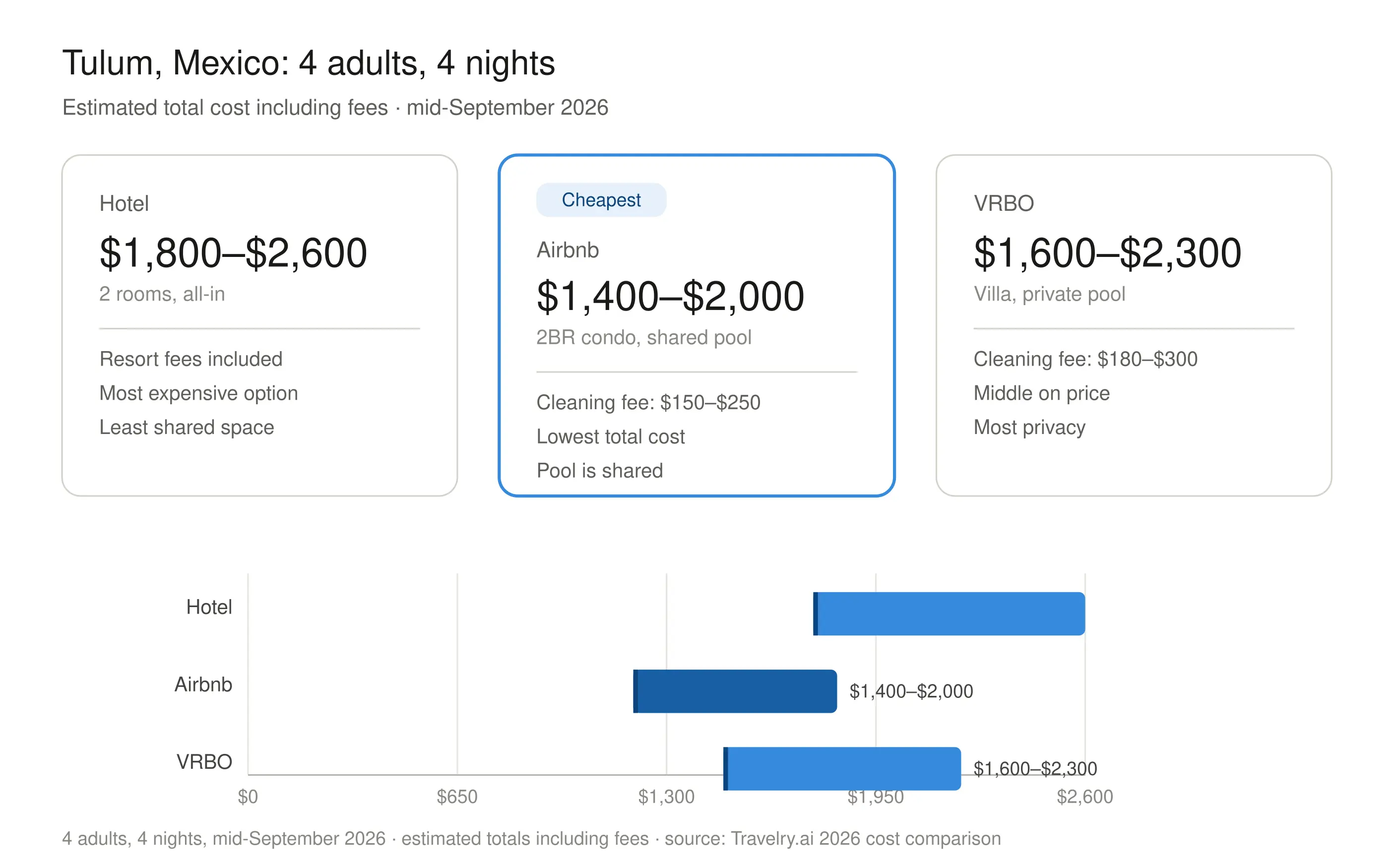
The Tulum scenario from Travelry.ai's 2026 cost comparison illustrates this clearly. For four adults staying four nights in mid-September 2026, a boutique hotel or resort near the beach or in Aldea Zama runs an estimated $1,800–$2,600 all-in, including resort fees. A comparable 2-bedroom Airbnb condo with a shared pool in the same area runs $1,400–$2,000, including a cleaning fee of approximately $150–$250. A VRBO villa — often with a private pool and slightly more space — runs $1,600–$2,300, including cleaning fees of $180–$300. The hotel is the most expensive option for this group, and the Airbnb is the cheapest, but only by a margin that depends on which specific properties you compare at the checkout stage.

The rule is simple: always reach the final checkout screen on each platform before making a comparison. Headline rates are marketing; checkout totals are reality.
Airbnb in 2026: Strengths, Weaknesses, and Who It Serves Best
Airbnb's primary advantage is scale. With over 8 million active listings, it offers the widest selection across urban centers, rural retreats, and international destinations. No other platform comes close to its geographic coverage, which matters most when you are traveling somewhere obscure or searching for a very specific property type.
Booking volume data confirms Airbnb's dominance. According to Triad Vacation Rentals' 2026 booking behavior analysis, in a multi-channel property management sample, Airbnb generated 2,043 reservations representing 58% of total bookings. VRBO generated 365 reservations at 10%. Nearly six in ten guests chose Airbnb even when the same properties were listed on multiple platforms simultaneously.
Airbnb serves the broadest range of trip types: solo city stays, couples getaways, group travel, and genuinely unique properties like treehouses, converted barns, or houseboats. The platform's ranking algorithm, as documented by Awning, rewards response rate, acceptance rate, review count, listing completeness, and price competitiveness — which means well-managed listings tend to surface reliably, and Superhost or Guest Favorite status provides a meaningful quality signal when you are uncertain about a host.
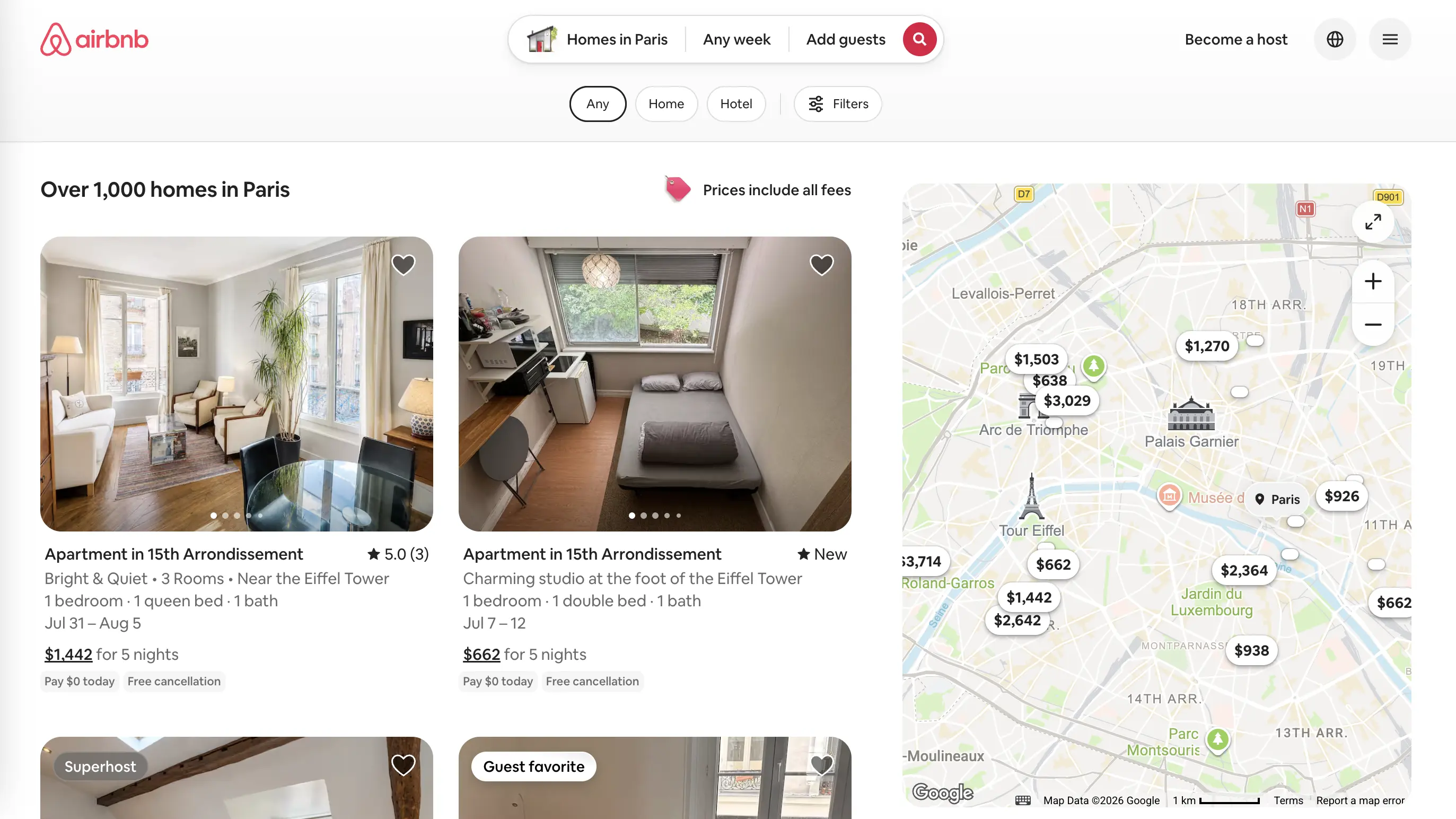
The weaknesses are real. Quality control is inconsistent. Cancellation policies vary by listing, so you need to read the specific terms rather than assuming a platform-wide standard. Most critically, cleaning fees make short stays disproportionately expensive. Using the Paris comparison from Travelry.ai's research as a reference point, a cleaning fee in the $100–$150 range on a 4-night stay adds roughly $25–$38 per night to your effective cost before service fees or taxes — and on a one- or two-night stay, that same flat fee is spread across far fewer nights, which is exactly where many hotels become cheaper. Airbnb is also competitive for extended stays of 7–30 nights, but according to Triad Vacation Rentals, guests in this segment increasingly expect direct conversation about lease terms rather than instant booking, which adds friction to the process.
VRBO in 2026: Why Families and Groups Keep Coming Back
VRBO's defining characteristic is its listing policy: every property on the platform is a whole home. There are no shared spaces, no host-occupied listings, and no situations where you might encounter another guest in the hallway. For families with young children, multi-generational groups, or anyone who values full privacy, this is not a minor detail — it is the primary reason to start your search on VRBO rather than Airbnb.
VRBO's approximately 2.2 million listings are fewer than Airbnb's, but they are concentrated in the destinations where families actually travel: beach towns, mountain resorts, and lake communities. According to Awning's platform comparison, VRBO is particularly strong in these classic vacation markets and benefits from Expedia Group cross-promotion across Expedia, Hotels.com, and Hotwire — increasing listing visibility for travelers who start their search on those platforms.
For luxury properties with average daily rates of $500 or more, VRBO often outperforms Airbnb. Triad Vacation Rentals' 2026 booking behavior data shows that in this luxury segment, guests spend more time evaluating host credentials and About pages, cleaning fee tolerance is higher — up to 20–25% of the total booking, compared with the 15–17% threshold that triggers checkout abandonment in the broader market — and VRBO's audience of families and mature travelers is a better fit for high-end whole-home properties. Direct bookings and referrals also represent a larger share of luxury reservations, suggesting that VRBO guests in this tier are more deliberate and less price-sensitive than the average Airbnb user.
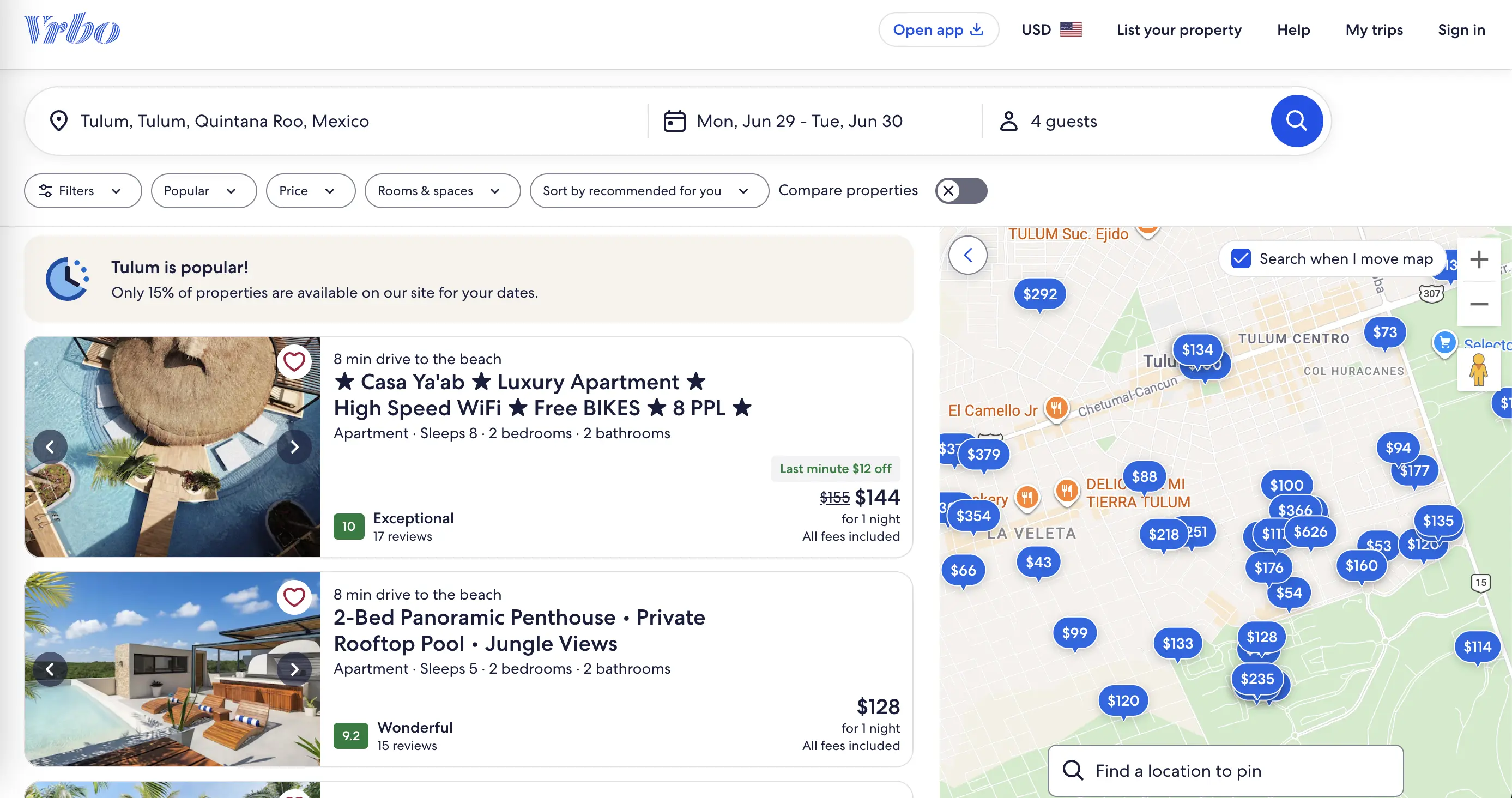
Returning to the Tulum example: the VRBO option at $1,600–$2,300 for four adults over four nights frequently includes a private pool — a meaningful upgrade over the shared-pool Airbnb condo at a comparable or slightly higher price. For a group that values that privacy, the incremental cost is easy to justify. For a multi-generational beach trip where grandparents, parents, and children need separate bedrooms and a shared living space, VRBO's inventory of larger whole-home properties makes it the natural first search, not an afterthought.
Hotels in 2026: Where They Still Win — and Where They Don't
Hotels have genuine, underappreciated advantages that vacation rental comparisons often dismiss too quickly. No cleaning fee on arrival. Daily housekeeping if you want it. A 24-hour front desk. Standardized cancellation policies that are consistent across the brand. These are not trivial conveniences — they are meaningful reliability guarantees that vacation rentals rarely match.
For solo travelers on short trips, especially business travel, hotels frequently win on total cost and pure convenience. A one-night stay at a Marriott or Hilton property earns loyalty points, may include breakfast, offers guaranteed late checkout for elite members, and involves zero uncertainty about the state of the room on arrival. No Airbnb or VRBO listing can replicate the predictability of a branded hotel room, and for a traveler who values that consistency above all else, the platform comparison is straightforward.
Loyalty programs represent a genuine financial advantage for frequent travelers. Marriott Bonvoy, Hilton Honors, and World of Hyatt accumulate points across stays that can be redeemed for free nights, room upgrades, and travel credits. Airbnb and VRBO have no equivalent program, which means the effective cost of hotels decreases meaningfully for travelers who stay frequently enough to reach mid-tier or elite status.

Illustrative: boutique hotel style in Tulum
Hotels lose badly on group travel. Four adults in Tulum need two hotel rooms, which doubles the room rate and eliminates any shared-space benefit. The Travelry.ai data showing $1,800–$2,600 for two boutique hotel rooms in Tulum versus $1,400–$2,000 for a two-bedroom Airbnb condo illustrates a cost gap that widens as group size increases. At six or eight travelers, the comparison is not close.
Accessibility is an area where hotels maintain a clear advantage. ADA-compliant rooms, roll-in showers, visual fire alarms, and on-site staff trained to assist guests with disabilities are standardized at major hotel brands in ways that vacation rentals inconsistently provide. If accessibility is a requirement rather than a preference, hotels are the more reliable choice in 2026.
The transparency problem with resort fees and destination fees remains unresolved at many hotel brands. Returning to the Tulum example above: a boutique hotel that advertises an appealing nightly rate can still land at $1,800–$2,600 total for two rooms over four nights once resort fees and taxes are applied — a gap that only becomes fully visible at checkout. This is the same transparency problem that Airbnb and VRBO have, just structured differently.
The Decision Framework: Which Platform Wins by Trip Type
Rather than a generic ranking, the right approach is matching platform strengths to your specific situation. The table below reflects the evidence from 2026 market data and the booking scenarios examined throughout this article.
| Trip Type | Airbnb | VRBO | Hotel |
|---|---|---|---|
| Solo, 1–3 nights, urban | Not ideal — cleaning fees erode savings | Not ideal — limited urban inventory | Recommended — convenience, loyalty points, no cleaning fee |
| Couple, 3–7 nights, leisure | Competitive — unique properties, compare checkout totals | Competitive — whole-home privacy, fewer urban options | Competitive — depends on loyalty status and destination |
| Group of 4+, any duration | Recommended — shared space, single checkout divides well | Recommended — whole-home guarantee, private pools | Not ideal — multiple rooms multiply costs |
| Family or multi-gen, beach/mountain | Competitive — wide selection | Recommended — whole-home focus, classic vacation markets | Not ideal for larger groups |
| Extended stay, 7–30+ nights | Competitive — negotiate terms directly | Competitive — larger properties | Not ideal — costs accumulate, no kitchen |
| Luxury property, $500+ ADR | Competitive | Recommended — audience fit, credential visibility | Competitive for branded luxury hotels |
| Accessibility requirements | Not ideal — inconsistent | Not ideal — inconsistent | Recommended — standardized ADA compliance |
For extended stays, the Triad Vacation Rentals data shows that booking windows for 7–30 night stays average 30–60 days, and guests in this segment prioritize workspace quality, kitchen equipment, and parking above most other filters. If you are planning a stay of this length, start your search earlier than you would for a short trip, and be prepared to message hosts directly rather than relying on instant booking.
How to Read Fees Before You Book: A Practical Checklist
The single most effective habit you can develop as a traveler in 2026 is reaching the final checkout screen on every platform before making a decision. Here is a repeatable process for doing that accurately.
- Airbnb: Click the price breakdown icon on any listing page before entering payment details. Most listings now show the total price upfront with no separate guest service fee, but a price breakdown still itemizes the nightly subtotal, cleaning fee, and estimated taxes. Do not compare Airbnb to a hotel using the nightly rate displayed in search results — always use the total.
- VRBO: The total price including all fees is displayed before checkout, but cleaning fees and service fees are listed separately. Add them manually when comparing to a hotel rate or Airbnb listing.
- Hotels: Search for "resort fee" or "destination fee" in the property details on the hotel's own website. Aggregator sites like Google Hotels and Kayak frequently omit these charges from the displayed rate. Call the property directly if the fee structure is unclear.
- Group trips: Divide the total checkout cost by the number of travelers to calculate a true per-person cost. For example, a $3,600 VRBO villa total for six people works out to $600 per person — often less than a single hotel room per person in the same destination. Run this math on your own checkout total rather than assuming it holds for every property.
- Short stays: For stays of one or two nights, calculate the effective nightly rate including the cleaning fee. A $150 cleaning fee on a single night at a $150-per-night Airbnb effectively doubles your cost for that stay. At that point, a hotel room at a comparable nightly rate, with no cleaning fee and daily housekeeping included, is usually the better deal.
- Cancellation policy: Read the specific cancellation terms on every vacation rental listing — they vary by host, not by platform. Hotels with flexible rate tiers offer more predictable cancellation windows, which matters if your travel dates might change.
Frequently Asked Questions
Is Airbnb or VRBO better for families?
VRBO is generally the stronger starting point for families. Its whole-home-only policy eliminates any uncertainty about shared spaces, and its inventory is concentrated in beach, mountain, and lake destinations where families most commonly travel. For luxury family properties with daily rates of $500 or more, VRBO's audience of mature and family travelers makes it the better fit, according to Triad Vacation Rentals' 2026 booking behavior data.
When does a hotel beat Airbnb on cost?
Hotels typically beat Airbnb on total cost for solo stays of one to three nights in urban destinations. A flat cleaning fee — commonly in the $100–$250 range depending on the property and market — barely changes your per-night cost on a week-long stay, but on a one- or two-night booking it can add $50 or more per night to your effective rate before service fees and taxes. At that point, a hotel room with no cleaning fee and included amenities is frequently cheaper. The comparison shifts in favor of Airbnb as stay length increases and group size grows.
How much does VRBO charge guests in fees?
VRBO charges hosts 5% of the rental amount plus a 3% payment processing fee (8% total). Guests pay a separate service fee on top of the nightly rate. Some high-volume hosts use VRBO's annual subscription model at $499 per year instead of the per-booking fee, which may affect how costs are passed through to guests. Always check the total at checkout rather than calculating from the nightly rate alone.
Are vacation rental platforms safer than hotels?
Hotels offer more standardized safety guarantees: fire safety inspections, ADA compliance, 24-hour staff, and brand-level accountability. Vacation rentals vary significantly by host and property. Airbnb's Superhost and Guest Favorite designations and VRBO's review system provide quality signals, but they are not substitutes for regulatory compliance. For travelers with accessibility needs or those who prioritize consistent safety standards, hotels remain the more reliable choice.
Is it worth booking directly instead of through Airbnb or VRBO?
Direct bookings can eliminate platform service fees, but they also remove the platform's dispute resolution and payment protection. For first-time stays with an unknown host or property manager, the platform's protections are worth the fee. Direct bookings make more sense for repeat stays with a host you already trust, or for extended stays where the fee savings are substantial enough to justify the reduced protection.
Final Recommendation
There is no universally correct answer to the Airbnb vs VRBO vs hotels question in 2026 — but there is a correct answer for your trip, and it follows a clear logic.
Book a hotel if you are traveling solo for one to three nights in an urban destination, if you rely on loyalty points to offset costs, or if accessibility is a non-negotiable requirement. The convenience, predictability, and fee structure of hotels genuinely win in these scenarios.
Book on Airbnb if you want the widest selection, are traveling as a couple or small group for three or more nights, or are looking for a unique property type that hotels cannot offer. Airbnb's 8 million listings and 58% booking share across multi-channel markets reflect real demand — it is the default platform for most trip types for good reason. Just always compare checkout totals, not nightly rates.
Book on VRBO if you are traveling with a family, a multi-generational group, or four or more people to a beach, mountain, or lake destination. VRBO's whole-home guarantee and concentration in classic family vacation markets make it the most reliable starting point for this segment. For luxury properties at $500 or more per night, VRBO's audience fit and host credential visibility give it an edge over Airbnb in this tier as well.
The Tulum scenario that opened this article is a useful anchor: four adults, four nights, mid-September 2026. Two hotel rooms: up to $2,600 all-in. A two-bedroom Airbnb condo: $1,400–$2,000. A VRBO villa with a private pool: $1,600–$2,300. The hotel costs more and offers less shared space. The Airbnb costs less but shares a pool. The VRBO sits in the middle on price and offers the most privacy. Which is right depends on what your group values — but now you have the framework to decide before you book, not after you arrive.