

This comparison was researched using manufacturer data, industry foot traffic reports, loyalty program terms, and aggregated buyer feedback from multiple independent sources, updated June 2026. Trusted Buyer Report has not personally shopped or tested products at either retailer for this article. We cite every data point.
We may earn a commission if you shop through links on this page, at no extra cost to you. Full disclosure →
Quick Verdict (TL;DR)
- Ulta Beauty wins for: mixed drugstore + prestige shoppers, salon service access, direct cash-back rewards, suburban US coverage, and deep one-day sale discounts.
- Sephora wins for: prestige and luxury-only shoppers, exclusive brand launches, international access, semi-annual broad discounts, and curated event makeup services.
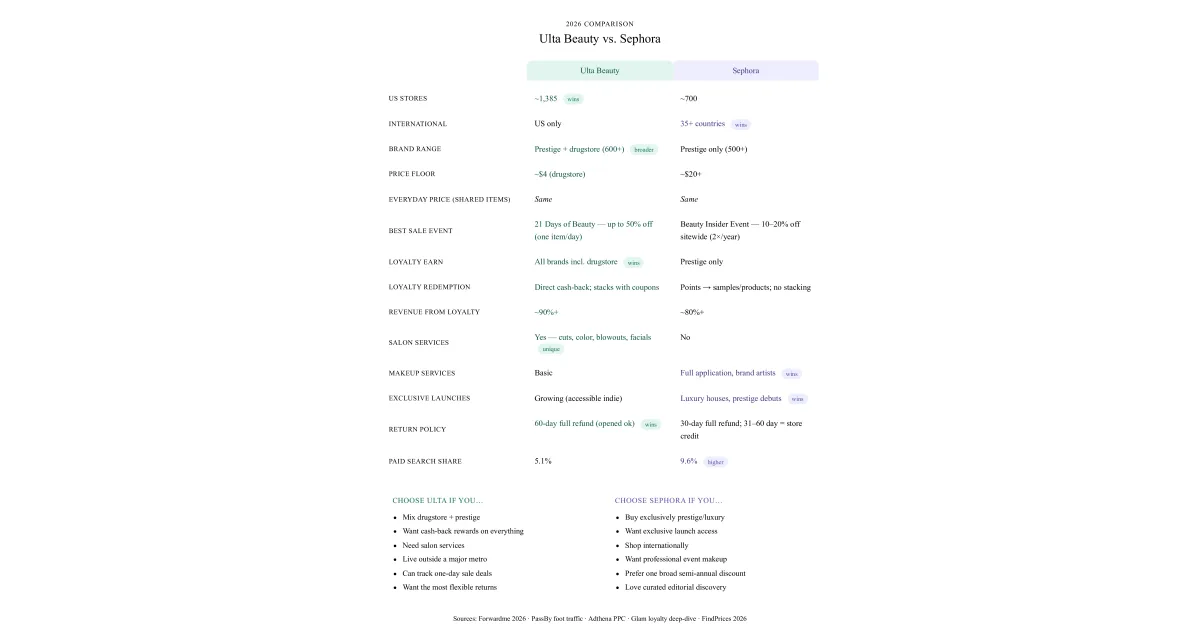
On identical products, the everyday price is almost always the same at both retailers. The real difference is brand range, loyalty math, and sale structure — not sticker price.
The One Thing Most Comparisons Get Wrong
Here's the counterintuitive starting point: on shared prestige products, Ulta and Sephora charge the same price. Both are authorized retailers and neither routinely undercuts the other on a given SKU.
That single misconception — that one store is "just cheaper" — drives billions of dollars in shopping decisions every year, most of them based on habit rather than actual analysis.
What separates these two retailers is brand philosophy, service model, loyalty mechanics, and the specific shopper each store is built for. If you've been defaulting to one out of habit, this guide gives you the data to make a more informed call.
Here's what we'll cover:
- Store footprint and where you can physically shop
- Brand range and which price tiers each retailer serves
- How pricing actually works (sale events, not everyday price)
- Loyalty program math — which one pays out more for your spend level
- In-store services and what each does better
- Shopper profiles: who should choose which
Store Footprint: Where Can You Actually Shop?
Physical access is often the most immediate constraint — especially outside major metro areas.
Ulta Beauty operates approximately 1,385 US stores as of 2026, making it the larger domestic chain by nearly double. For shoppers in smaller cities or suburban markets, Ulta frequently has a location when Sephora does not. (Forwardme 2026 comparison)
Sephora runs approximately 700 US locations — but flips the script internationally. With more than 3,000 stores across 35 countries, Sephora is the only option if you are shopping outside the United States. Ulta is a US-only retailer with no international shipping.
What about the shop-in-shop formats?
Both retailers have expanded through host-store partnerships:
- Ulta Beauty: mini-stores inside Target locations
- Sephora: shop-in-shop inside Kohl's locations
According to PassBy's 2026 foot traffic analysis, Ulta locations inside Target saw year-over-year traffic decline of 3.6%, compared to a smaller 2.1% decline for standalone Ulta stores — suggesting the mini-store format underperforms the full-format experience. The shop-in-shop struggles appear format-driven, not brand-driven: standalone Ulta stores actually showed a 4.1% YoY traffic increase, while Sephora posted 2.9% growth over the same period.
Bottom line: If you're in the US and geographic access matters, Ulta's larger footprint is the practical advantage. If you travel internationally or live outside the US, Sephora is the default by necessity.
Brand Range: Prestige-Only vs. the Full Spectrum
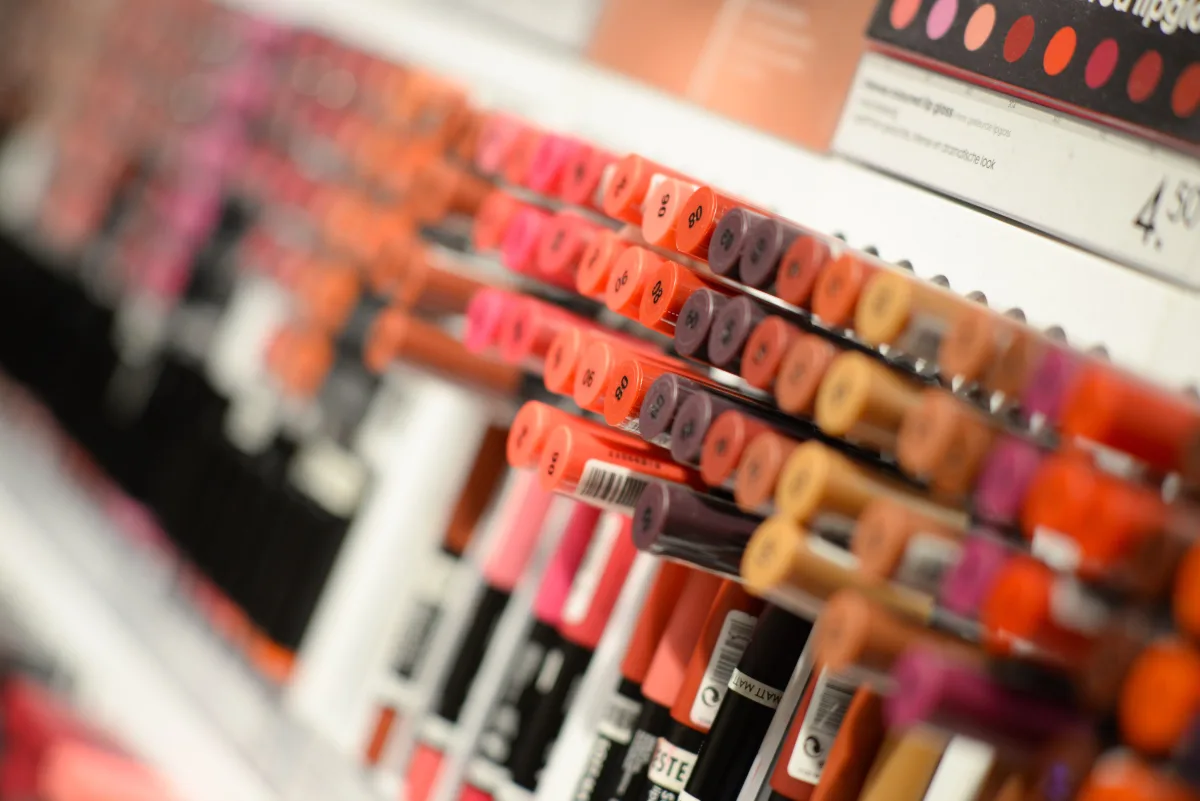
This is the single most important difference — and it shapes everything else.
| Sephora | Ulta Beauty | |
|---|---|---|
| Brand focus | Prestige & luxury only | Prestige + drugstore (all tiers) |
| Total brands | 500+ | 600+ |
| Price floor | ~$20+ | ~$4 (drugstore) |
| Drugstore brands (Maybelline, L'Oréal, NYX) | ❌ | ✅ |
| Luxury houses (Dior, Chanel, YSL) | ✅ | Partial |
| Exclusive indie/luxury launches | Strong | Growing |
Sephora carries exclusively prestige and luxury brands. You'll find Charlotte Tilbury, Tatcha, Drunk Elephant, Fenty Beauty, and Maison Margiela fragrances. You will not find L'Oréal, Maybelline, or e.l.f. Cosmetics. That is a deliberate strategy, not an oversight.
Ulta is the only major beauty retailer that carries both prestige and drugstore under one roof. A single Ulta transaction can include a $5 NYX eyeliner, a $18 CeraVe moisturizer, and a $499 Dyson hair tool. For shoppers who use products across the price spectrum — which describes most people — Ulta eliminates the need for a second stop. (Forwardme 2026)
Exclusive launches: Sephora holds the stronger hand in prestige launches. Luxury houses tend to debut limited-edition collections and new fragrances at Sephora first. Brands like MERIT, HAUS LABS BY LADY GAGA, and Kosas originated as Sephora exclusives. Ulta is more likely to carry exclusive indie brands at accessible price points — ColourPop and Juvia's Place are examples. (paige ditullio, Feb 2026)
For haircare specifically: Ulta wins on breadth — it stocks professional brands like Matrix and Redken that are only accessible via salons or specialty retailers, in addition to Dyson, Ouai, and amika. Sephora covers the luxury end (Kérastase, K18, Oribe) but doesn't touch salon-only professional lines. (Forwardme)
Pricing: Are Products Actually Cheaper at One Store?

Let's settle this clearly: on identical prestige products, the everyday price is almost always the same. Both retailers honor manufacturer pricing, so neither routinely undercuts the other on a shared SKU. (FindPrices 2026 comparison)
Where pricing diverges is in sale events and rewards stacking — and here the structures are very different.
Ulta's 21 Days of Beauty
One product per day, discounted up to 50% off — but only for that single day. If you're organized and know exactly which foundation or serum you want, Ulta wins decisively for that item. Miss the window and you pay full price. There are no broad sitewide codes running during this event.
Ulta also issues 20% off coupons periodically throughout the year that apply to most of the store, including prestige brands — a rarity in beauty retail. (apartstyle.com 2026)
Sephora's Beauty Insider Savings Event (twice yearly)
Sephora runs a semi-annual sale in spring and fall. Discounts apply broadly across most of the catalog, but the discount tier is gated by your loyalty status:
- Insider (free entry): 10% off
- VIB (spend $350+/year): 15% off
- Rouge (spend $1,000+/year): 20% off
If you want to haul across a variety of prestige products at a reliable discount without tracking specific windows, Sephora's event structure is more predictable.
The practical decision rule:
- Know exactly what you want + can track the sale calendar → Ulta's 21 Days saves more
- Want a broad discount across multiple products at once → Sephora's semi-annual event is better
- Shopping outside a sale window → prices are a wash; loyalty point math takes over
Loyalty Programs Compared: Which Actually Pays Off?
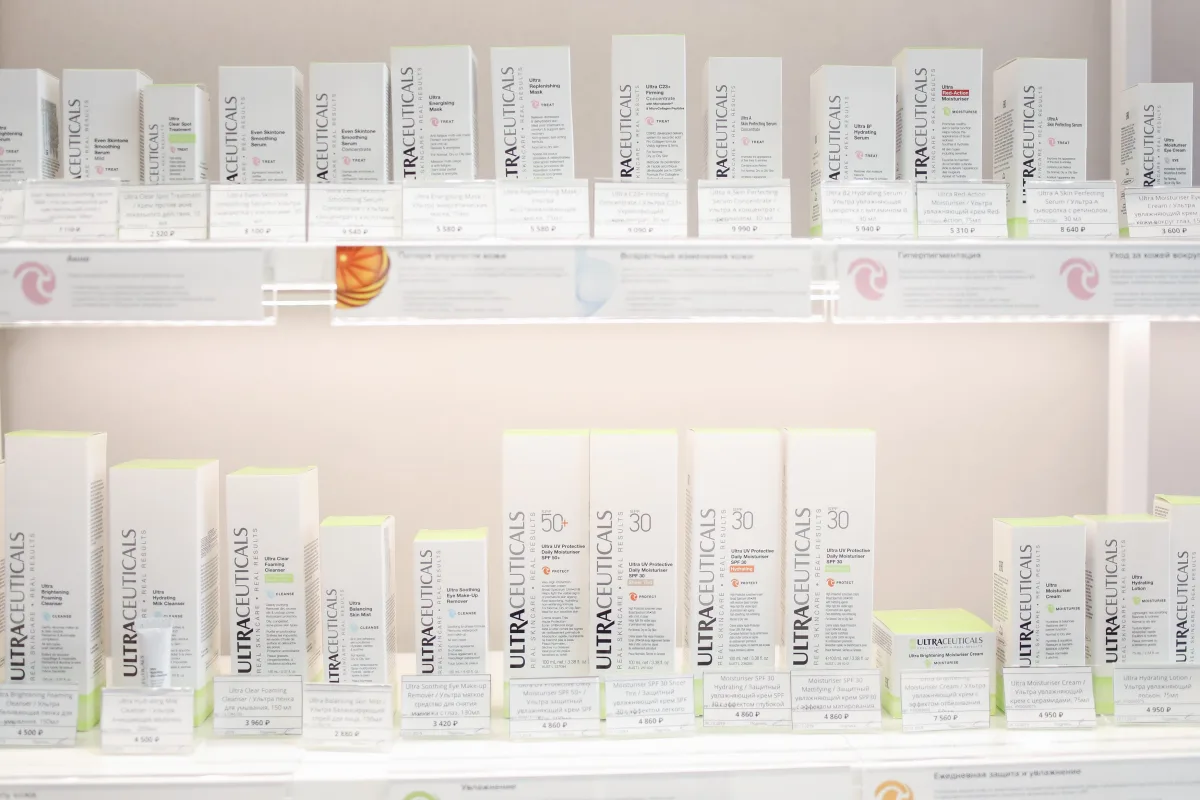
Loyalty programs aren't afterthoughts at either chain. According to data cited by multiple industry analyses, Sephora's Beauty Insider drives over 80% of its revenue and Ulta's Ultamate Rewards drives over 90% — these programs are the businesses. (LoyaltyLevers analysis)
Sephora Beauty Insider
| Tier | Entry threshold | Savings Event discount |
|---|---|---|
| Insider | Free | 10% |
| VIB | $350/year | 15% |
| Rouge | $1,000/year | 20% |
- 1 point per $1 spent
- 500 points = $10 off
- Rouge Reward: 2,500 points = $100 off
- Points expire after 12 months of inactivity
- Points cannot be combined with other discount codes
- Birthday gift: deluxe sample from a prestige brand
Ulta Ultamate Rewards
| Points | Value |
|---|---|
| 100 pts | $3 off |
| 500 pts | $17.50 off |
| 1,000 pts | $50 off |
| 2,000 pts | $125 off |
- Earns points on every purchase including drugstore brands
- Platinum/Diamond members earn bonus points per dollar
- Redemption codes can be combined with other offers — a key advantage over Sephora
- Birthday perk: double points for your entire birthday month + free gift
- Platinum/Diamond members also receive a $25 annual beauty services gift card
(Glam.com)
The critical difference: Sephora's program only captures prestige spend — there are no drugstore brands in the catalog. If your annual beauty budget is split between a $9 drugstore mascara and a $65 prestige serum, Ulta's program accumulates points on both. Sephora's program only sees the serum.
Who each program favors:
- Ulta's program is better if you spend across price tiers and want straightforward cash-back that stacks with coupons.
- Sephora's program is better if you spend exclusively on prestige/luxury and value exclusive experiences, samples, and event access over cash-back.
For high-frequency mixed-tier shoppers, Ulta's program captures meaningfully more value per dollar. For prestige-only spenders who hit Rouge, Sephora's exclusives and experiences are a real differentiator.
In-Store Experience: Services, Atmosphere, Staff
The most concrete functional difference in the physical experience: Ulta has salons. Sephora does not.
Ulta Beauty locations include full-service salons offering:
- Haircuts and color treatments
- Blowouts and styling
- Skincare facials and waxing
If you want to combine a product shopping trip with a hair appointment, Ulta is the only option between these two retailers. Platinum and Diamond loyalty members also receive a $25 annual beauty services gift card. (Forwardme 2026)
Sephora's in-store services center on makeup application, skincare consultations, and shade-matching — all performed by staff trained in prestige brand techniques. For event or bridal makeup, Sephora's trained artists with prestige products are the stronger option.
Staff expertise: Both chains vary by individual location. The general pattern: Ulta staff are described as accessible generalists covering both drugstore and prestige; Sephora staff lean toward brand-specific depth and training in prestige formulations. Neither is universal, but the training philosophy differs in ways that affect recommendation quality.
Product testing: In 2026, both stores use disposable applicators and maintain sanitized testing stations. Both have deployed virtual try-on tools widely, reducing the need for physical testers on color products.
Digital Experience: Apps, Online Shopping, and Paid Search
Both retailers ship nationally and offer comparable e-commerce infrastructure. The meaningful digital gap shows in paid search performance.
According to Adthena's April 2026 US retail health and beauty PPC market share data, Sephora leads with 9.59% of paid search clicks vs. Ulta's 5.08%. Sephora's heavier digital investment aligns with its prestige positioning — it's bidding aggressively for high-intent brand-specific searches where luxury shoppers already are.
Both mobile apps offer loyalty integration, product scanning, virtual try-on, and same-day pickup. The content approach differs:
- Sephora's app: editorial-forward, curated collections, prestige brand storytelling, beauty education
- Ulta's app: utility-forward, stronger on points tracking, sale alerts, cross-category browsing
Depending on whether you shop for inspiration or efficiency, one approach will suit you better.
Return Policies: A Practical Comparison
| Ulta Beauty | Sephora | |
|---|---|---|
| Full refund window | 60 days (with receipt, even opened) | 30 days |
| Store credit window | N/A (full refund to 60 days) | 31–60 days (store/online credit only) |
| Policy verdict | More flexible | More restrictive |
Ulta's return policy is notably more customer-friendly — 60-day full refund on even opened products gives you real time to test. Sephora's tightened to 30 days for full refund, with only store credit available from 31–60 days. (apartstyle.com 2026)
Who Should Choose Which: Shopper Profile Breakdown
Rather than declaring a single winner, the 2026 data points clearly to distinct profiles for each retailer.
Choose Ulta Beauty if you:
- Buy both drugstore and prestige products and want to complete the purchase in one trip
- Want your loyalty points to accumulate on every purchase regardless of price tier
- Need salon services — haircuts, color, blowouts — alongside product shopping
- Live in a smaller US city where Ulta has a store and Sephora doesn't
- Are organized enough to track Ulta's 21 Days of Beauty for 50% off specific items
- Want a broader, more open store environment with products across all price ranges
- Prefer a 60-day return window with maximum flexibility
Choose Sephora if you:
- Buy exclusively prestige and luxury products and want the deepest selection in that tier
- Want early access to exclusive launches from luxury houses in fragrance, skincare, and makeup
- Shop internationally and need a retailer with global store presence (35+ countries)
- Want professional event or bridal makeup from brand-trained artists
- Prefer a curated, editorial store experience with concentrated expertise in luxury brands
- Benefit more from a broad semi-annual percentage discount than tracking one-day deals
The dual-retailer strategy (most value overall):
Many strategic beauty shoppers use both — Ulta for drugstore staples, points accumulation, and salon services; Sephora for prestige exclusives and the semi-annual Savings Event haul. The retailers are not mutually exclusive. Understanding what each does best extracts more value than committing to one.
How to Make the Decision: A 5-Step Framework

- Write down your last five purchases. If all five are prestige brands available at both retailers, loyalty math and sale timing become the deciding factors. If any are drugstore, Ulta is the only one-stop option.
- Calculate your annual spend by tier. If you spend across price tiers, Ulta's program captures more of your spend. If you spend exclusively on prestige and hit or approach $1,000/year, Sephora's Rouge tier may deliver meaningful perks.
- Assess your sale shopping style. Track-a-specific-product-by-day → Ulta's 21 Days. Want a reliable broad discount twice a year → Sephora's Savings Event.
- Check physical access. If only one retailer has a store near you, the question resolves immediately for in-person shopping.
- Consider services. Need salon services → Ulta. Need event makeup application from brand-trained staff → Sephora.
Frequently Asked Questions
Is Ulta Beauty cheaper than Sephora?
On identical prestige products, the everyday price is almost always the same at both retailers. The real savings difference is in sale events: Ulta's 21 Days of Beauty can reach 50% off on specific items, while Sephora's semi-annual Beauty Insider Savings Event offers 10–20% off broadly based on your loyalty tier. Ulta's overall price floor is lower (~$4) because it carries drugstore brands that Sephora doesn't stock. (FindPrices 2026)
Does Ulta carry the same brands as Sephora?
There is overlap in prestige brands, but the catalogs are not identical. Sephora carries exclusively prestige and luxury brands (500+). Ulta carries both prestige and drugstore (600+). Some prestige brands are exclusive to one retailer or debut there first, particularly for limited editions and luxury launches. (paige ditullio, Feb 2026)
Which loyalty program is better — Ulta Ultamate Rewards or Sephora Beauty Insider?
It depends on how you spend. Ulta's Ultamate Rewards earns on all purchases including drugstore, converts points directly to dollar-off certificates, and allows stacking with other offers — better for mixed-tier shoppers. Sephora's Beauty Insider rewards prestige-heavy spending with tiered event discounts and exclusive product access. At Ulta, 2,000 points = $125 off; at Sephora, 500 points = $10 off.
Does Sephora have hair salons?
No. Sephora offers makeup application services and beauty classes in store, but does not operate hair salons. Ulta Beauty includes full-service salons at most locations, offering haircuts, color, blowouts, and skincare treatments — this is a meaningful practical differentiator for shoppers who value both services.
How many Ulta stores vs. Sephora stores are there in the US in 2026?
Ulta operates approximately 1,385 US stores and Sephora approximately 700 US locations. Sephora has the significantly larger international footprint with 3,000+ stores across 35 countries. Ulta operates exclusively in the United States. (Forwardme 2026)
What is Ulta's return policy vs. Sephora's?
Ulta accepts returns for up to 60 days with a full refund, even on opened products with a receipt. Sephora offers a full refund within 30 days; returns from 31–60 days receive store or online credit only. Ulta's policy is more flexible for shoppers who want time to test products before committing.
Can I use Ulta coupons on prestige brands?
Yes. Ulta periodically issues 20% off coupons that apply to most of the store, including prestige brands — something Sephora does not offer outside of its semi-annual loyalty tier events. This is one of Ulta's strongest pricing advantages for prestige shoppers.
How This Comparison Was Researched
This guide synthesizes publicly available 2026 data from multiple independent sources, including Forwardme's head-to-head comparison (updated May 2026), PassBy's US beauty retail foot traffic analysis, Adthena's April 2026 PPC market share data, FindPrices' pricing comparison, LoyaltyLevers' loyalty program analysis, and Glam.com's loyalty deep-dive. We have not personally shopped at either retailer for this article. We cite every substantive claim. If you spot an error, let us know via our corrections policy.
We may earn a commission when you shop through links on this page, at no additional cost to you. Our editorial assessment is completed before any affiliate link is applied. Read our full affiliate disclosure → · This article was drafted with AI assistance and fact-checked by a human editor before publishing. Our AI ethics policy →