How this guide was researched: This guide draws on manufacturer specifications, independent market data from Mordor Intelligence, Statista, and Clarkston Consulting, and verified consumer research from TheRoundup, SCAYLE, and IFA Paris. It does not reflect hands-on testing by Trusted Buyer Report. Claims are cited at source.
This article was drafted with AI assistance and reviewed by our editorial team before publishing. We may earn a commission from purchases made through our links — applied only after our assessment is complete. Read our full disclosure →
You're holding two versions of the same white T-shirt. One costs $12. The other costs $38 and says "organic cotton, ethically made."
You have about 90 seconds before your patience runs out. Which one do you buy — and how do you actually know if you're making the right call?
That moment is what this guide is built to resolve. Most fashion content is dressed up as buying advice but is really a trend roundup. This one isn't. The Fashion & Apparel Buying Guide 2026 answers the structural question underneath every clothing purchase: how do you evaluate apparel across price, quality, environmental impact, and longevity — without a degree in textile manufacturing?
The short answer: You use a repeatable framework. This guide gives you one.
Who this is for:
- Shoppers who want to spend less but buy better
- Anyone confused by sustainability claims and certifications
- People rebuilding a wardrobe from scratch or on a budget
- Buyers who want to understand when fast fashion is defensible and when it isn't
1. Fast Fashion vs. Sustainable Clothing: Head-to-Head Comparison
Before any market context, here's the comparison most shopping guides bury in paragraph 12: fast fashion versus sustainable apparel across the criteria that actually affect your wallet and your wardrobe over time.
| Criteria | Fast Fashion | Sustainable / Mid-Market |
|---|---|---|
| Upfront Cost | Low — $8–$25 for a casual top | Higher — $35–$85 for a comparable piece |
| Cost Per Wear | Often higher — items worn 5–10× before degrading | Lower over time — quality construction extends lifespan to 2–4 years |
| Environmental Footprint | High — water-intensive dyeing, synthetic microfibers, high discard rate | Lower — certified organic fibers, reduced chemical processing, longer use cycle |
| Supply Chain Transparency | Minimal — most brands disclose little about factory conditions | Higher — GOTS, Fair Trade, B Corp certifications require third-party audits |
| Resale Value | Near zero — fast fashion items rarely hold value on resale platforms | Moderate to strong — quality pieces from recognized brands hold value |
| Labor Conditions | Variable and largely opaque — wage and safety standards inconsistent | Audited and disclosed — certifications require minimum labor protections |
Verdict by buyer profile:
Fast fashion makes defensible sense for rapidly growing children, for trend-driven items you know you'll wear only one season, or when budget constraints are genuinely tight.
Sustainable and mid-market apparel delivers better long-term value for core wardrobe pieces — basics, outerwear, workwear — where longevity and cost-per-wear matter most.
Here's the honest caveat most guides skip: the math favors quality only if you actually wear the piece consistently. A $120 coat you wear every winter for six years beats a $40 coat on cost-per-wear by a wide margin. A $90 dress you wear twice does not.
2. The 2026 Apparel Market in Numbers
Understanding the market explains why brands behave the way they do — and why you get the choices you do.
Global scale: The global apparel market was valued at approximately USD 1,400 billion in 2025 and is projected to reach USD 1,443.68 billion in 2026, growing at a 3.12% CAGR through 2031, according to Mordor Intelligence. That modest growth rate means brands are competing intensely for each marginal sale — which translates directly into more aggressive marketing, faster trend cycling, and more pressure to buy frequently.
The US market: Statista's 2026 US apparel forecast puts US revenue at $368.4 billion — the highest single national market globally. Women's apparel leads at $243.2 billion. Critically, 93% of US apparel sales are non-luxury, meaning nearly every purchasing decision happens in the mid-market or value segment — exactly where fast fashion vs. quality trade-offs are sharpest.
Category dominance: Casual wear accounts for 36.78% of global apparel revenue (Mordor Intelligence), driven by sustained work-from-anywhere adoption. If you're building a wardrobe in 2026, this is the category with the most options — and the most noise to cut through.
Supply chain shifts: Clarkston Consulting's 2026 apparel trends report documents significant production migration from China to Vietnam and other Asian markets in response to tariff changes. This near-shoring creates quality variance even within the same brand across production seasons — a practical reason to inspect garments at the point of purchase rather than relying on brand reputation alone.
One useful historical anchor: Bureau of Labor Statistics data shows that apparel prices in 2024 were essentially flat in real terms versus 1994, even as overall consumer prices rose 6.4× since 1974. Cheap clothing is not new — it has been the market norm for three decades. That context explains why fast fashion pricing feels normal: it is the baseline most US shoppers have always known.
3. How to Calculate Cost Per Wear (And Why It Changes Everything)
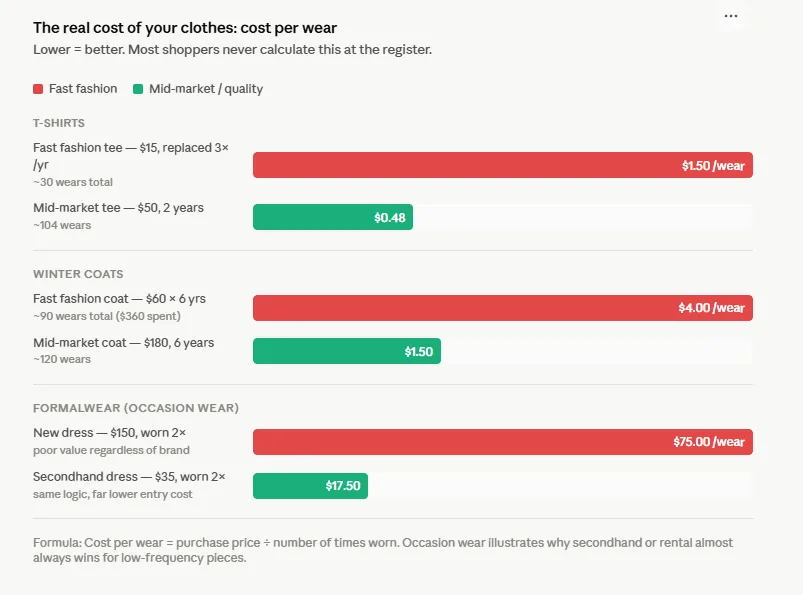
Cost per wear is the single most useful calculation in apparel buying — and almost no one uses it at the point of purchase.
The formula:
Cost Per Wear = Purchase Price ÷ Number of Times Worn
Here's how it plays out in practice:
| Scenario | Price | Times Worn | Cost Per Wear |
|---|---|---|---|
| Fast fashion T-shirt, replaced 3× in a year | $15 × 3 = $45 | ~30 total | $1.50 |
| Mid-market T-shirt, 2 years | $50 | ~104 | $0.48 |
| Designer coat, 8 years | $400 | ~160 | $2.50 |
| Quality mid-market coat, 6 years | $180 | ~120 | $1.50 |
| Fast fashion coat, replaced annually | $60 × 6 = $360 | ~90 | $4.00 |
The takeaway: A $50 mid-market T-shirt worn twice a week for two years costs $0.48 per wear. The same calculation applied to a $15 fast fashion tee worn 10 times before pilling costs $1.50 per wear — more than 3× as expensive in actual use.
But the math only works if you wear the item. Before applying cost-per-wear logic, ask yourself honestly: Will I actually wear this 50+ times? If the answer is no, fast fashion may genuinely be the right call.
Where cost-per-wear logic is most useful:
- Outerwear (coats, jackets) — highest per-item cost, worn frequently
- Work clothing you wear multiple days a week
- Basic wardrobe staples: tees, jeans, casual trousers
- Shoes worn daily
Where it's least useful:
- Event/occasion wear (dresses, formalwear) — strong argument for secondhand or rental instead
- Children's clothing — outgrown before it wears out
4. What "Sustainable" Actually Means — and How to Verify It
The word "sustainable" appears on enough hang tags and homepage banners in 2026 that it has nearly lost meaning. Here's how to restore it.
The Certifications That Actually Mean Something
GOTS (Global Organic Textile Standard) The most comprehensive fiber-to-garment certification available. Covers the entire textile supply chain — from raw fiber to finished product. Requires at least 70% certified organic fibers and prohibits a specific list of hazardous chemicals. If a brand claims organic, ask if it's GOTS-certified — most legitimate ones can answer immediately.
OEKO-TEX Standard 100 Tests finished products for harmful substances. Does not certify organic farming or labor conditions — only that the final garment is free from a list of hazardous chemicals. Narrower than GOTS, but meaningful, particularly for children's clothing.
Fair Trade Certified Focuses on labor conditions and fair wages. Does not necessarily address environmental practices. Most useful in combination with fiber certifications.
B Corp Certification Assesses overall company social and environmental performance, governance, and accountability. Broad but less product-specific — better as a company-level signal than a garment-level one.
Important caveat: No single certification covers everything. A GOTS-certified garment can still be produced in a factory with poor labor conditions if Fair Trade auditing is absent. Treat certifications as credible evidence, not guarantees.
The EU Digital Product Passport: A 2027 Signal Worth Watching Now
Starting in 2027, the EU's Digital Product Passport will mandate that textiles sold in European markets carry full traceability data — fiber origin, manufacturing location, chemical inputs, and end-of-life instructions. IFA Paris notes that brands are already investing in this infrastructure ahead of the mandate.
For 2026 shoppers, this means brands investing in traceability now are signaling genuine commitment — this infrastructure is expensive to build purely for marketing purposes.
Greenwashing Red Flags to Spot Before You Buy
- Vague claims without specifics: "eco-friendly collection," "conscious line," "made with sustainable materials" — without identifying which materials or what percentage
- Percentage claims without a baseline: "30% recycled content" sounds meaningful until you realize the starting point was 0%
- Self-reported sustainability with no third-party audit: Brand reporting without independent verification is marketing, not accountability
- Goals described as current practices: Sustainability pages that describe what they plan to do rather than what they do now
Skai's 2026 CPG Apparel Marketing Guide identifies radical transparency as the dominant competitive strategy for fashion brands in 2026. When a brand won't disclose, that absence is itself data.
Secondhand as a Sustainability Strategy
Secondhand fashion is projected to grow 2–3× faster than traditional retail by 2027, according to IFA Paris citing The State of Fashion 2026. Zara has responded with Zara Pre-Owned. Patagonia's Worn Wear program has been running for years. Peer-to-peer platforms extend garment life cycles without the environmental cost of new manufacturing.
For shoppers whose primary sustainability goal is reducing consumption: buying secondhand is more impactful than buying a new "sustainable" garment. It requires no new production at all.
5. Category-by-Category Buying Guide
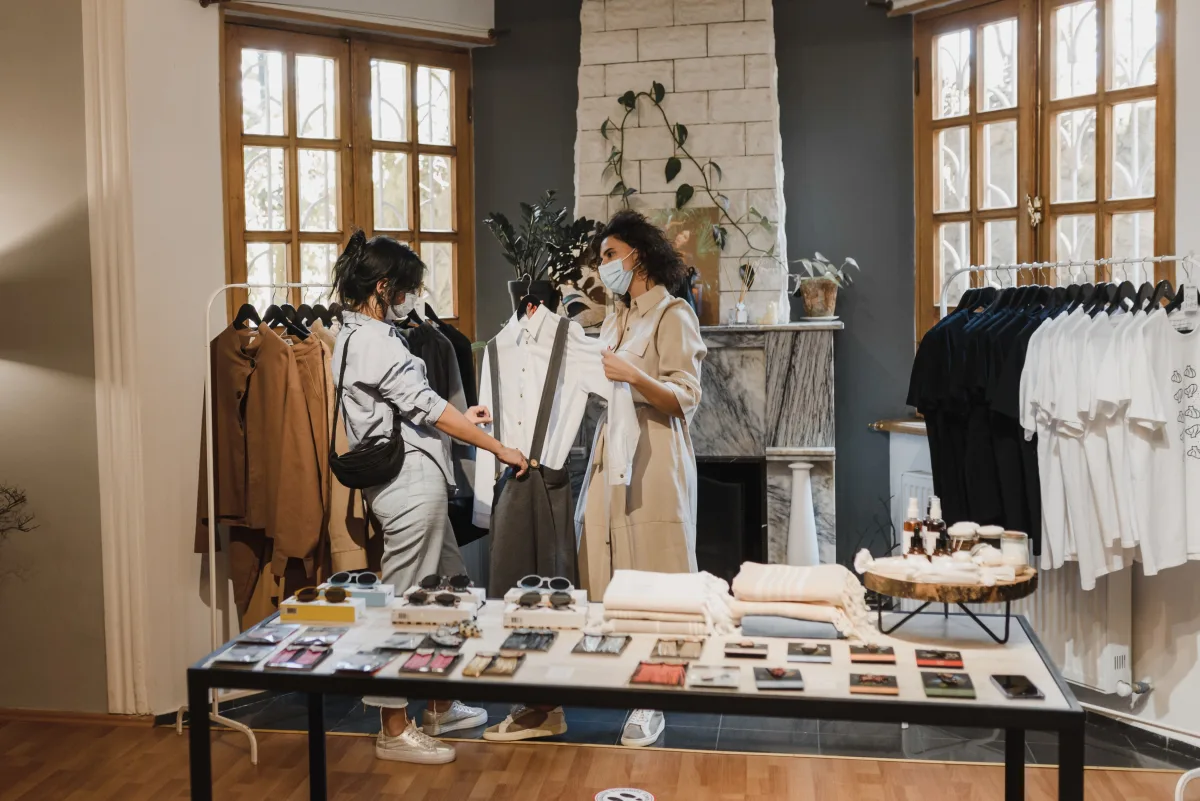
Everyday Casual Wear
This is where wardrobe ROI is highest and where most people spend the most money over time. Casual wear represents 36.78% of global apparel revenue for a reason — it's what you actually wear every day.
What to prioritize: fabric durability and construction over trend alignment. A well-made cotton-modal blend T-shirt at $28 will outlast three $12 alternatives in both washes and wears.
Quality checks: stitch density at the collar and underarm seams, whether the fabric puckers at stress points, and whether the hem is double-stitched.
Budget guidance: Spend more here than anywhere else. The compounding effect of better basics — worn 150+ times per year — dramatically outperforms any other wardrobe investment on a cost-per-wear basis.
Recommended internal link: See our Best Sneakers 2026: Nike vs Adidas vs New Balance Compared for how this logic applies to casual footwear.
Workwear and Professional Attire
Fit matters more than brand. Near-shoring production shifts mean quality variance is increasing even within established brands — a suit from the same label may be cut differently depending on which factory produced it that season.
What to check at point of purchase:
- Shoulder seam alignment — it should hit precisely at the shoulder edge
- Pattern matching at the chest pocket (if present) — consistent matching is a manufacturing care indicator
- Armhole depth — too deep creates tension when you move; too shallow restricts movement
Budget guidance: Spend on fit above all else. Tailoring a $150 blazer to fit perfectly beats wearing an $800 blazer off-the-rack with the shoulders misaligned.
Activewear and Sportswear
The fastest-growing apparel segment through 2031 (Mordor Intelligence), and also the category with the most verifiable performance claims.
What to look for:
- Fabric specs: moisture-wicking polyester blends should specify GSM (grams per square meter) — 150–200 GSM for performance tees, 200+ for compression garments
- Bluesign certification indicates the fabric was produced with reduced water and chemical impact — meaningful in a synthetic-heavy category
- Four-way stretch vs. two-way stretch — four-way handles multi-directional movement better for high-intensity exercise
Budget guidance: Buy cheap for low-intensity activity (yoga, walking). Spend on technical specs for running, cycling, or high-output training — the performance difference is real and verifiable.
Outerwear
The highest cost-per-item category is also where buying quality once genuinely outperforms buying cheap twice.
What the specs actually mean:
- Fill power (down jackets): 600+ is functional warmth; 800+ is premium; 900+ is expedition-level. Fill power measures loft, not warmth per se — a higher fill power jacket achieves the same warmth at lower weight.
- Seam taping (waterproof shells): Critical seams taped = fully waterproof; critical seams only = semi-waterproof; no seam taping = water-resistant only
- YKK zippers: The industry-standard zipper manufacturer. YKK presence signals a brand that cares about hardware quality; unbranded zippers often fail first.
Our winter coat comparison: Best Winter Coats & Outerwear 2026: Warmth by Budget breaks down exactly how warmth scales across four price tiers, using lab-tested heat-loss data.
Formalwear and Occasion Wear
The strongest case for secondhand or rental. Buying a new garment for an event you'll attend once or twice is the least efficient wardrobe spend in any category.
Secondhand formal platforms offer designer pieces at 60–80% below retail. Rental services extend this further for one-time occasions. The average American is projected to own 88 pieces of apparel in 2026 (Statista) — unused occasion wear contributes disproportionately to that number and to textile waste.
If you do buy new: Invest in versatility over novelty. A well-cut navy blazer works across more occasions than a heavily embellished piece that dates quickly.
Children's Clothing
The one category where fast fashion's cost argument is most defensible. Children outgrow clothes before they wear them out.
What to prioritize: safety over durability. Look for OEKO-TEX certification — it confirms no harmful dye chemicals are present in the garment. This matters more for children's skin and for items mouthed by toddlers than any quality or longevity consideration.
Where to spend more: Outerwear and footwear. These affect safety and structural development (footwear especially), and children use them across full seasons. The fast fashion calculus flips here.
Where to save: Basics and sleepwear. Buy secondhand or in multi-packs. A child who grows 1.5 inches per year doesn't need premium cotton tees.
See our Best Baby Clothing Brands 2026 for a framework specifically covering the infant and toddler segment.
6. How to Inspect Clothing Quality Before You Buy
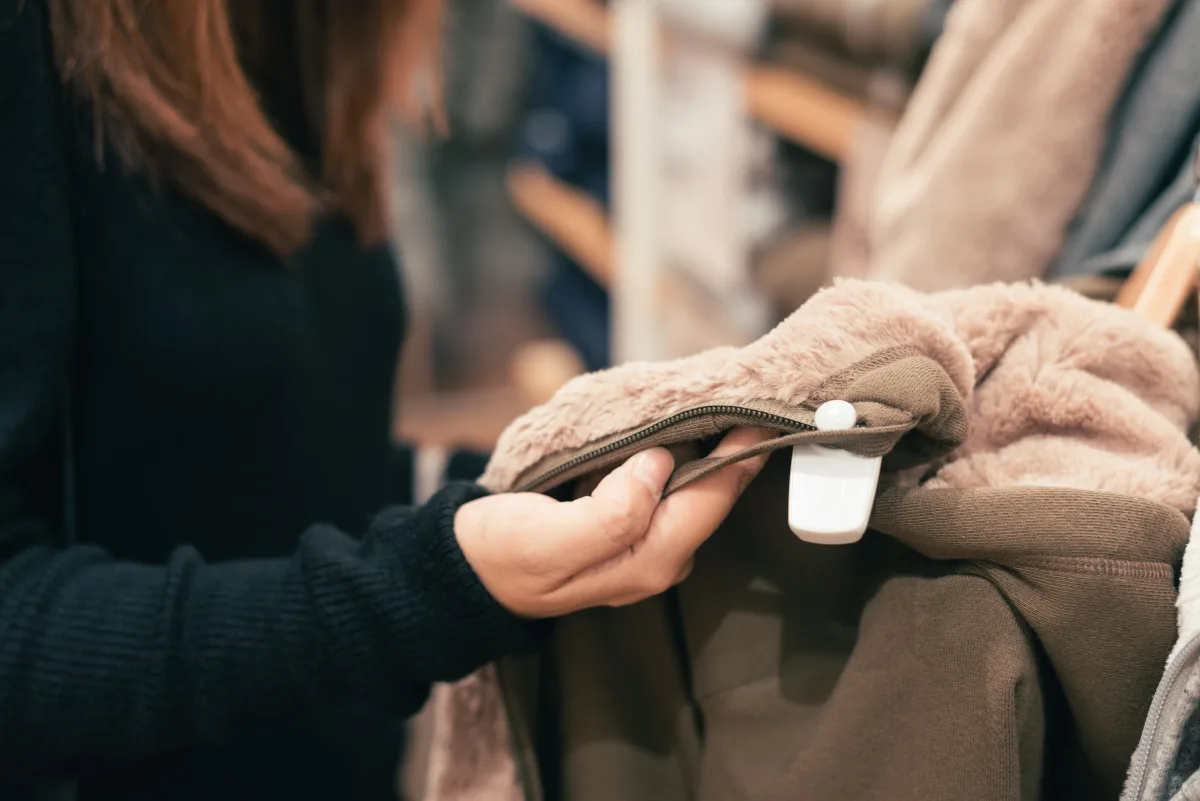
This is the practical section most buying guides don't include. Here's a 90-second inspection you can run at the rack or before clicking "add to cart."
The 6-Point In-Store Inspection
1. The seam stretch test Grab a seam at a stress point (underarm, waistband) and gently stretch it. Quality garments return to shape. Cheap construction shows gaping stitches or fabric distortion immediately.
2. The stitch count check Higher stitch density = stronger seams. Roughly: 8–12 stitches per inch is baseline adequate; 12+ is quality construction. You can count 1 inch along a seam with a thumbnail. This takes 10 seconds.
3. The pilling test (for knits) Rub two layers of the fabric together firmly for 5 seconds. Natural fibers with long staple length resist pilling; short-staple synthetics and blends show friction damage almost immediately. If you see fuzzing during the test, expect significant pilling within 10 washes.
4. The fabric weight and drape check Lift the garment and assess weight. Quality fabric has natural drape and structure. Thin fabric that clings or collapses without shape is typically a durability signal. This is most relevant for shirts, blouses, and blazers — less so for activewear, where lightweight is a feature.
5. The label check Read the fiber composition. Look for long-staple cotton (often labeled "Pima" or "Egyptian"), merino wool, or linen for natural fibers that wear well. Be skeptical of blends that combine more than two fibers with no dominant component — often a sign of cost-cutting in the fiber blend.
6. The hardware check (for jackets and coats) Pull the zipper. It should glide without catching. Check whether it's YKK branded (look on the zipper pull). Check button attachment — give each button a firm tug. Loose buttons are cheap to fix; failing zippers on outerwear are expensive and often structurally limiting.
What You Can't Check In-Store (But Should Research)
- Wash performance: How a garment holds up through 50+ washes is rarely verifiable at purchase. User reviews filtered to 3-month+ ownership comments are the most reliable proxy. Short reviews are often written immediately after delivery.
- Colorfastness: Particularly relevant for dark-colored garments and anything printed. Look for reviews mentioning fading after 5–10 washes.
- Shrinkage: Check whether the brand pre-washes its fabric. If not, size up by one for cotton items and always wash cold.
7. Online vs. In-Store vs. Secondhand: Choosing Your Channel

Online shopping accounts for 27% of global apparel sales (wifitalents.com, 2026 clothing industry data), but that means 73% of apparel is still purchased through physical channels. The channel you choose should match what you need to verify before buying.
When to Buy In-Store
In-store is a quality verification tool more than a transaction point. Use it for:
- Outerwear, blazers, and anything where fit is structurally important — shoulder seams and armhole depth can't be assessed from a product photo
- Any new brand you haven't bought before — feel the fabric, check the construction, establish a benchmark before ordering online
- Shoes and footwear — last shape and width vary significantly by brand; sizing charts are imprecise proxies
SCAYLE's 2026 US fashion retail research found that 27% of US shoppers begin their apparel journey in physical stores even though apparel is the top online purchase category. The physical store functions as a research tool; the purchase often happens online at a better price.
When to Buy Online
Online is most efficient when:
- You know the brand's fit and sizing from previous purchases
- The item is a basic (undershirts, socks, basics in known sizes)
- You have free returns and a clear return window — always confirm both before purchasing
Check return policies before you buy. Free returns are not universal. Several fast fashion brands have moved to paid returns or store credit only, which effectively raises the real cost of online purchases for items that don't fit.
When to Buy Secondhand
Secondhand is the highest-value channel for:
- Occasion and formalwear — 60–80% below retail for worn-once pieces
- Luxury and designer items — resale platforms offer authentication and condition grading
- Sustainable shopping on a tight budget — secondhand requires no new production
For verified secondhand platforms, see our Best Luxury & Designer Fashion Deals 2026, which covers the authenticated resale market and where structural market shifts are creating genuine buyer opportunities.
8. Brand Tier Map: Where the Real Value Lives in 2026
Not every shopper needs to know which brand is "best." What most shoppers need is a rough framework for where the money actually goes at each price tier.
| Tier | Price Range (Top) | What You're Paying For | Where Value Holds |
|---|---|---|---|
| Ultra-fast fashion | $5–$15 | Trend speed, not quality | Trend items you'll wear 3–5× only |
| Fast fashion mid-tier | $15–$35 | Volume production, acceptable construction | Basics with limited life expectancy |
| High-street / vertical | $35–$80 | Better fabric sourcing, moderate construction control | Core basics, workwear basics |
| Mid-market quality | $80–$200 | Fabric quality, construction oversight, often domestic or near-shored production | Outerwear, shoes, key wardrobe pieces |
| Premium / contemporary | $200–$500 | Material quality, fit precision, brand longevity signals | Special-purpose investment pieces |
| Luxury | $500+ | Craftsmanship, heritage, resale value retention | Items bought once, worn for decades |
The honest observation: In 2026, the $80–$200 mid-market tier delivers the best cost-per-wear ratio for most core wardrobe purchases. Below that, quality drops off meaningfully. Above $500, you're partially paying for brand status — which has real value for resale but may not reflect proportional construction quality.
For a deeper look at where fast fashion brands specifically sit on this spectrum, see our Fashion Nova Review 2026 — a detailed breakdown of quality, sizing, and delivery benchmarks for one of the US's highest-traffic fast fashion brands.
FAQ
Is fast fashion ever worth buying in 2026?
Yes — in specific situations. Children's basics (outgrown before they wear out), trend-driven items you plan to wear 3–5 times, and extremely budget-constrained purchases are cases where fast fashion is defensible. The problem isn't fast fashion existing; it's using it for core wardrobe pieces that would benefit from durability.
What is the most important quality indicator when buying clothes?
Seam construction and fabric quality are the two signals most predictive of long-term durability. The 90-second inspection outlined above covers both. Stitch density at stress points (underarm, waistband) and fabric behavior under the pilling test are the highest-signal checks you can do at the rack.
How do I know if a brand's sustainability claims are real?
Look for third-party certifications: GOTS for organic textiles, OEKO-TEX Standard 100 for chemical safety, Fair Trade for labor conditions. Self-reported sustainability without independent auditing is marketing. If a brand can't name the certification and the certifying body when asked, treat the claim as unverified.
Is secondhand fashion actually more sustainable than buying "sustainable" new clothing?
In most cases, yes. Secondhand requires no new fiber production, no manufacturing energy, and no new chemical processing. Even a conventionally produced secondhand garment has a lower lifecycle footprint than a new "sustainable" garment in most material categories. The exception: secondhand items with high shipping miles or poor condition that result in short use cycles.
What does cost per wear mean, and how do I calculate it?
Cost per wear = purchase price ÷ estimated number of times worn. A $50 shirt worn 100 times costs $0.50 per wear. A $15 shirt worn 10 times costs $1.50 per wear. The key variable is honest use estimation — cost per wear logic only works if you're realistic about how often you'll actually wear the piece.
Where is the best place to buy clothes online in 2026?
There's no single best answer — it depends on category, budget, and whether you prioritize price, sustainability, or convenience. Use our Fashion & Apparel category for store reviews and comparisons across specific brands and platforms.
Last reviewed: June 2026. Data sourced from Mordor Intelligence, Statista, Clarkston Consulting, TheRoundup, SCAYLE, IFA Paris, wifitalents.com, and Skai. Market figures are projections and subject to revision.