This guide was researched and drafted with AI assistance, then reviewed and fact-checked by our editorial team before publishing. We aggregate manufacturer data, independent price comparisons, and verified consumer sources — and cite every claim. We have not conducted hands-on in-store testing ourselves. How we review · How we use AI
Trusted Buyer Report may earn a commission when you use our links. This does not influence our rankings or editorial content. Full disclosure →
Quick Verdict: Which Wholesale Club Should You Join?
Bottom line before you read further:
- Costco — Best overall for households that want premium and organic brands, a curated selection, and a no-hassle return policy. Priciest membership ($65/year base) but the Kirkland Signature private label consistently delivers quality-adjusted value.
- Sam's Club — Best for lowest sticker price on everyday grocery staples and the fastest in-store checkout experience (Scan & Go). After a May 2026 fee increase, base membership is now $60/year — still the most affordable tier.
- BJ's Wholesale Club — Best for East Coast households, coupon users, and smaller households that need a broader variety with more manageable package sizes. Base membership is $60/year and BJ's is the only club of the three that accepts manufacturer's coupons.
Can't choose? Scroll to the "Which Club Wins for Your Shopper Profile" section and match your situation to a recommendation.
The State of Wholesale Clubs in 2026
The U.S. warehouse club market is bigger and more competitive than most shoppers realize. The three-player market is highly concentrated: Costco holds roughly 63.7% of U.S. warehouse club market share, Sam's Club holds about 29.2%, and BJ's holds approximately 7.0%, according to MMCG Invest's 2026 comparative analysis, citing Costco and Walmart 10-K filings and BJ's company disclosures.
That concentration matters to you as a shopper for one reason: long-term stability. These aren't niche memberships that might disappear in a few years.
| Operator | U.S. Club Count | U.S. Market Share |
|---|---|---|
| Costco (incl. Puerto Rico) | 633+ | 63.7% |
| Sam's Club | ~600 | 29.2% |
| BJ's Wholesale Club | ~247 | 7.0% |
Source: MMCG Invest, citing Costco 10-K FY2025, Walmart 10-K FY2025, BJ's company disclosures.
Visit-share data from Placer.ai for July 2025 shows Costco capturing 54.3% of combined in-store visits across the three clubs, Sam's Club at 36.0%, and BJ's at 9.7%.
Warehouse clubs are outgrowing most conventional retail formats. Inflation-weary consumers respond well to bulk pricing and membership-model loyalty — and all three clubs are actively expanding, not contracting. This is a stable, growing channel worth committing to with an annual membership.
For a broader framework on where wholesale clubs fit into your overall household budget, the Ultimate US Shopping & Money-Saving Guide 2026 is a useful companion piece — it puts in-store versus online spending in perspective using NIQ data.
Membership Fees in 2026: What You Pay Before You Buy Anything
Every dollar you spend on a membership is a sunk cost you must recover through savings before you break even. Here's where things stand in mid-2026:
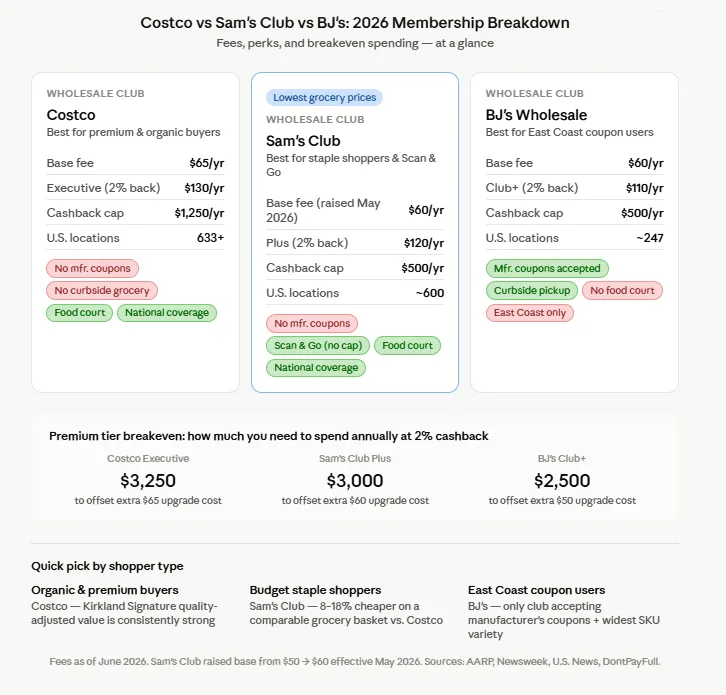
Important update: Sam's Club raised its membership fees starting May 1, 2026 — the first increase in several years. According to Newsweek's April 2026 reporting, the base membership rose from $50 to $60/year, and the Plus tier climbed from $110 to $120/year. This narrows the price gap between Sam's Club and Costco considerably.
| Club | Base Membership | Premium Tier | Premium Perks |
|---|---|---|---|
| Costco | $65/year | $130/year (Executive) | 2% cashback, capped at $1,250/year |
| Sam's Club | $60/year | $120/year (Plus) | 2% cashback, capped at $500/year |
| BJ's | $60/year | $110/year (Club+) | 2% cashback on in-store + gas discounts |
Sources: AARP membership comparison, U.S. News 2026 analysis, Newsweek Sam's Club fee update
One key differentiator most guides miss: BJ's offers discounted membership fees of $25/year for college students, first responders, veterans, active-duty military, teachers, government employees, and medical professionals, according to The Penny Hoarder's May 2026 comparison. Costco and Sam's Club do not offer equivalent across-the-board discounts for these groups.
Is the premium tier worth it? All three clubs offer 2% cashback on the premium tier, but the math only works if your annual spending is high enough. At 2% cashback, you need to spend approximately $3,000–$3,250 per year at the club to break even on the extra fee cost. If your annual club spend is below that threshold, stick with the standard membership.
Notably, Costco's cashback cap is $1,250/year versus Sam's Club's $500/year — so for heavy spenders ($25,000+ annually at the club), Costco's Executive tier has more upside. For most households, the gap is irrelevant.
All three clubs offer full membership refunds if you're not satisfied. This makes it lower-risk to try one for a few months before committing to renewal.
Grocery Prices Head-to-Head: Which Club Saves You the Most?
This is where the comparison gets concrete — and more nuanced than most headlines suggest.
Sam's Club wins on everyday staple prices. A 150-item price comparison published in early 2026 found Sam's Club cheaper on 68% of items, with average unit prices running 8.2% lower than Costco, according to data cited by DontPayFull's 2026 membership analysis. An AARP grocery basket test found Sam's Club cheaper by roughly 18% on a 30-item weight-adjusted comparison.
The reason is structural: Walmart's supply chain leverage runs straight through Sam's Club's pricing. As debt expert Howard Dvorkin explained in the AARP analysis: "The reason Sam's Club is the least expensive of the three is because of Walmart's buying power. That said, they don't have the premium brands Costco typically has." That's an honest summary of the tradeoff.
Costco wins on premium and organic. Kirkland Signature organic products consistently come in below grocery store prices. On organic peanut butter, Costco offered the lowest per-ounce price among all three clubs. Costco's rotisserie chicken at $4.99 and its selection of gourmet prepared meals offer what one shopper described to U.S. News as "an upper-middle-class lifestyle on a budget."
BJ's wins on specific categories — and on coupons. BJ's whole milk came in at a lower per-gallon price than Costco in an item-level test by AllRecipes. More importantly: BJ's is the only wholesale club of the three that accepts manufacturer's coupons, according to AARP's membership guide. BJ's also publishes its own member coupon books. Stacking both can partially or fully close BJ's shelf-price gap versus Sam's Club for shoppers who use coupons regularly.
The takeaway: For a conventional grocery cart, Sam's Club is the cheapest. For premium and organic categories, Costco's quality-adjusted value often beats its higher sticker prices. For coupon users on the East Coast, BJ's effective price (after coupons) can be competitive with both.
Product Selection: More Choices vs. Curated Simplicity

The three clubs take fundamentally different approaches to what they put on the shelf — and which approach suits you depends on how you shop.
BJ's has the widest selection. A typical BJ's stocks around 5,600–7,000 SKUs — significantly more than Sam's Club and far more than Costco, according to Michael G. Clayman, editor of Warehouse Club Focus, as cited by AARP. BJ's also offers smaller package sizes than its competitors, which is a practical advantage for smaller households, apartment dwellers, or anyone without the storage space for a 40-roll paper towel pack.
Costco deliberately limits to ~4,000 SKUs. The curation is intentional: every item on the shelf survived a selection process. Costco often requires product exclusivity from suppliers, meaning a product carried by Costco typically cannot be sold to Sam's Club or BJ's under the same terms. The result is a tighter edit where nearly everything moves quickly — which keeps prices low.
For shoppers who want to get in and out without decision fatigue, Costco's edit is a feature. For shoppers who want multiple brands of a product or a broader grocery category, BJ's hybrid warehouse-supermarket format is genuinely useful.
Private labels:
- Kirkland Signature (Costco) — the most recognized store brand in warehouse retail. Many Kirkland products are made by the same manufacturers that produce national brand equivalents. Consistently strong across olive oil, batteries, protein bars, paper goods.
- Member's Mark (Sam's Club) — has expanded significantly and competes directly with Kirkland on staples. Strong on paper goods, pantry items, and cleaning supplies.
- Wellsley Farms / Berkley Jensen (BJ's) — serves the same role but carries less brand recognition outside the East Coast markets where BJ's operates.
Location and Accessibility: Where Can You Actually Shop?
Geography often makes this decision for you. If there's no club within a practical drive, the membership has no value regardless of prices.
Costco: Most accessible nationally, with more than 800+ locations across the U.S. and 14 countries total, per Yahoo Finance's 2026 club comparison. Best footprint for California shoppers (132 locations).
Sam's Club: ~600 U.S. locations with solid coverage in suburban and mid-sized markets, particularly strong in Texas (82 stores) and Southern markets where Walmart's retail network is dense. After its 2026 fee hike, Sam's Club is also accelerating new store openings, which may improve accessibility in underserved markets.
BJ's: ~247 clubs concentrated on the East Coast. If you live in the Midwest, South, or West, BJ's is simply not a practical membership — with one developing exception: BJ's announced plans to open 25–30 new clubs in Texas over 2025–2026, beginning a geographic expansion that could shift this calculus for some shoppers over the next few years, according to the BJ's Newsroom expansion announcement.
BJ's dense East Coast footprint creates a genuine competitive moat in suburban East Coast markets. Within that geography, BJ's is a strong local choice even at smaller overall scale.
In-Store Experience and Technology
Checkout technology: Sam's Club leads. Its Scan & Go app lets members scan items as they place them in the cart, pay through the app, and exit by showing a digital receipt — no checkout line required. AARP describes this as a genuinely line-free experience, which is a meaningful time-saver on a busy Saturday. BJ's offers a similar app feature but caps it at 20 items per transaction, limiting its usefulness for large warehouse shopping trips. Costco does not offer a comparable scan-and-go checkout.
Food courts: Costco's hot dog and soda combo has been famously priced at $1.50 for decades — a value signal and member loyalty touchstone. Sam's Club has its own food court with comparable low-cost offerings. BJ's does not have a food court at any location.
Fuel: All three clubs with attached gas stations price aggressively against nearby competitors. Patrick De Haan, GasBuddy's head of petroleum analysis, stated directly: "Every one of these wholesale clubs that has a station attached generally does very high volumes of fuel and generally is priced extremely aggressively compared to nearby competition." For households that drive frequently, fuel savings alone can offset a meaningful portion of annual membership costs.
Car washes: Sam's Club leads with 41 car wash locations. Costco has 13. BJ's does not offer car washes.
Omnichannel / curbside: BJ's punches above its size here. Digitally enabled sales exceed 11% of total BJ's sales, driven by curbside pickup and same-day delivery, according to MatrixBCG's BJ's competitive analysis. For members who don't always want to make a full warehouse trip, BJ's convenience options are stronger than its overall scale suggests. Costco does not offer curbside pickup for grocery products.
Additional services: BJ's locations typically include a tire and car service center, optical center, and travel services. Costco locations (depending on location) may include a pharmacy with home delivery, optometrist, and hearing aids. Sam's Club similarly offers pharmacy and optical services.
Which Club Wins for Your Shopper Profile?
No single club dominates every category. Use this framework:
Choose Costco if: You live in an area with easy access, you prioritize premium, organic, or specialty brands, you shop in large quantities once or twice a month, and you value a curated assortment where nearly everything is a strong buy. Costco's return policy (no questions asked on most items) and Kirkland Signature quality make it the best club for households that want fewer, better choices.
Choose Sam's Club if: Lowest sticker price on everyday staples is your primary goal, you want the fastest in-store checkout via Scan & Go, or you live in a market where Sam's Club is more accessible than Costco. Post-May 2026, Sam's is no longer the lowest-fee club (tied with BJ's at $60/year base), but its price advantage on everyday groceries remains real.
Choose BJ's if: You live on the East Coast, you regularly use manufacturer's coupons, you have a smaller household that can't absorb Costco-scale package sizes, or you want wider grocery variety in a single trip. BJ's is also the better choice if curbside pickup and same-day delivery matter to you on a regular basis.
Consider two memberships if: You live in an East Coast market where all three clubs are accessible. Some households find that a BJ's membership for weekly grocery runs (leveraging coupons and variety) combined with a Costco membership for bulk pantry staples and Kirkland products produces better total savings than either club alone. Both are now priced at $60/year base, making the dual-membership math more viable than in prior years when Sam's Club had a $10 fee advantage.
Comparison Table: Costco vs Sam's Club vs BJ's (2026)
| Feature | Costco | Sam's Club | BJ's |
|---|---|---|---|
| Base membership fee | $65/year | $60/year | $60/year |
| Premium tier fee | $130/year | $120/year | $110/year |
| Premium cashback cap | $1,250/year | $500/year | $500/year |
| U.S. locations | 633+ | ~600 | ~247 |
| Geographic coverage | National | National | East Coast |
| SKU count | ~4,000 | ~6,000–7,000 | ~5,600–7,000 |
| Accepts mfr. coupons | ❌ | ❌ | ✅ |
| Scan & Go checkout | ❌ | ✅ (unlimited items) | ⚠️ (20-item cap) |
| Food court | ✅ | ✅ | ❌ |
| Curbside pickup (grocery) | ❌ | ✅ | ✅ |
| Same-day delivery | ✅ (via Instacart) | ✅ | ✅ |
| Car wash | 13 locations | 41 locations | ❌ |
| Military/teacher discount | ❌ | ❌ | ✅ ($25/year) |
| Grocery prices (staples) | Mid | Lowest | Higher (pre-coupon) |
| Private label | Kirkland Signature | Member's Mark | Wellsley Farms / Berkley Jensen |
Frequently Asked Questions
Is Costco actually worth the higher membership fee compared to Sam's Club?
It depends on what you buy. Sam's Club has a meaningful price advantage on conventional grocery staples — roughly 8–18% cheaper on a comparable basket, based on 2026 comparisons. But Costco consistently offers premium and organic brands at below-grocery-store prices, and its Kirkland Signature private label covers a wide range of categories with reliable quality. If your household spends heavily on organic or premium items, Costco's value proposition is strong. If you mostly buy conventional staples and want the lowest checkout total, Sam's Club still wins on price.
Does Sam's Club still offer the cheapest membership after its 2026 fee increase?
Sam's Club raised its base membership from $50 to $60 starting May 1, 2026, per Newsweek's April 2026 reporting. It is now tied with BJ's at $60/year for a standard membership. Costco remains the most expensive base tier at $65/year. The gap has narrowed significantly — Sam's Club is no longer "clearly cheapest" on membership fee alone.
Can you use coupons at Costco or Sam's Club?
No. BJ's is the only wholesale club of the three that accepts manufacturer's coupons. Costco and Sam's Club do not accept outside coupons — their savings model is built into shelf pricing. BJ's also publishes its own member coupon books, and stacking those with manufacturer's coupons can produce savings that partially offset BJ's higher base shelf prices.
Is BJ's Wholesale Club worth joining if you don't live on the East Coast?
Not currently for most shoppers. BJ's operates approximately 247 clubs concentrated on the East Coast. If you live outside that region, a standard BJ's membership has no practical value. The one developing exception: BJ's announced 25–30 new Texas clubs planned over 2025–2026, which could make it a viable option for Texas shoppers within the next few years. For everyone else outside the East Coast, the realistic choice is between Costco and Sam's Club.
Which wholesale club has the best app and technology experience?
Sam's Club leads on in-store technology. Its Scan & Go app allows members to scan and pay for a full cart without standing in a checkout line — no item cap. BJ's offers a similar feature but limits it to 20 items per transaction, which significantly reduces its usefulness for bulk shopping trips. Costco does not offer a comparable scan-and-go checkout. On delivery and curbside, BJ's digitally enabled sales exceed 11% of total sales — a strong omnichannel investment for a club its size.
Which club is best for a small household or apartment dweller?
BJ's is the most practical option for smaller households on the East Coast. It offers smaller package sizes than Costco and Sam's Club, a wider variety of grocery items, curbside pickup, and same-day delivery. For smaller households outside the East Coast, Sam's Club is the better option — it has more accessible locations nationally and has been expanding its product variety. Costco's large package sizes are the biggest practical challenge for households without bulk storage space.
How do the fuel prices compare across the three clubs?
All three clubs with attached gas stations price aggressively below nearby retail competitors. According to GasBuddy's Patrick De Haan, wholesale club gas stations "generally do very high volumes of fuel and generally [are] priced extremely aggressively compared to nearby competition." For households that drive frequently, fuel savings alone can offset a significant portion of annual membership costs at any of the three clubs.
Final Framework: How to Make This Decision
The Costco vs. Sam's Club vs. BJ's comparison doesn't produce a single universal winner — and any guide that pretends otherwise is oversimplifying. Here's how to make the call for your specific situation:
- Start with location. If BJ's isn't within a practical drive, remove it from consideration. If only one club is accessible, your decision is made for you.
- Identify your top spending categories. Heavy organic and premium buyers lean toward Costco. Conventional staple buyers lean toward Sam's Club. Coupon users with variety needs on the East Coast lean toward BJ's.
- Run the premium tier math. Estimate your annual club spend. Multiply by 2%. Compare the result to the additional cost of upgrading. Only upgrade if the math clearly works.
- Weight the convenience factors honestly. Scan & Go matters to you? Sam's Club. Curbside grocery pickup matters? Sam's Club or BJ's. Food court is part of your routine? Costco or Sam's Club. BJ's simply doesn't have one.
- Revisit annually. Club fees, expansions, and your household needs shift over time. Sam's Club's 2026 fee increase is a reminder that membership pricing isn't static.
For ongoing price tracking across retailers before your next warehouse run, the Price Trend Analyzer on Trusted Buyer Report can help you assess whether a bulk purchase is actually timed well.