
Reviewed by the Trusted Buyer Report editorial team. This article was researched and drafted with AI assistance, then fact-checked by a human before publishing. Trusted Buyer Report may earn a commission when you click links and make a purchase, at no extra cost to you. Our editorial rankings are finalized before affiliate links are placed. Full disclosure →
The short answer: If you primarily bake cakes and lighter batters, the Cuisinart SM-50 ($150–$200 street price) saves you real money and handles those tasks well. If you bake a wide range of things and want one machine for the long haul, the KitchenAid Artisan Series 5-Quart ($349–$450 depending on retailer and sale) is the stronger all-rounder. If bread is your main reason for buying, neither is the optimal tool — the Bosch Universal Plus is.
You've been staring at the same two browser tabs for the past twenty minutes — one with the KitchenAid Artisan, one with the Cuisinart Precision Master SM-50 — and you're no closer to a decision than when you started. Both have thousands of reviews. Both get recommended constantly. Every comparison article ends with something like "it depends on your needs," and never once explains what those needs look like in practice.
This guide skips the vague verdicts. It maps each mixer's independently tested strengths and real limitations to specific baking habits — and tells you when neither machine is the right answer. By the time you finish reading, you'll know exactly which mixer fits your kitchen.
Before committing to a stand mixer, it's worth thinking about it alongside the rest of your appliance lineup. The Home & Kitchen Buying Guide 2026 covers stand mixers, blenders, and other major countertop purchases so you can prioritize budget across categories.
How This Guide Was Researched
This guide synthesizes findings from independent hands-on tests published by Wirecutter, Bon Appétit, Reviewed (by USA Today), Tom's Guide, PureWow, and Everything Kitchens — not manufacturer spec sheets or press materials. It does not reflect hands-on testing conducted by Trusted Buyer Report.
Each publication tested a standard battery of tasks: whipping egg whites to stiff peaks, making buttercream frosting, mixing box cake batter, kneading bread dough, and working through dense cookie dough with mix-ins. These span the full torque range a home mixer encounters — from the lightest (egg whites) to the most punishing (stiff enriched dough).
Reviewers also evaluated noise level, counter stability under load, ease of adding ingredients mid-mix, and attachment swap speed. Wirecutter explicitly factored durability and repairability into its methodology, noting a well-maintained stand mixer can last for many years and is designed to be serviced rather than replaced — a framing that changes the cost-per-use math between a $200 Cuisinart and a $400 KitchenAid.
KitchenAid Artisan vs. Cuisinart SM-50: Head-to-Head Comparison
| Feature | KitchenAid Artisan 5-Qt | Cuisinart SM-50 |
|---|---|---|
| Motor | Proprietary (not disclosed) | 500 watts |
| Bowl Capacity | 5 quarts | 5.5 quarts |
| Weight | ~26 lbs | 16.5 lbs |
| Speed Settings | 10 | 12 |
| Warranty | 1 year | 3 years |
| Street Price (2026) | ~$349–$450 | ~$150–$200 |
| Attachment Ecosystem | 10+ hub-powered options | Limited (pasta, meat grinder, ice cream) |
| Noise Level | Moderate | Quieter (tied with Smeg in Reviewed's test) |
| Best For | Versatile bakers, bread included | Cake bakers, light-duty use |
Price note: The KitchenAid Artisan 5-Qt lists for $449.99 at full retail (Home Depot, Williams Sonoma) but frequently drops to $349–$399 at Walmart, Best Buy, and during KitchenAid's own sales. The Cuisinart SM-50 typically runs $150–$200 across major retailers. Always check current prices — the gap between these two narrows meaningfully on sale.
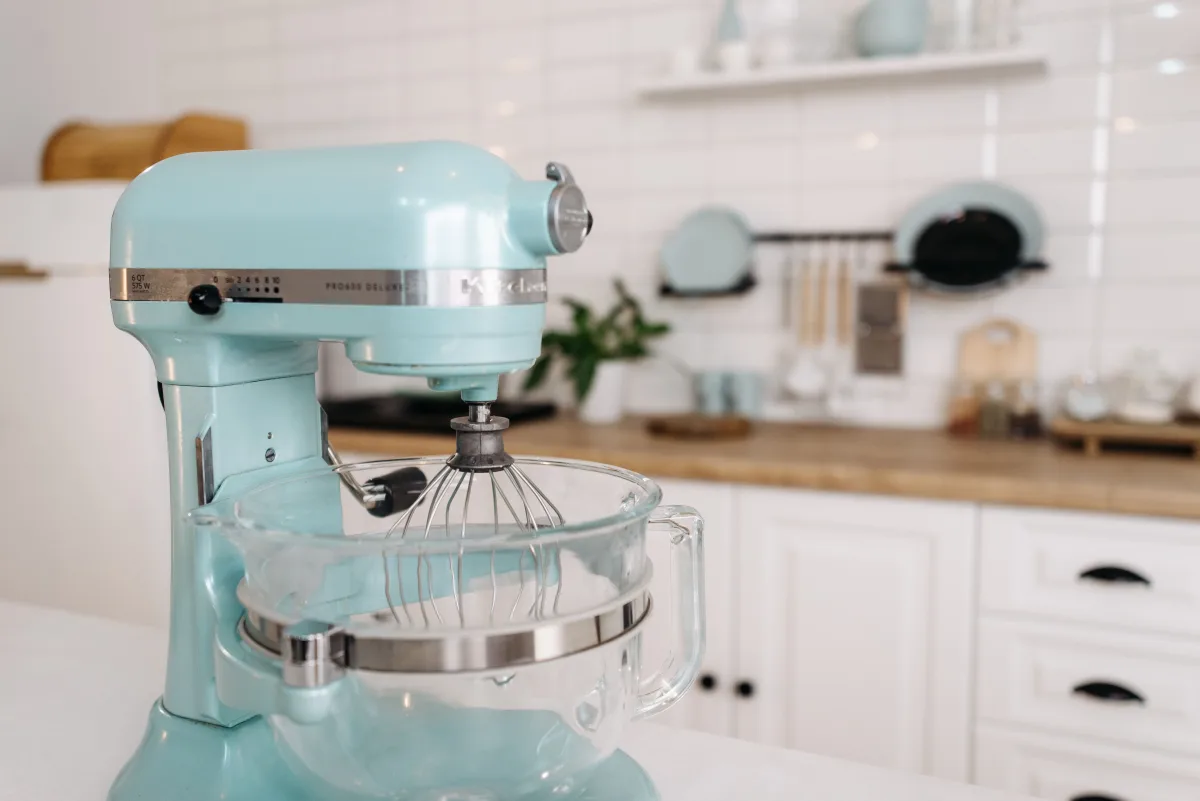
KitchenAid Artisan Series 5-Quart: What Independent Tests Actually Found

In PureWow's side-by-side test, the KitchenAid Artisan Series 5-Quart scored 94 out of 100, earning full marks for functionality, aesthetics, and mixing power. The tester ran it through buttercream, rye bagels, cookies, and cupcakes without a single instance of overheating, stalling, or counter-walking. That consistency across a wide range of tasks — from meringue to stiff enriched dough — is what separates the Artisan from most competitors at this price point.
The attachment ecosystem is a genuine differentiator. According to KitchenAid's official product page, the Artisan is compatible with over 10 hub-powered attachments — pasta rollers, meat grinders, ice cream makers, and more. No competitor in this price range matches that breadth. If you already own KitchenAid attachments from a previous machine, ecosystem continuity is another reason to stay.
The tilt-head mechanism is heavier to operate than the Cuisinart's, and some users find the speed dial less intuitive than the SM-50's large-numbered version. These are real ergonomic trade-offs worth testing in-store before you buy.
One model to skip: The KitchenAid Artisan Mini 3.5-Quart. Wirecutter found its bowl too small for standard recipes, and its footprint is only marginally smaller than the full-size Artisan. It doesn't meaningfully solve a space problem — and creates a capacity problem. For tight counter space, a powerful hand mixer is a more honest solution.
2026 lineup note: KitchenAid also launched the Artisan Plus (KSM50PKVX), which adds a built-in bowl light and Precision Speed Control dial for smoother speed transitions. It comes with a double flex edge beater and lists at a higher price than the standard Artisan. For most home bakers, the standard Artisan remains the value pick.
Best for: Versatile home bakers who mix a wide range of recipes — cakes, bread, pasta — and want a multi-attachment platform built to last.
Pros:
- Consistently strong across all dough types, including stiff enriched doughs
- 10+ hub-powered attachments, broadest ecosystem in this category
- Built to be serviced and last for many years
- Available in 20+ colors
Cons:
- Heavier tilt-head mechanism; less ergonomic than Cuisinart's
- 1-year warranty vs. Cuisinart's 3-year coverage
- Full retail price is steep; shop sales to get value
Cuisinart Precision Master SM-50: What Independent Tests Actually Found
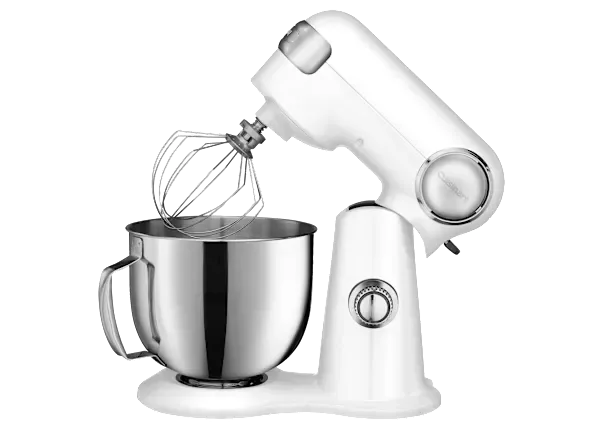
The Cuisinart SM-50 is the right machine for a specific baker — someone who primarily makes cakes, cupcakes, whipped cream, and lighter batters, and who values ease of use and portability over raw power. Reviewed's conclusion after testing was direct: the SM-50 is "best for cake bakers," and the test data supports it.
Its weight is a genuine advantage that gets underplayed in most reviews. At 16.5 lbs, it's roughly 35% lighter than the KitchenAid Artisan, per PureWow's measurement. That difference matters if you store your mixer in a cabinet and bring it out per session, or if lifting heavy appliances is physically difficult.
Quiet operation is another practical benefit. In Reviewed's test group, the SM-50 tied with the Smeg for lowest noise under load — noticeably quieter than the KitchenAid in similar conditions. In an apartment or shared home, that matters at 7 a.m.
The 3-year warranty is a meaningful advantage over KitchenAid's 1-year coverage. If something fails in year two, that difference has real dollar value.
Where it falls short: Wirecutter found the Cuisinart rocked and strained with chunky cookie dough and pizza dough. Its top speed setting is slower than the KitchenAid's mid-range speed. The manufacturer caps recommended dough use at two loaves of bread — not a guideline, a specification. If you regularly make bread, this machine will be running at its limit, which affects both results and long-term reliability.
Best for: Cake bakers, first-time stand mixer owners, apartment cooks with storage constraints, or anyone who prioritizes ease of use and value.
Pros:
- ~35% lighter than the KitchenAid Artisan — easier to move and store
- Quieter operation in independent tests
- 12 speeds vs. KitchenAid's 10; smooth, clearly marked dial
- 3-year warranty
- Significantly lower price
Cons:
- Struggles with dense doughs (pizza, stiff cookie); rocks under heavy loads
- Top speed slower than KitchenAid's mid-speed setting
- Limited attachment options compared to KitchenAid's ecosystem
- Manufacturer caps bread dough use at two loaves per session
Which Is Better for Bread Dough: KitchenAid or Cuisinart?

The honest answer: neither is the optimal bread mixer. Both can handle occasional loaves, but neither is engineered for regular, high-hydration, or whole-grain bread baking.
The KitchenAid Artisan handles bread better than the Cuisinart — it doesn't rock or stall under stiff dough loads the way the SM-50 does. But for bakers who make bread multiple times per week, the right machine is purpose-built for dough.
The Bosch Universal Plus Mixer is the machine serious home bread bakers consistently return to. Its motor and bowl geometry are designed for sustained, high-torque kneading, and it handles large batches efficiently — a meaningful advantage when you're making four loaves at once.
The Ankarsrum Original Assistent takes a fundamentally different approach. Instead of planetary mixing action (where the attachment orbits a fixed center), the Ankarsrum uses a rotating bowl with a roller and scraper that works dough from the outside in. For high-hydration and whole-grain breads, this geometry develops gluten more gently and thoroughly than a standard dough hook. Available from Sur la Table and King Arthur Baking Company, it reflects specialized engineering at a higher price point.
The trade-off with both: neither is as intuitive as the KitchenAid or Cuisinart for non-bread tasks. If bread is 80% of your mixer use, that's an acceptable trade. If it's 20%, it probably isn't.
Best for: Home bakers who make bread, pizza dough, or bagels multiple times per week and want purpose-built equipment.
Design-Forward Options: Smeg and Kenwood
Some buyers want a mixer that looks as good as it performs — a permanent countertop fixture, not an appliance that lives in a cabinet. Two brands compete for that buyer.
The Smeg Stand Mixer surprised Bon Appétit's testers. The publication is typically skeptical of Smeg products, finding them aesthetically pleasing but underperforming. The stand mixer proved to be well-constructed with a 600-watt motor capable of handling demanding tasks. The catch: during dense bread dough tests, the Smeg jumped around the counter more than both the Breville and KitchenAid. If your baking skews toward cakes and lighter batters, the Smeg's performance is genuinely adequate. If you make bread regularly, the counter movement is a real problem.
The Kenwood Chef Major Titanium ranked second in power output in Everything Kitchens' comparative testing. The limitation: Kenwood's attachment ecosystem doesn't fully exploit the motor's power. For a machine with that much torque, the range of available accessories is narrower than KitchenAid's platform. Powerful machine; underutilized potential.
The honest framing for design-forward mixers: you pay a premium for aesthetics, and in the Smeg's case, you accept some performance trade-offs under heavy loads. If the mixer lives on your counter permanently and visual coherence in your kitchen matters to you, that premium may be worthwhile. If it goes in a cabinet between uses, paying for design makes less sense.
The 2026 Stand Mixer Market: Why So Many Options Exist

A decade ago, KitchenAid essentially owned the premium home stand mixer conversation. Today, Ankarsrum, Bosch, Smeg, Kenwood, Breville, and Cuisinart all compete credibly across different segments.
According to The Insight Partners, the global stand mixer market was valued at approximately $1.26 billion in 2025 and is projected to reach $1.63 billion by 2034, growing at a compound annual rate of 5.4%. The drivers: home baking experimentation, demand for multi-functional kitchen tools, the artisan bread trend, and the rise of cottage bakery startups.
That competition is good for buyers: more purpose-built options mean less settling for one-size-fits-all compromises.
If you're evaluating the stand mixer alongside a broader kitchen upgrade, it's worth comparing appliance priorities together. Our best blenders guide and best coffee makers guide cover the other major countertop investments worth stacking against your mixer budget. For kitchen cleanup to match your baking output, see our best dishwashers guide.
Final Recommendations: Which Stand Mixer Should You Buy in 2026?
Choose based on what you actually bake most, not what you imagine you might bake someday:
Buy the Cuisinart SM-50 if: You primarily make cakes, cupcakes, whipped cream, and lighter batters. It handles these tasks well, it's quieter, it's lighter, the 3-year warranty is better, and at $150–$200 it costs significantly less than the KitchenAid. Its limitations with stiff dough won't affect you regularly.
Buy the KitchenAid Artisan Series 5-Quart if: You bake a wide variety of things — cakes one weekend, bread the next, pasta occasionally — and want one machine that handles all of it without limitations. The performance consistency across tasks, combined with the 10+ attachment ecosystem, justifies the higher price for a versatile baker. Shop sales: $349 is a reasonable price; $450 is hard to justify when retailers discount regularly.
Buy the KitchenAid 7-Quart Bowl-Lift if: You're a KitchenAid loyalist who regularly makes double batches or large loaves. The Pro 600 has been discontinued; this is the current step-up model. Bon Appétit tested it and found performance equal to the Artisan for standard tasks.
Buy the Bosch Universal Plus (or Ankarsrum) if: Bread, pizza dough, or bagels are your primary reason for owning a stand mixer. You want a machine engineered for dough, not a general mixer pushed to its limits.
Buy the Smeg if: Performance for cakes and lighter tasks is sufficient, and design genuinely matters to you. Accept the counter-movement limitation under heavy dough loads.
One warranty note before you buy: KitchenAid's 1-year coverage vs. Cuisinart's 3-year warranty is a real difference, not a footnote. If you're paying full retail for a KitchenAid, factor in whether an extended protection plan from the retailer makes sense.
Frequently Asked Questions
Is the Cuisinart SM-50 powerful enough for bread dough?
For occasional use within the manufacturer's specification — two loaves at a time — the SM-50 can manage. Wirecutter found it rocked and strained with pizza dough and chunky cookie dough, and its top speed is slower than the KitchenAid's mid-range setting. If you make bread regularly, the SM-50 will be running at its ceiling consistently, which affects both output quality and long-term reliability.
Why does the KitchenAid Artisan Mini exist if it's not recommended?
The Mini targets buyers who want a smaller footprint, but independent testing found its bowl too small for standard recipes and its overall dimensions only marginally smaller than the full Artisan. It doesn't solve a space problem meaningfully, and creates a capacity problem. A hand mixer is a more honest solution for genuinely constrained kitchens.
What happened to the KitchenAid Professional 600?
According to Everything Kitchens, the KitchenAid Pro 600 has been discontinued and replaced by the KitchenAid 7-Quart Bowl-Lift Stand Mixer. If you encounter the Pro 600 listed new in 2026, it's likely old inventory. The 7-Quart Bowl-Lift is the current upgrade path.
Does the KitchenAid Artisan go on sale, and when?
Yes — frequently. The Artisan 5-Quart lists at $449.99 but Walmart, Best Buy, and Costco regularly sell it in the $349–$399 range. Major sales typically align with Black Friday, Prime Day, and holiday weekends. It's rarely worth paying full MSRP if you can wait a few weeks.
Are KitchenAid stand mixer attachments worth buying?
For versatile bakers, yes — particularly the pasta roller/cutter set and the food grinder, which turn the Artisan into a legitimate multi-function kitchen tool. The attachment value argument is less compelling if you primarily bake cakes and cookies; in that case, the Cuisinart's lower price and equal performance on light tasks is harder to argue against.
Can I use a stand mixer to make pasta dough?
Yes, but the result depends on the machine. The KitchenAid Artisan handles pasta dough well with its dough hook, and the pasta roller/cutter attachment (sold separately) makes pasta-making straightforward. The Cuisinart SM-50 also offers a pasta extruder attachment, though its attachment ecosystem is more limited. For fresh pasta as a regular practice, the KitchenAid's broader attachment library is worth the premium. For an overview of complementary kitchen tools that pair well with fresh cooking from scratch, see our best instant pot and pressure cooker guide.
This article was researched and drafted with AI assistance, then reviewed and fact-checked by our editorial team before publishing. How we review → · AI ethics policy →
Trusted Buyer Report may earn a commission from purchases made through links on this page, at no extra cost to you. Affiliate links are added only after editorial rankings are finalized. Affiliate disclosure →