We may earn a commission when you use our links to make a purchase. Rankings are finalized before any affiliate link is placed. Full disclosure.
Most e-bike roundups bury the one thing you need first: which category fits your life. Buy a 65-lb fat-tire bike for a fourth-floor walk-up, or a 15.5-mph folding bike for keeping pace with US traffic, and no amount of spec-sheet excellence will save you.
Quick verdict: for most daily riders, the Aventon Level 3 (~$1,899) is 2026's best value commuter e-bike; the Brompton Electric T-Line is the folding benchmark if you can live with its speed cap; and budget fat-tire models like Heybike's cover rough-road and light-trail duty for the least money. The full comparison — and the honest trade-offs — below.
If e-bikes are one line item in a bigger gear refresh this year, our 2026 outdoor and sports gear buyer's guide puts this category in context alongside everything else worth upgrading.
2026 e-bike comparison table: best picks by category
| Category | Model | Price | Motor | Key strength | Best for |
|---|---|---|---|---|---|
| Commuter — value | Aventon Level 3 | ~$1,899 | 500W hub (torque + cadence) | Feature density for the money | Daily urban/suburban commuters |
| Commuter — premium | Gazelle Eclipse C380+ | $6,399 | Bosch mid-drive | Build-quality benchmark | Long-term investment riders |
| Commuter — mid-range | Gazelle Medeo T9 HMB | Below Trek Verve+ 3 | Bosch Active mid-drive | Racks, fenders, lights included | Practical riders on a tighter budget |
| Folding — premium | Brompton Electric T-Line | Premium tier | e-Motiq hub | Titanium build, desk-sized fold | Apartment and transit commuters |
| Folding — mid-range | Tern NBD P8i | Mid tier | Bosch Active | Easy transport, quality drivetrain | Multi-modal commuters |
| Trail — budget | Heybike fat-tire model | $1,399 | Hub motor | Grip on rough, unmaintained roads | Weekend and rough-road riders |
| Trail — mid | Freysky 2026 Alaska Pro | Mid-range | Hub motor | Trail-capable build | Mixed-terrain riders |
The spread runs from under $1,000 at the entry level to well past $6,000 for premium builds. That gap means category fit matters more than price: a fat-tire trail bike and a folding commuter at the same price are optimized for completely different lives.
How this guide was researched
This guide synthesizes lab-tested rankings from OutdoorGearLab, long-form reviewer assessments from WIRED, commuter-focused testing from Wirecutter, and US market analysis — so you don't have to read all of them. Trusted Buyer Report has not hands-on tested these bikes ourselves. Where sources disagree, we say so; prices were verified against manufacturer and dealer listings as of July 2026. How we review.
What do e-bike classes mean in the US?
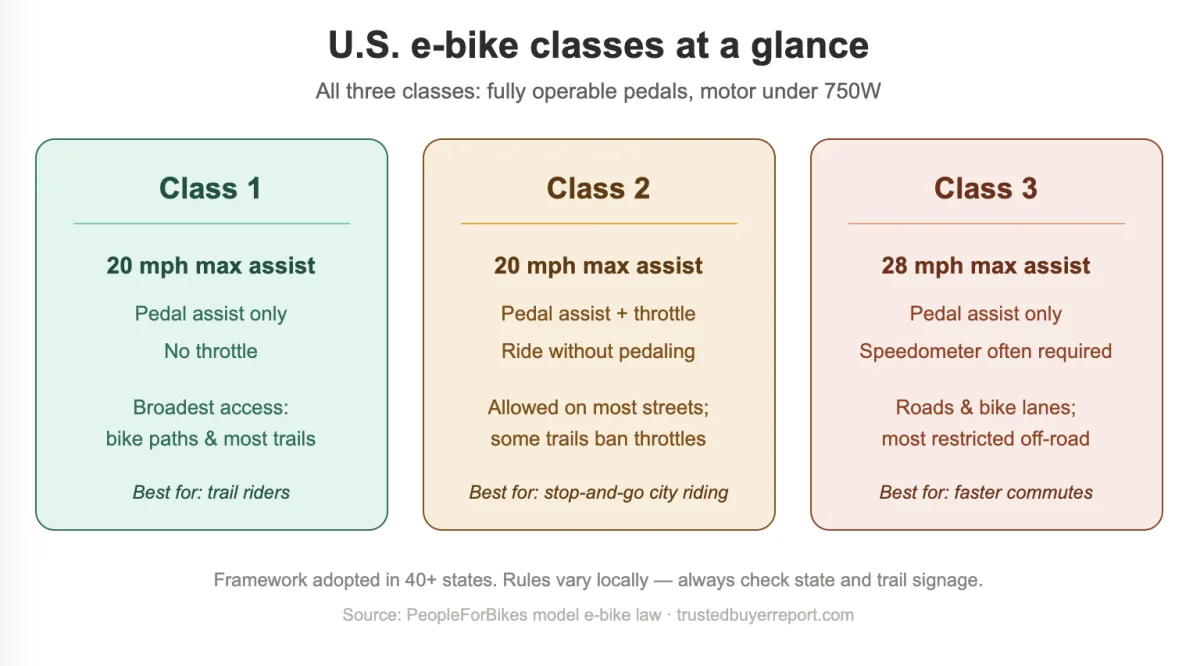
US e-bikes fall into three classes: Class 1 (pedal assist only, 20 mph cap), Class 2 (adds a throttle, 20 mph cap), and Class 3 (pedal assist only, 28 mph cap). All three require a motor under 750W. The framework, created under PeopleForBikes' model e-bike legislation, has been adopted in most states — but trail access rules vary locally.
Why this matters before you shop: some imported bikes don't fit the US framework at all. Here's the trap —
The Brompton Electric T-Line ships speed-limited to 15.5 mph for the UK market, well below the 20 mph American riders expect from a Class 2 bike. If your commute means riding alongside traffic, that's a deal-level difference, not a footnote. Check the class label (and the assist cap) on any imported model before buying.
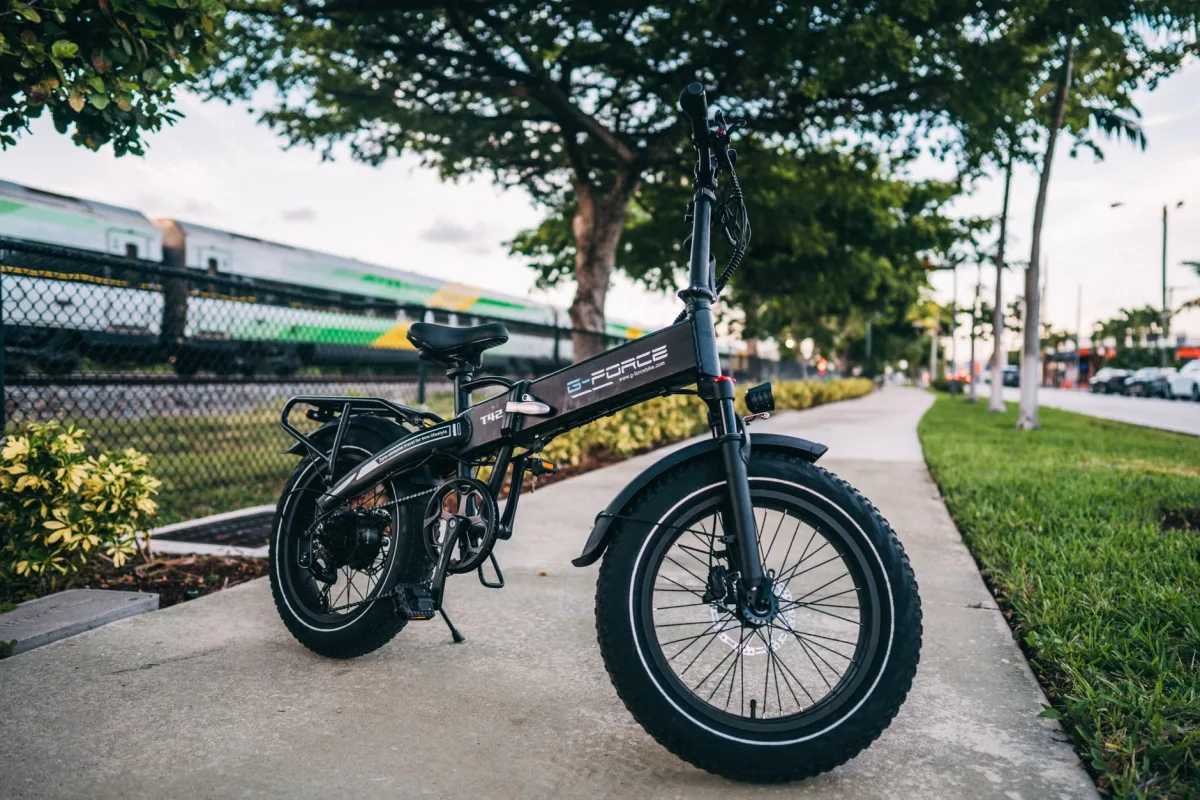
Best commuter e-bikes of 2026
Commuter bikes are the practical center of the market: reliable daily mileage, cargo capacity, integrated lights, and enough range that a low battery three miles from work isn't a crisis.

Aventon Level 3 — best value commuter
OutdoorGearLab's lab testing calls the Aventon Level 3 arguably the best commuter bike for the money, praising its Magura hydraulic brakes — rare on a sub-$2,000 e-bike — stability at speed, and road-ready setup out of the box. Per Aventon's official specs, you get a 500W hub motor, up to 70 miles of range, fenders, a 59-lb-capacity rear rack, and GPS anti-theft features, typically for $1,899.
The honest limits: it ships Class 2 (20 mph) with Class 3 speeds unlockable in the app, but it's still a hub-motor bike — you don't get the mid-drive feel Wirecutter recommends for hilly commutes, or a dealer network behind the warranty.
Gazelle Eclipse C380+ — the premium reference point
WIRED rates the Gazelle Eclipse C380+ 8/10 and treats it as the benchmark for what a high-end commuter delivers over cheaper direct-to-consumer bikes. At $6,399 it's a serious outlay — the price-tier section below breaks down exactly what that extra money buys.
Trek Verve+ 3 and Gazelle Medeo T9 HMB — the Bosch mid-range
Wirecutter's commuter guide centers on the Trek Verve+ 3, which carries UL 2849 certification — a battery and electrical safety standard worth verifying on any e-bike you consider. Its budget alternative, the Gazelle Medeo T9 HMB, keeps the Bosch Active mid-drive motor and includes racks, fenders, and lights. Wirecutter's one real complaint: the step-through version mounts the battery on the rear rack, raising the center of gravity and complicating child-seat racks.
Best folding e-bikes of 2026
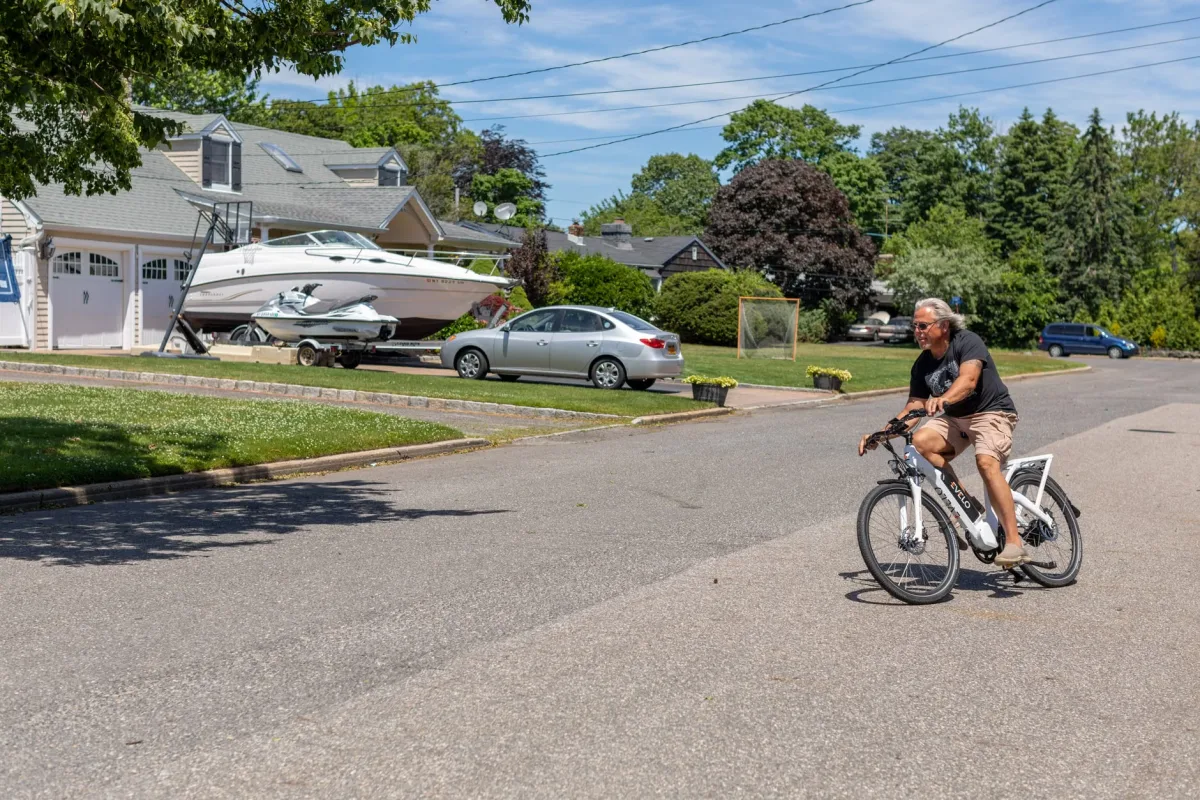
Folding e-bikes solve a storage problem, not a speed problem: subway cars, apartment closets, car trunks, office corners.
Brompton Electric T-Line — the folding benchmark
WIRED's review is close to a rave: an aerospace-grade titanium frame made in the UK, carbon fork and bars, a fold that fits under a desk, and a detachable battery bag roomy enough for a lock and lunch. WIRED calls the design museum-worthy.
But there's a catch you already know: the 15.5 mph UK speed cap, which WIRED flags as genuinely slow for American roads. Add 16-inch wheels that feel twitchy until you adapt, and the T-Line is best for well-heeled urban riders who rank portability and design above pace.
Tern NBD P8i — folding without the compromises
Wirecutter's folding pick, the Tern NBD P8i, runs the same Bosch Active drivetrain family as its commuter recommendations — meaningful, because motor quality is usually the first thing folding bikes sacrifice.
What to check on any folding e-bike: weight under ~55 lbs (you will carry it), a torque sensor rather than cadence-only, and hinge durability — TST EBike's design team rates its 2026 hinges for 20,000 fold cycles, a longevity spec most buyers never think to ask about.
Best mountain and fat-tire e-bikes of 2026
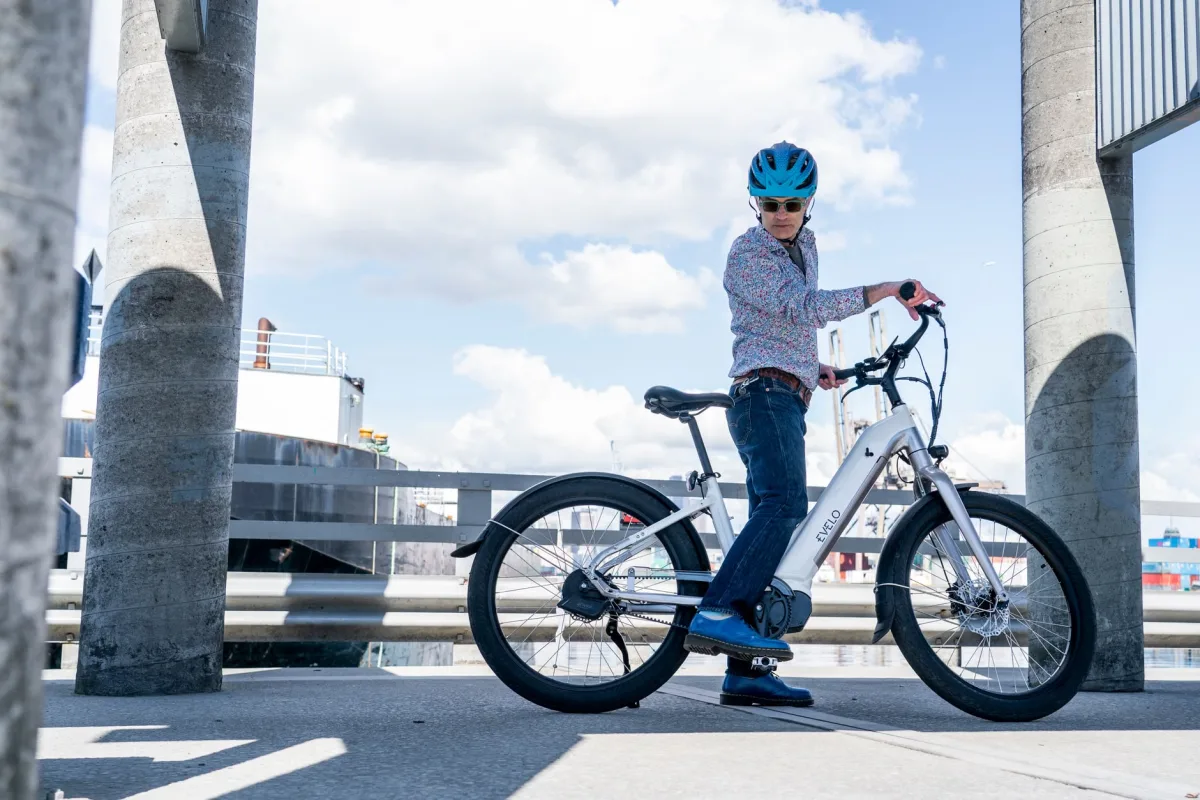
This category spans fat-tire crossovers for rough pavement all the way to purpose-built trail machines. Be honest about where you actually ride.
Heybike fat-tire model — budget rough-road crossover
The Heybike fat-tire model featured in a 2026 video review roundup pairs 26×4-inch tires with a front suspension fork and a dead-simple 3-speed shifter. On potholed streets and gravel, the grip is a real advantage — the same reason fat-tire e-bikes have become a favorite for hauling rods and tackle to hard-to-reach water (pair one with the right kit from our 2026 fishing gear guide).
The downsides are just as real: at roughly 65 lbs it's a workout to load solo, and the reviewer flags inconsistent Heybike customer-service response times. Great for weekend riders; wrong for anyone carrying a bike up stairs.
Freysky 2026 Alaska Pro — mid-range mixed terrain
The same roundup lists the Freysky 2026 Alaska Pro as the step up: more trail capability than a fat-tire commuter crossover, without full-suspension pricing. If your rides mix fire roads with trailhead access — say, bikepacking toward a campsite — it slots neatly alongside the setups in our 2026 camping and hiking gear guide.
The performance segment
At the top end, GMInsights' US e-bike market analysis highlights Trek's ongoing investment in motor systems, connectivity, and lightweight frames — backed by a dealer network that matters when something breaks. Cycling Electric's 2026 editor's choice awards also single out Estarli's gravel e-bike: a 252Wh battery, low weight, and generous tire clearance — a reminder that off pavement, low weight and smart geometry often beat raw wattage.
Is an expensive e-bike actually worth it?
An expensive e-bike buys three things a budget bike can't fake: a mid-drive motor with natural, hill-efficient assist; lighter premium frame materials; and a dealer network for in-person service. Whether that's worth $4,000+ depends on your mileage — daily riders feel the difference constantly, occasional riders rarely do.
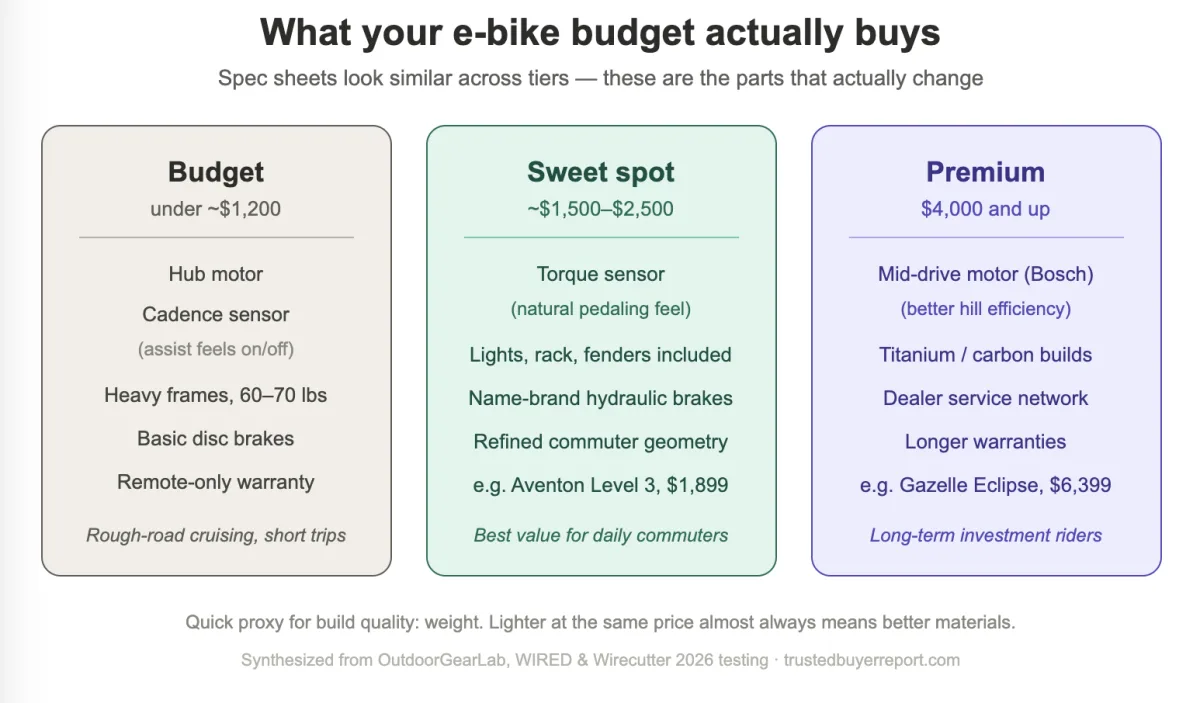
The clearest cross-tier proxy is weight. The Brompton's titanium-and-carbon build is dramatically lighter than a steel-framed budget bike, and you feel that difference on every staircase, train platform, and turnstile. Direct-to-consumer brands compress prices by cutting dealer margin — OutdoorGearLab notes Lectric's scale lets it undercut smaller brands — but local service access disappears with that margin.
Where should you buy: dealer, co-op, or direct?
Buy direct-to-consumer when price is the priority and you're comfortable handling warranty claims remotely. Buy from a dealer or co-op when you want assembly, fitting, and in-person service — REI, for example, sells and services e-bikes nationwide, and its return policy is one of the most buyer-friendly in outdoor retail; our REI review for 2026 breaks down whether the co-op membership pays for itself.
Frequently asked questions
What is the best electric bike for daily commuting in 2026?
For most commuters, the Aventon Level 3 (~$1,899) offers the strongest feature-to-price ratio, per OutdoorGearLab's lab testing. Riders who want a mid-drive motor and dealer support should look at the Trek Verve+ 3 or Gazelle Medeo T9 HMB, both with Bosch systems, per Wirecutter.
Are folding e-bikes worth buying?
Yes — if portability is genuinely part of your life. Apartment storage, transit connections, and car trunks are problems a folding e-bike actually solves. If you ride point-to-point and store in a garage, you're paying a portability premium for nothing. Target under 55 lbs with a torque sensor.
Is the Brompton Electric T-Line too slow for US riders?
Its 15.5 mph assist cap is a real limitation where Class 2 bikes legally assist to 20 mph. If you commute in mixed traffic, that gap matters daily. If you ride bike paths and value the desk-sized fold, it's the best-built folding bike money can buy.
Should I buy a Class 2 or Class 3 e-bike?
Choose Class 2 if you want throttle convenience for stop-and-go city riding and the broadest legal access. Choose Class 3 if your commute is longer and keeping pace with traffic at up to 28 mph matters more than trail access — Class 3 bikes face the most path restrictions.
Bottom line by rider: apartment + transit → Brompton or Tern; daily suburban commute → Aventon Level 3; hills and high mileage → a Bosch mid-drive (Trek/Gazelle); rough roads on a budget → a fat-tire crossover, eyes open about the weight.
Trusted Buyer Report may earn a commission from purchases made through links on this page. This article was drafted with AI assistance and fact-checked by a human editor before publication. Sources cited inline; see our methodology.