Reviewed by the TrustedBuyerReport editorial team. This article was drafted with AI assistance and fact-checked before publishing. We may earn a commission from purchases made through links on this page — at no extra cost to you.
Your dog won't stop scratching. Your cat's stomach is a mess. You've tried switching foods, added supplements, and spent a small fortune at the vet — but nothing sticks. That's exactly the scenario where pet owners find their way to the 5Strands pet test. But is it actually useful, or is it wishful thinking backed by questionable science?
Here's the straight answer: 5Strands can be a useful starting point for elimination diets, but the hair-based bioresonance technology it uses has not been validated by mainstream veterinary science. Many owners report meaningful symptom improvements after acting on the results; others find the results confusing or off-base. Whether it's "worth it" depends heavily on what you expect from it — and that's exactly what this review unpacks.
This guide is based on aggregated owner feedback from Chewy, Amazon, Walmart, and pet forums, combined with publicly available veterinary and allergy research. We have not independently lab-tested the kit.
Quick Facts
| Price range | ~$66–$148 depending on the kit |
| Items tested | 400–1,036 (varies by kit tier) |
| Sample type | 5–15 strands of pet hair |
| Turnaround | 3–7 days after lab receipt |
| Technology | Bioresonance (hair analysis) |
| Scientific recognition | Not validated by AAAAI or veterinary dermatology bodies |
| Where to buy | 5strands.com |
| Best for | Pet owners wanting a structured elimination diet starting point |
| Not a replacement for | Veterinary allergy testing (intradermal or serum IgE blood testing) |
What Is the 5Strands Pet Test?
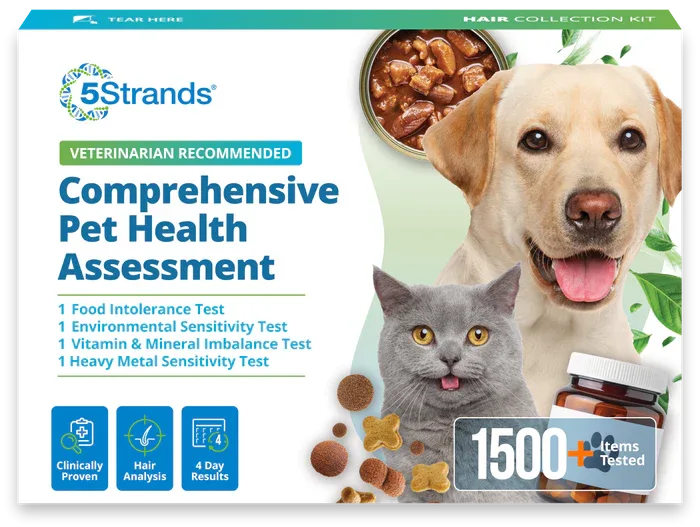
5Strands is a US-based company that launched in 2018, offering at-home sensitivity tests for both humans and pets. Their pet line focuses on dogs, cats, and small animals. The core premise: you mail in a small sample of your pet's hair, and the lab analyzes it against hundreds of food and environmental items using bioresonance technology, then returns a color-coded report indicating which items your pet shows an "intolerance" or "imbalance" response to.
The company claims to have tested over 345,000 pets and people. Their most popular pet kits include:
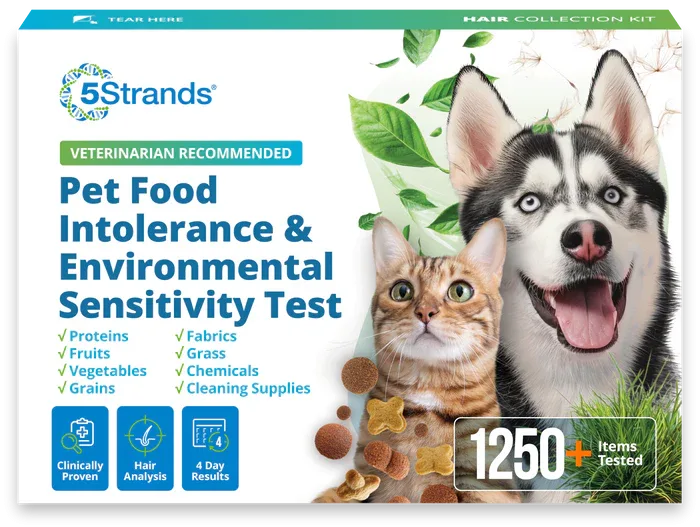
Pet Food Intolerance Test — covers 825 commercial pet food ingredients (proteins, grains, preservatives, additives, treats). Priced around $66.
Pet Food & Environmental Intolerance Test — adds 282 environmental items (fabrics, cleaning products, pollen, grasses). Around $104.
Pet Health Test (full bundle) — also includes nutritional imbalances, metals, and minerals. Up to $148.
Each kit comes with a prepaid return label, a collection bag for the hair sample, and a unique ID code to register the kit and access results via the 5Strands app or website.
If your pet is on a raw or fresh food diet specifically, they also offer a dedicated Raw & Fresh Pet Food Intolerance Test covering 400+ raw ingredients — a niche but thoughtful product differentiation that most competitors skip. If you've been spending money on Chewy rotating proteins without a clear direction, that pet food-focused test is worth comparing to what's in your cabinet right now. Speaking of which, check out our analysis of the best dog food brands for 2026 if you're at the stage of rebuilding your pet's diet from scratch.
The Science Question: What Does "Bioresonance Hair Testing" Actually Mean?
This is the part most reviews gloss over. Let's be direct.
Bioresonance is a method based on the idea that living organisms emit electromagnetic frequencies, and that these frequencies stored in hair can be compared against the "frequencies" of food or environmental items to detect incompatibilities. It's used in some integrative and holistic veterinary practices.
However, mainstream allergy science does not recognize hair analysis as a validated diagnostic tool. The American Academy of Allergy, Asthma and Immunology (AAAAI) has listed hair analysis among diagnostic methods that are "either disproved or unproven" for food intolerance or allergy evaluation (AAAAI Food Allergy Practice Parameter). A 2018 review published in the Journal of Allergy and Clinical Immunology: In Practice similarly categorized hair analysis alongside other "unproven diagnostic tests for adverse reactions to foods," noting a lack of reproducibility and correlation with disease in controlled studies (JACI: In Practice, 2018).
The veterinary-specific evidence is equally sobering. A 2019 study published in Veterinary Dermatology (Bernstein et al.) submitted duplicate hair samples from one allergic dog, one non-allergic dog, and a fake sample (synthetic fur) to a direct-to-consumer hair analysis service. The results performed no better than random chance and were not reproducible between duplicate submissions (Veterinary Dermatology, 2019). A separate analysis documented by Quackwatch compared two 5Strands reports for the same pet taken three weeks apart — only two of nine flagged items overlapped between the two tests.
5Strands itself states clearly on its website: "Testing results should not be compared to traditional blood or saliva allergy test results." That disclaimer matters.
None of this means the test is useless — but it does mean you shouldn't treat the results as a clinical diagnosis. The distinction between what the science says and what owners actually experience is where the real story lives.
What Owners Actually Report (Aggregated from 1,000+ Reviews)

Across Chewy, Amazon, Walmart, and pet community forums, the pattern of feedback is consistent enough to draw some useful conclusions.
Where owners report wins:
The most common positive pattern is an owner who suspected a specific ingredient (beef, chicken, salmon) was causing problems — itching, loose stools, ear infections, coat issues — and found the 5Strands results aligned with that suspicion. After following the 6–8 week elimination protocol 5Strands recommends, a meaningful number report visible symptom improvement within weeks. One Chewy reviewer found that her dog's scratching stopped after switching away from turkey, salmon oil, and duck — all flagged as Level 3 by the test. Another described years of vet visits and steroid medications with no resolution until diet changes guided partly by the 5Strands report finally reduced symptoms.
For owners who've been "shooting in the dark" trying different proteins, the structured report gives something concrete to act on — and that structure itself may be as valuable as the specific results.
Where owners report frustration:
The most common negative pattern is getting a report where almost every ingredient the pet currently eats is flagged at Level 2 or 3. One Chewy reviewer described getting results so restrictive that no commercial food would realistically fit — leaving them more confused than before. Another owner noted that lamb (her dog's confirmed-safe protein) was flagged as a "discontinue immediately" Level 3 intolerance, while chicken (a known problem) was only Level 2.
There's also a subset of skeptical owners who point out that the bioresonance approach has no peer-reviewed backing, and that the improvement some owners see is likely explained by the elimination diet itself — not by the accuracy of the hair analysis identifying the specific trigger. That's a fair point. A structured elimination diet following any systematic list would probably yield some improvement for a pet with genuine food sensitivities.
The reproducibility concern: Owners who've retested the same pet at different times sometimes report significantly different results — consistent with what independent research has found about the methodology's reliability.
Is the 5Strands Pet Test Worth It?
The honest answer: it depends on what you're trying to accomplish.
It's a reasonable option if your pet has ongoing symptoms (itching, stomach issues, coat problems) and you want a structured, affordable framework to start an elimination diet — and you understand you're using it as a hypothesis generator, not a clinical diagnosis. At $66–$104, it's a fraction of the $900+ quote that some owners receive for in-office veterinary allergy blood testing.
It's not a good fit if you're hoping for a definitive diagnosis you can rely on without veterinary input, if your pet has a serious health condition requiring accurate diagnosis, or if you plan to make major health decisions based solely on the results.
A smart approach that several experienced owners use: run the test, use the results to narrow down which proteins and environmental triggers to eliminate first, then share the report with your vet. The vet can help you interpret the results in context of your pet's actual symptoms, history, and a proper physical exam. Your vet may also recommend formal allergy testing (intradermal or blood serum IgE) if symptoms are severe.
One underappreciated point: food allergies account for only about 10–15% of all allergies seen in dogs, according to veterinary dermatologists. If your pet's symptoms are driven primarily by environmental allergens (grass, dust mites, pollen), a dietary elimination alone — whether guided by 5Strands or not — may not fully resolve them. If you're navigating that complexity and wondering about environmental monitoring tools alongside pet care products, our roundup of pet products reviewed in 2026 covers a broader category landscape.
How the 5Strands Test Process Works
The process is genuinely straightforward:
- Order and register. After purchase, you register the kit on 5strands.com or the 5Strands app using the unique ID code in the box.
- Collect hair. Collect 5–25 strands of your pet's fur (from anywhere on the body). For short-haired pets, scissors can help.
- Mail it back. A prepaid return shipping label is included — no extra fees.
- Get results. The lab confirms receipt by email, then typically returns results 3–5 business days later, accessible in the app and as a PDF.
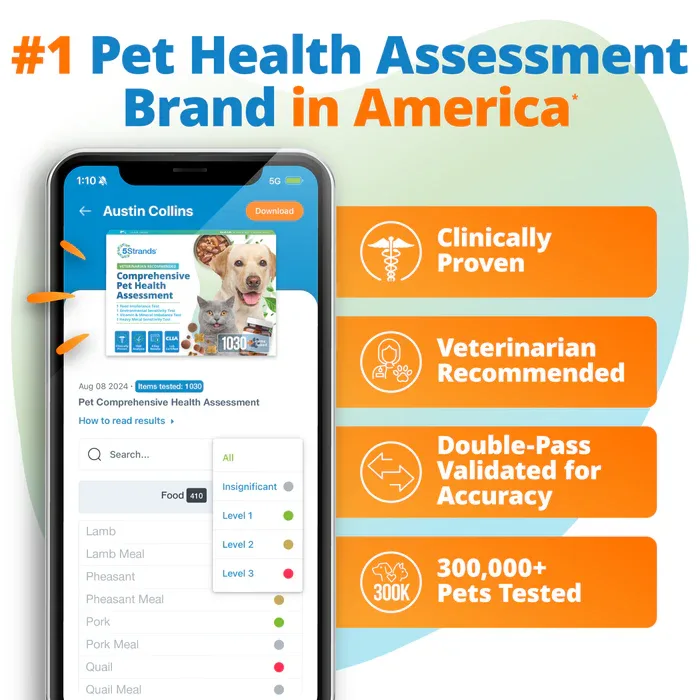
The results are color-coded: red (Level 3) for severe, yellow (Level 2) for moderate, green (Level 1) for mild, and gray for insignificant/below threshold. The report also includes an elimination guideline and a recommended 6–8 week timeline to remove high-sensitivity items from your pet's diet or environment.
The app allows you to look up individual ingredients on the fly — genuinely useful when you're reading a kibble label in a pet store.
5Strands vs. Veterinary Allergy Testing
| 5Strands Pet Test | Vet Intradermal Test | Vet Blood (IgE) Test | |
|---|---|---|---|
| Cost | ~$66–$148 | $500–$1,000+ (sedation req.) | ~$300–$900 |
| Invasiveness | None (hair) | High (needles, sedation) | Low (blood draw) |
| Scientific validation | Not validated | Gold standard | Validated, improving |
| Turnaround | 3–7 days | Same day / results in weeks | 1–3 weeks |
| What it tests | 400–1,000+ food/env items | Environmental allergens (IDT) | IgE-mediated allergens |
| Use case | Elimination diet starting point | Allergy shot formulation | Food + env. allergy diagnosis |
| Vet required? | No | Yes (specialist) | Yes |
For true allergy diagnosis, especially if your goal is immunotherapy (allergy shots), formal veterinary testing remains the only clinically validated path. The 5Strands test occupies a different lane — it's an accessible, affordable screen that helps pet owners take structured action without waiting weeks for a vet appointment.
Who Should (and Shouldn't) Buy the 5Strands Pet Test
Good fit:
- Pet owners with chronic, low-grade symptoms (itching, loose stools, coat dullness) who want to start an elimination diet without spending $900 on blood testing
- Owners who've already suspected specific food triggers and want a broad screen to validate or expand their investigation
- Anyone feeding a dog or cat on a homemade or raw diet who wants a comprehensive ingredient-level sensitivity check
- Those who plan to share results with their vet as a discussion starting point
Not the right fit:
- Pets with severe, acute, or rapidly worsening symptoms — see a vet first
- Owners who need a definitive medical diagnosis
- Anyone who will act on the results without any veterinary involvement
- Anyone expecting the same clinical accuracy as bloodwork
Frequently Asked Questions
Is the 5Strands pet test the same as an allergy test? No. 5Strands tests for intolerances and imbalances using bioresonance technology, which the company itself notes should not be compared to traditional allergy tests (blood IgE or skin prick). Allergies involve an immune response (IgE antibodies); intolerances are a different mechanism. The methods for detecting each are also different.
Can I use the 5Strands results to replace vet allergy testing? No — and 5Strands doesn't claim otherwise. The results can help you structure an elimination diet and provide a list of items to discuss with your vet, but for diagnosis-level accuracy (especially for allergy shot formulation), formal veterinary testing is required.
How many items does the 5Strands pet test cover? It depends on which kit. The standard food-only test covers 825 commercial pet food ingredients. The food and environmental combo covers 857 items. The full health bundle tests over 1,000 items including nutritional deficiencies and metals.
How long does it take to get results? Results are typically available 3–5 business days after the lab receives your sample. The prepaid shipping label simplifies the return process.
What if the results seem inaccurate? It's a known limitation. If a result doesn't match your pet's actual experience (for example, a food flagged as Level 3 that your pet has been eating without any issues), use your own observation to override it. Discuss anomalies with your vet before making major dietary changes.
Does 5Strands test cats too? Yes. The same kits work for dogs, cats, and small animals. The test process is identical — collect 5–25 fur strands and mail them in. If you're also evaluating what to feed your cat alongside any sensitivity testing, our 2026 cat food guide covers vet-analyzed wet vs. dry options.
Bottom Line
The 5Strands pet test sits in an honest niche: it's an affordable, structured tool for curious, proactive pet owners — not a clinical diagnostic instrument. The bioresonance hair testing method it uses has not been validated by AAAAI or veterinary dermatology guidelines, and independent studies have raised questions about reproducibility. At the same time, hundreds of thousands of owners have used the results as a practical framework to start elimination diets, and many report real symptom improvement as a result of those dietary changes.
If you're already doing an elimination diet, a tool that gives you a structured list of 825+ ingredients to work through — and an app to check ingredients at the store — is genuinely useful, even if the underlying mechanism is contested.
Use it as a starting hypothesis, not a final answer. Share the results with your vet. And go in with realistic expectations.
If you're ready to try it, you can order directly from 5Strands. For a broader look at our full 5Strands assessment including our trust and value scores, see our 5Strands store review.