
Researched and drafted with AI assistance, reviewed and fact-checked by our editorial team before publishing. Trusted Buyer Report may earn a commission from purchases made through links on this page, at no extra cost to you.
A disorganized workshop doesn't just look bad — it costs you money. Tools left loose on a floor or workbench get damaged, rust, or simply disappear. The right storage system turns a cluttered garage into a space where you can actually get work done.
But here's the catch: the tool chest market in 2026 is flooded with units that look industrial but are built from steel so thin it flexes when loaded. Bright colors and "1,200 lb. capacity!" marketing hide the single number that actually matters — steel gauge. And beyond roll-around chests, an entire generation of modular systems (Milwaukee Packout, DeWalt ToughSystem, Flex Stack Pack) has changed how professionals and serious DIYers think about portable versus stationary storage.
This guide breaks it all down by use case — homeowner garage, serious mechanic, jobsite professional — so you can match the right system to your actual situation without overspending or under-buying.
What Steel Gauge Actually Means (and Why Manufacturers Hide It)
Before naming a single product, you need to understand the one spec that separates a lasting tool chest from a money pit.
Steel gauge works backwards: a lower number means thicker steel. 18-gauge steel is meaningfully stronger than 21-gauge steel. The problem is that most manufacturers don't advertise gauge on the product page. They lead with load capacity claims — "1,200 lb. total!" — without mentioning that such ratings assume perfectly uniform drawer loading under controlled lab conditions.
Here's the practical breakdown:
- 16-gauge — heavy professional grade; found on Gearwrench's 72-inch model and high-end Snap-On units. Overkill for most garages, necessary for daily commercial shop use.
- 18-gauge — the sweet spot for serious home garages and light professional use. Husky's Heavy-Duty Series is built to this spec. Resists denting and flexing under real-world loads.
- 20-gauge — standard for mid-range units. Fine for homeowners who aren't overloading drawers. Milwaukee's PACKOUT-adjacent cabinet sits here.
- 21-gauge and above — budget territory. Adequate for light use, but noticeably lighter when you open and close a loaded drawer.
When you're shopping in store, load a few heavy items into a lower drawer and push the chest slightly. If it flexes visibly, you're looking at thin gauge.
The 4 Categories of Workshop Storage in 2026
Workshop storage has split into four distinct categories. Understanding which one (or combination) you need prevents both over-buying and expensive do-overs.
1. Rolling tool chests and cabinets — the traditional floor-standing combo with a top chest stacked on a rolling base cabinet. Best for stationary garages and shops where everything stays in one place.
2. Modular stackable systems — Milwaukee Packout, DeWalt ToughSystem 2.0, Flex Stack Pack, Ridgid Pro Gear 2.0. Interlocking boxes, drawers, and crates that travel between job site, truck, and shop. The fastest-growing segment in 2026.
3. Wall storage systems — pegboard, slatwall (Gladiator GearWall, Rubbermaid FastTrack), and the newer Milwaukee Packout Wall Plates. Best for maximizing floor space in small garages.
4. Workbench-integrated storage — units where the storage is built into the work surface itself, like the Husky 52-inch Mobile Workbench or DeWalt ToughSystem Modular Work Station.
Most shops benefit from combining two of these. A rolling chest for stationary hand tools plus a modular system for tools that travel is the most practical setup for a working DIYer.
Best Rolling Tool Chests 2026: Ranked by Use Case
Best Overall for Home Garages: Husky Heavy-Duty Series (52-inch)
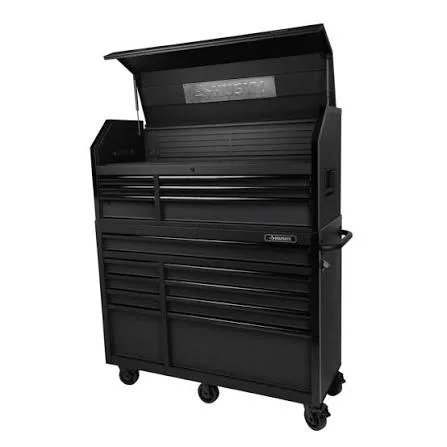
The Husky 52-inch tool chest and cabinet combo earns the top overall pick for home garages because nothing else balances durability, features, and price as well at this tier.
The Heavy-Duty Series is built with 18-gauge all-welded steel — not folded-and-screwed construction, but welded corners that don't flex under load. Nine drawers run on full-extension ball-bearing slides rated to 120 lbs each, and the soft-close mechanism keeps drawers from slamming. A built-in power strip, aluminum edge guards, and six swivel casters (including two locking) round out the package.
As Pro Tool Reviews — which has been using Husky units in their own shop for years — puts it: Husky's Heavy-Duty Series delivers a balance of durability, capacity, and features that no competing unit at this price point matches. For the homeowner who doesn't want to finance a Snap-On chest, the 52-inch combo is the rational choice.
Price range: $499–$699 (frequently on sale at Home Depot)
Where to buy: Home Depot exclusively
Best for: Homeowners and serious DIYers with a stationary garage setup
Not ideal for: Daily commercial shop use or mechanics needing 200+ lb. drawer slides
Best for Serious Mechanics: Milwaukee 46-inch High-Capacity Cabinet
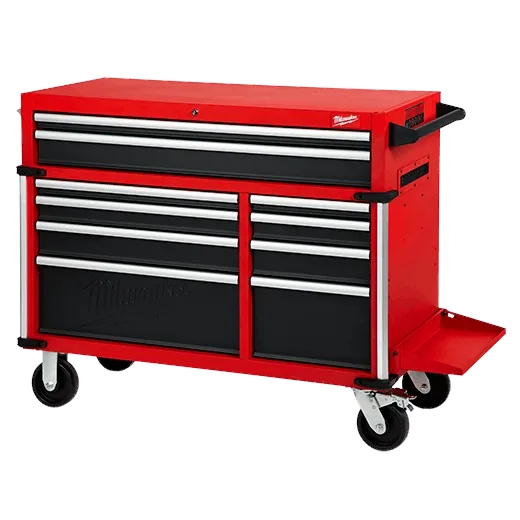
Milwaukee's steel storage lineup is built with the same engineering attention the brand brings to its power tools. The 46-inch High-Capacity Cabinet features ball-bearing slides with soft-close technology, a sliding pegboard panel in the top storage area, an integrated side power strip with USB and Milwaukee M18 battery charger mounts, and 24,199 cubic inches of total storage space.
The sliding pegboard is the detail that separates this unit from competitors — it means you can reorganize your most-used hand tools without drilling new holes or buying new hooks. The corner bumpers protect both tools and the cabinet itself in active shop environments.
The honest trade-off: Milwaukee storage has moved decisively upmarket. The 46-inch unit carries a price premium that requires you to actually use the features to justify it. For a weekend DIYer driving three cars through the garage, the Husky does the job for less.
Price range: $799–$1,099
Where to buy: Home Depot, Milwaukee Tool
Best for: Active mechanics, contractors with a permanent shop, anyone already invested in the Milwaukee M18 ecosystem
Not ideal for: Homeowners on a budget; the premium is real
Best Budget Option: Craftsman 2000 Series Combo
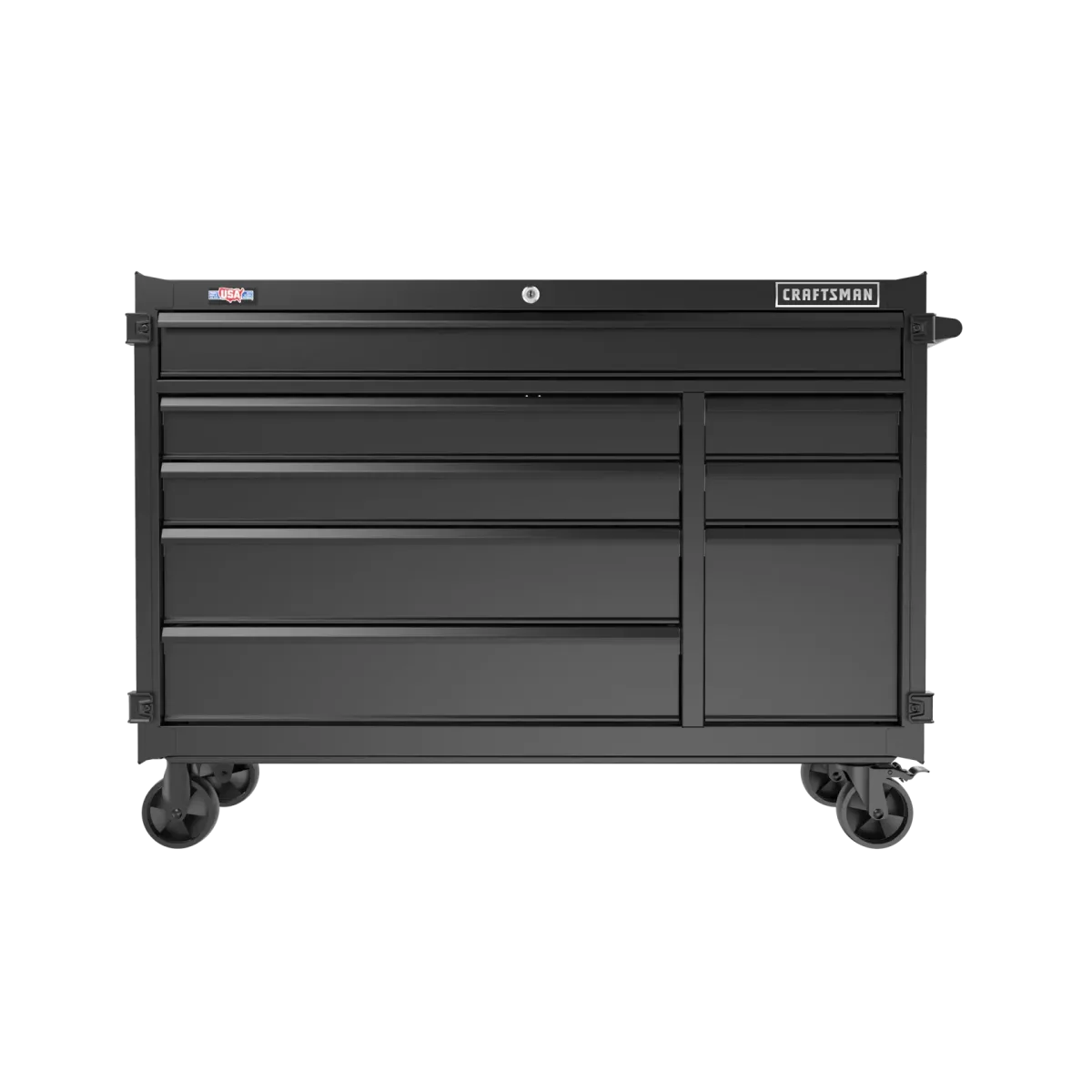
Craftsman's 2000 Series (also called the S2000) is the benchmark of the value segment — and it earns that position through quality control and warranty rather than specs alone. The steel is 21-gauge, which is noticeably lighter than Husky or Milwaukee, but the drawer slides are smooth, the fit and finish is consistent, and Craftsman backs the unit with a lifetime hand tool warranty that covers the tools stored inside it.
The combo configuration includes a top chest and rolling base cabinet, giving you overhead and floor storage in a matching set. The open till area on the top chest works well for charging stations — a detail that matters now that most tool collections include multiple battery-powered tools.
Price range: $299–$449
Where to buy: Lowe's, Craftsman.com
Best for: Budget-conscious buyers, first garage tool chest, apartment storage
Not ideal for: Anyone who routinely overloads drawers or works in a professional shop environment
Best for Professional Mechanics: Dragonfire Pro Series
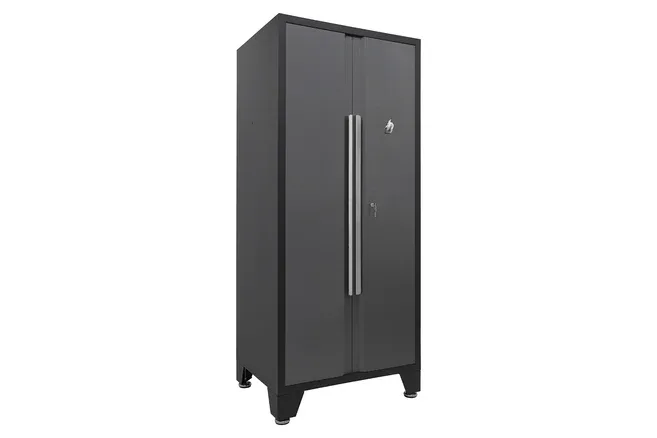
Snap-On makes exceptional storage but at prices that can push into five figures before you add a single tool. Dragonfire's Pro Series fills the gap with drawer slides rated between 200 and 400 lbs per drawer depending on configuration — far exceeding the 100–150 lb. slides on consumer-grade units — at a fraction of the price.
For a mechanic pulling and installing transmissions, the weight capacity of drawer slides isn't marketing. Heavy components loaded into a drawer with 100 lb. slides will eventually cause slide failure. Dragonfire's 6,400 lbs of total drawer capacity across a standard configuration gives professional shops headroom without the Snap-On financing.
Where to buy: DragonFireTools.com and select professional distributors
Modular Tool Storage 2026: Which System Should You Buy Into?
Here's the decision most shoppers underestimate: choosing a modular system is a platform commitment, not a single purchase. The boxes interlock only within a brand ecosystem. Buying into Milwaukee Packout means future purchases stay Milwaukee; buying into DeWalt ToughSystem means the same for yellow.
Make this decision based on the broadest set of tools you'll own over the next five years, not your first purchase.
If you're building out a workshop and want to learn more about matching your storage to the right tool ecosystem, our complete guide to power tools, hand tools, and workshop setup in 2026 breaks down exactly which brand platform suits which type of work — from framing and concrete to finish carpentry and electrical.
Milwaukee Packout — The Most Actively Expanding System
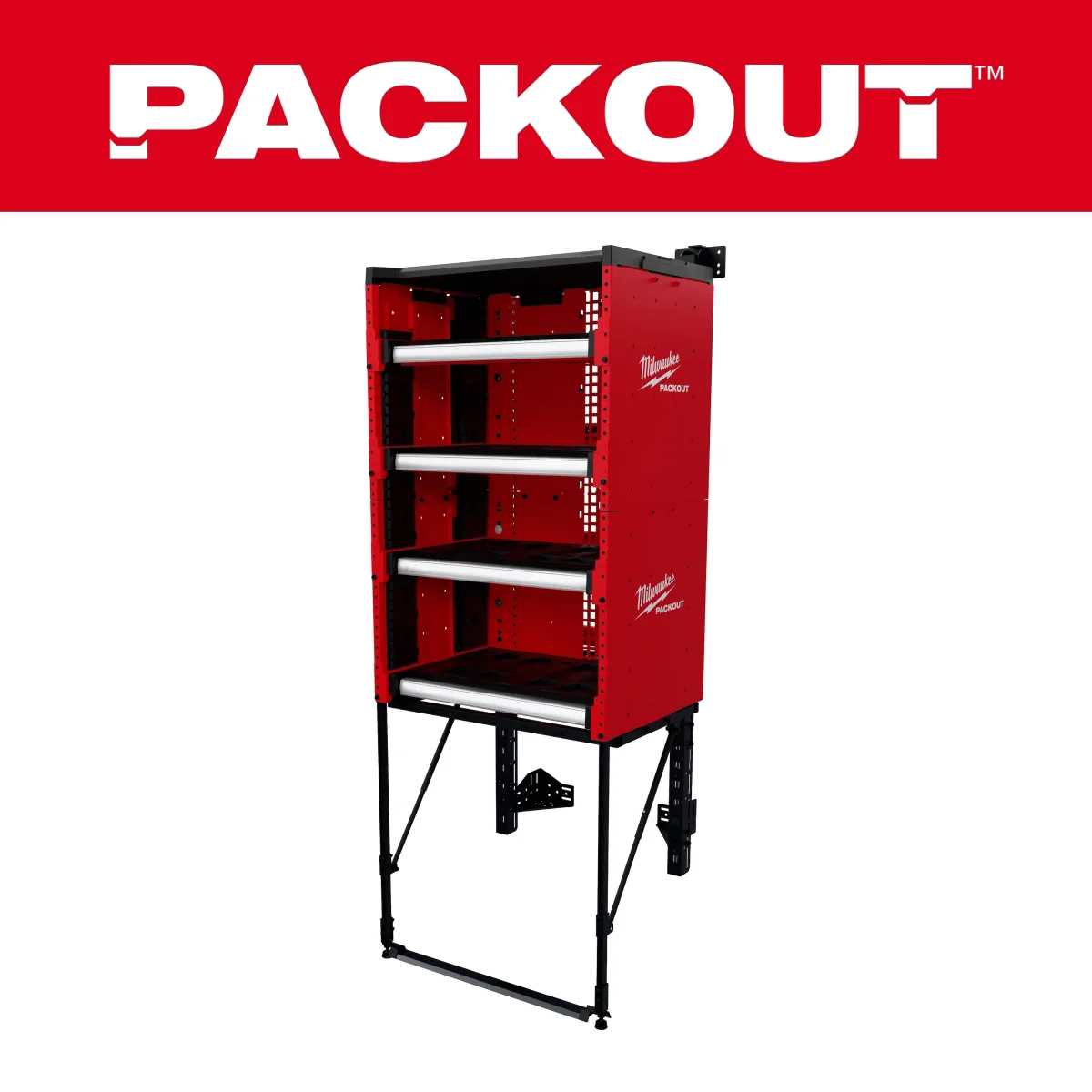
Milwaukee Packout remains the largest and most actively expanding modular storage system on the market. As of mid-2026, Milwaukee has announced over 15 new Packout products for the year alone — new crate sizes (compact, low-profile, and XL), wire-pulling crates for electricians, a four-bay simultaneous M18/M12 super charger that snaps directly onto the Packout stack, and multiple new wall plate accessories.
The wall-mounted Packout system — large wall plates with 150 lb. capacity, tool station docks for drills and impact wrenches, hooks and rails for hand tools — turns a bare garage wall into a fully integrated storage system that connects to the same mobile stack you bring to job sites.
Packout wall plates mount directly to studs and hold 150 lbs in shop environments, 75 lbs when vehicle-mounted. The quick-alignment tabs make installing multiple plates in a row simple enough to do alone.
Best for: Anyone invested in the Milwaukee M18/M12 ecosystem, electricians, contractors who need portable-to-stationary integration
Entry point: Around $60–$100 for starter boxes; full setups commonly run $400–$800+
DeWalt ToughSystem 2.0 — Best for Carpentry Crews
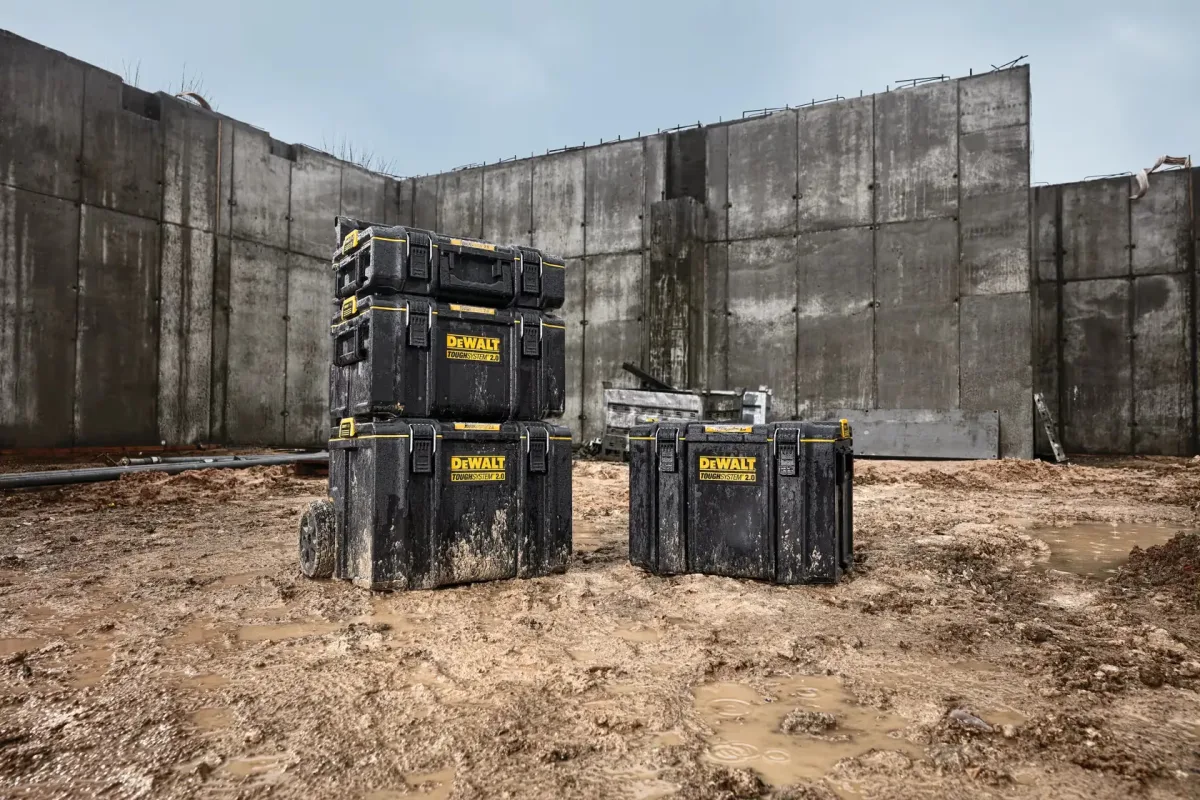
DeWalt's ToughSystem 2.0 is well-featured at a lower price point than Packout and bridges the gap between modular storage and tool chests with its Modular Work Station — a wheeled dolly base, drawer units, and a workspace on top, compatible with all other ToughSystem 2.0 boxes and exterior accessories. For a carpentry crew that needs integrated storage and a rolling workbench at the same address, this is the most practical configuration available.
The honest limitation: DeWalt last significantly expanded the ToughSystem core lineup around three years ago, while Packout continues to receive active development. If ecosystem longevity matters to you, Packout currently has more momentum.
Best for: DeWalt 20V MAX and FlexVolt users, carpentry contractors, anyone who wants a rolling workbench integrated into their modular system
Entry point: $50–$80 per box; workstation configurations run $300–$500
Flex Stack Pack — Best Durability at Mid-Range Price
Flex's Stack Pack earns consistent praise for a build quality that punches above its price point. The system has expanded more recently than ToughSystem, adding a rolling drawer tool box that handles bulkier power tools. If you're not already invested in a specific cordless platform, Flex Stack Pack is worth a serious look for garage-based storage.
Ridgid Pro Gear 2.0 — Home Depot Exclusive with Unique Flexibility
Ridgid's Pro Gear 2.0 is only sold at Home Depot, which limits comparison shopping, but the system offers some unique drawer configurations and versatility improvements not found elsewhere. Development appears to have slowed since its initial launch, making it a reasonable choice for occasional users but a risky long-term platform bet for heavy users.
Wall Storage: Pegboard vs. Slatwall vs. Milwaukee Packout Wall Plates
Wall storage is the highest-ROI investment in a small garage. Getting heavy tools off the floor and onto the wall frees up floor space and reduces the time spent searching through drawer stacks for a tool you use twice a week.
Three systems dominate the US market in 2026:
Traditional pegboard — cheapest entry point, widely available, endlessly customizable. The limitation is that pressed pegboard (Masonite) warps with humidity over time, and standard round-hole pegboard can't support heavy power tools reliably. Metal pegboard — from Wall Control or similar brands — solves the warping problem and dramatically increases weight capacity, while remaining compatible with standard peg accessories.
Slatwall systems (Gladiator GearWall, Rubbermaid FastTrack, Craftsman VersaTrack) — aluminum or steel horizontal channels that accept purpose-built hooks and baskets. No stud requirement for the channels themselves; easier to reconfigure than pegboard; significantly more hook and basket weight capacity than round-hole peg systems. Higher upfront cost than pegboard but better long-term durability.
Milwaukee Packout Wall Plates — the most expensive option, but the only system that integrates directly with a Packout mobile stack. If your shop workflow involves moving tools from wall storage to a rolling cart and back, this integration eliminates a friction point that matters more than it sounds.
For most homeowners, a metal pegboard or slatwall system in the $150–$400 range, installed over a dedicated tool wall, is the right starting point. Save Packout wall plates for when you're already running a full Packout mobile system.
The Hidden Cost of Tool Storage: What the Price Tag Doesn't Tell You
A $499 Husky chest is not a $499 purchase — it's the start of a longer spend.
Drawer liners: Most quality units include them, but cheaper ones don't. Budget $20–$40 for foam or rubber liners if they're not included. Unlined metal drawers damage precision tools over time from vibration and sliding contact.
Caster quality: The casters on budget units are often the first thing to fail under real loads. Replacement caster sets for a 52-inch chest run $30–$60. Check that the units you're considering have casters rated for the load you'll actually put in them.
Lock quality: Most tool chests include a basic keyed lock system, but the quality varies dramatically. For garage security, consider adding a separate hasp and padlock to any unit where the built-in lock is obviously flimsy.
Space for future tools: The single most common buyer regret in tool storage is buying a chest that's 80% full the day it's assembled. Buy one size larger than you think you need. Tool collections grow; tool chests don't.
How to Organize a Tool Chest: The System That Actually Sticks
Buying a tool chest is the easy part. Maintaining a system that keeps you from spending 10 minutes finding a 3/8-inch socket is where most people fail.
The frequency rule — most-used tools at eye level, least-used tools at the bottom. This means the drawer layout that came with the chest is rarely the right layout for your tools.
One category per drawer, labeled — wrenches, sockets, screwdrivers, pliers, measuring tools. Don't let a "miscellaneous" drawer exist. It becomes the place every tool goes when you're in a hurry and can't remember its home.
Shadow boards or foam inserts — cut foam or use pre-cut foam inserts (Kaizen foam works well) so every tool has an outline. You'll immediately see when something is missing or out of place. This is especially useful for socket sets, where losing a single size means buying the set again.
Top chest for daily drivers — the tools you use on more than 50% of jobs. Bottom cabinet for specialty tools, power tool accessories, and hardware that you need occasionally but not constantly.
Workshop Storage for Specific Use Cases
The Homeowner with Basic Tools
You need a rolling chest, not a cabinet combo. A Craftsman 2000 Series top chest or Husky 27-inch roller gives you enough drawers for a standard homeowner tool kit (sockets, wrenches, screwdrivers, pliers, measuring tools) without taking over half the garage. Budget $200–$400.
Add a basic metal pegboard panel above the workbench for frequently used hand tools, and you have a complete system for under $500 total.
The DIY Woodworker
Woodworking tools divide naturally: stationary power tools (table saw, band saw, router table) don't go in a chest — they stay on their bases. Hand tools and accessories do — and they benefit from a shallow-drawer chest where chisels, hand planes, marking tools, and measuring instruments sit flat and visible.
A Husky 52-inch Mobile Workbench — which doubles as a rolling work surface — is the most space-efficient solution for a one-car garage woodshop. The top surface handles assembly and finishing work; the drawers handle tools.
The Mechanic Working on Cars at Home
You need drawer slides rated to at least 150 lbs, a combo unit with floor-level drawers deep enough for impact guns and air tools, and an integrated power strip. The Milwaukee 46-inch High-Capacity Cabinet or Husky 56-inch Professional Set (with its dual power center setup) are the realistic choices at below-Snap-On pricing.
The Husky 56-inch is worth specific attention: the dual power centers — one inside the chest for battery charging, one side-mounted cabinet outlet — eliminate the extension cord problem that plagues most garage setups.
The Contractor Who Moves Between Job Sites
You don't need a rolling chest at all. You need a Milwaukee Packout system or DeWalt ToughSystem 2.0. Stationary chests don't travel in trucks; modular systems do. Build a rolling Packout stack for the job site and a matching wall-plate system in the shop, and your tools can move between environments without repacking.
Quick Comparison: 2026 Tool Storage by Budget
| Budget | Best Pick | Category | Where to Buy |
|---|---|---|---|
| Under $300 | Craftsman 2000 Series | Rolling chest combo | Lowe's |
| $300–$600 | Husky 52-inch Heavy-Duty | Rolling chest combo | Home Depot |
| $600–$1,000 | Milwaukee 46-inch High-Capacity | Rolling cabinet | Home Depot / Milwaukee |
| $400–$800+ | Milwaukee Packout stack | Modular portable | Home Depot / Milwaukee |
| $200–$500 | DeWalt ToughSystem 2.0 | Modular portable | Lowe's / DeWalt |
| $150–$400 | Wall Control Metal Pegboard | Wall storage | Amazon / WallControl.com |
| $1,000+ | Dragonfire Pro Series | Professional mechanic | DragonFireTools.com |
What to Skip in 2026
Harbor Freight for primary storage: U.S. General Series has improved enough to deserve serious consideration as secondary or overflow storage, but for a main chest in a working shop, the steel gauge and slide quality still fall short of Husky at comparable price points.
Kobalt: Kobalt's tool storage lineup has had significant continuity problems — models get discontinued, replacements don't match the quality of what they replaced, and the ecosystem doesn't integrate with any major modular system. The Pro Tool Reviews team removed Kobalt from their recommended list after a specific model was discontinued without an equivalent replacement.
No-name "industrial" chests online: The thick-gauge claims and dramatic load capacities on unbranded Amazon chests frequently don't survive contact with actual use. With a tool chest, you're buying something that will live in your garage for a decade. Saving $100 on a chest that fails in two years is not a savings.
FAQ
How many drawers do I actually need?
Most homeowners do fine with 9–11 drawers in a combo unit. A mechanic working on multiple vehicles simultaneously often needs 14–18 drawers to keep tool categories properly separated. More drawers isn't always better — shallow drawers on some budget units are too shallow to fit standard ratchets lying flat.
Is soft-close worth paying more for?
Yes, if the chest will see regular use. Beyond the quality-of-life benefit, soft-close mechanisms prevent the vibration and impact damage that causes precision tools to shift, chip, or rust-lock in drawers over time. One mechanic quoted by Garage World 360 calculated that soft-close technology saves him roughly 20–30 tool replacements annually from prevented impact damage.
Can I buy a top chest and base cabinet from different brands?
Technically possible if dimensions match, but not recommended. Stacking interfaces are brand-specific, and mismatched units often don't lock together securely. More importantly, the aesthetic and functional mismatch tends to cause people to upgrade anyway — which negates the savings.
Should I buy Milwaukee Packout if I don't use Milwaukee tools?
Packout is a storage system, not a tool system. The boxes, organizers, and crates work for any brand's tools. The wall-mounted charger mounts are Milwaukee-specific, but everything else is universal. If the modular portable format fits your workflow, Packout is worth considering regardless of which cordless platform you run.
What's the best way to protect tools stored long-term?
Drawer liners absorb vibration and prevent metal-on-metal contact. A light coat of paste wax on unpainted tool surfaces prevents rust. For tools stored in areas with humidity swings (unheated garages in cold climates), a desiccant pouch in each drawer makes a meaningful difference.
This guide is based on manufacturer specifications, independent testing data from Pro Tool Reviews and SlashGear, and verified customer feedback aggregated from multiple sources. It does not reflect hands-on testing by Trusted Buyer Report. We may earn a commission from purchases made through our links — rankings are completed before any affiliate link is placed.
Reviewed by the Trusted Buyer Report editorial team. This article was drafted with AI assistance and fact-checked before publishing.